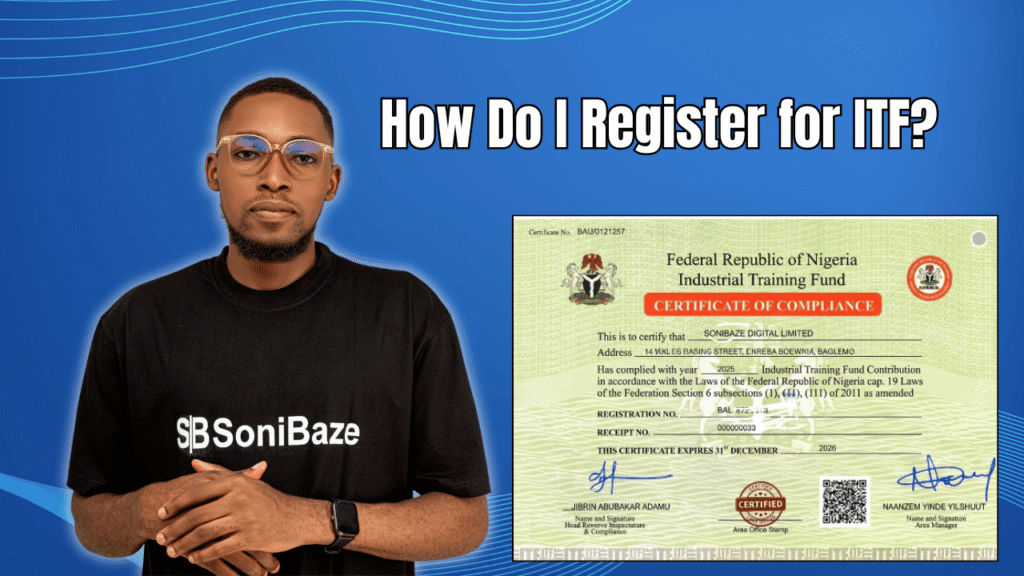
If your company qualifies for ITF contributions and you are trying to figure out how to get registered, the process is more straightforward than most people expect. The challenge is usually not the registration itself but understanding which type of ITF registration you actually need, because there are two distinct paths: employer registration for compliance and the Compliance Certificate, and the SUPA portal for artisans and vocational trainees.
This article covers both, with a focus on employer registration since that is what most businesses searching this topic are trying to complete.
Obtain Your ITF Certificate
Let us help you obtain your Industrial Training Fund (ITF) Compliance Certificate quickly and hassle-free. Our experts provide reliable support throughout the application process, ensuring your business meets all statutory compliance requirements.
What Is ITF and Why Does Registration Matter?
The Industrial Training Fund is a Federal Government parastatal established in 1971 under the Ministry of Industry, Trade and Investment. Its mandate is to promote and encourage the acquisition of skills in industry and commerce across Nigeria, generating trained manpower for the economy.
Registration matters for businesses for one primary reason: the ITF Compliance Certificate. Any supplier, contractor, or consultant bidding for contracts or soliciting business from any Federal Government Ministry, Department, Agency, or commercial entity is required to show evidence of ITF compliance. Without it, you cannot obtain a BPP certificate and cannot bid for government contracts. Banks and regulated institutions may also request it as part of corporate account requirements.
Who Is Legally Required to Register With ITF?
Not every business is obligated to register. The ITF Act as amended in 2011 sets clear thresholds.
| Threshold | Obligation |
|---|---|
| Five or more employees | Must register and contribute 1% of total annual payroll to ITF |
| Fewer than five employees but annual turnover of N50 million or above | Must register and contribute |
| Fewer than five employees and turnover below N50 million | Not legally required to contribute, though registration may still be needed for compliance documents |
The 1% contribution is calculated on total payroll, which covers basic pay, allowances, and other entitlements paid to all employees within and outside Nigeria.

Two Types of ITF Registration
Before you start, confirm which category applies to you.
| Type | Who It Is For | Portal |
|---|---|---|
| Employer Registration | Companies contributing 1% payroll to ITF and seeking a Compliance Certificate | itf.gov.ng / ITF Area Office |
| SUPA Registration | Artisans and vocational trainees seeking skills certification | supa.itf.gov.ng |
Most businesses asking how to register with ITF are looking for employer registration. The SUPA portal is specifically for individuals, artisans, and those seeking vocational skills certifications under ITF’s Skills Upgrade Programme for Artisans.
How to Register as an Employer With ITF
Step 1: Prepare Your Documents
Before you visit any portal or area office, gather the following documents. Arriving without them means making multiple trips.
| Document Required | Notes |
|---|---|
| CAC Certificate of Incorporation | Or Certificate of Registration for business names |
| Tax Clearance Certificate | Must be current and issued by FIRS |
| Audited Accounts | Certified true copies for the relevant trading period |
| Company details | Business name, address, postal address, email, phone number, nature of business, date of establishment |
| Employee count | Total number of Nigerian and expatriate employees |
| Total annual payroll figure | Used to calculate the 1% training contribution |
Step 2: Complete ITF Form 7A
New employers registering for the first time fill out ITF Form 7A. This is the Employer Registration and Payment of Training Contribution Form. It captures your business details, employee information, payroll figures, and training contribution calculation.
The form can be obtained from any ITF Area Office or downloaded from itf.gov.ng. It must be completed accurately. Any false information in the form carries legal consequences under the ITF Act, including fines and potential prosecution of company directors or officers.
Fill in all sections: business address, postal address, email, telephone number, nature of business, and the declaration section signed by the company secretary, accountant, or human resource manager.
Step 3: Submit to Your ITF Area Office
Take the completed Form 7A along with your supporting documents to the nearest ITF Area Office in your state. ITF operates 42 Area Offices and 6 Zonal Offices across Nigeria. For businesses in Abuja, the relevant office is the FCT Area Office.
The Area Office will assess your company for its liability to the Fund. ITF Revenue, Inspectorate and Compliance Officers carry out this assessment.
Step 4: Generate Your RRR and Make Payment
Once your liability is assessed, you will need to generate a Remita Retrieval Reference number through the ITF Pay-Portal or the Remita platform directly. This RRR is what you take to the bank to make your training contribution payment into the ITF account.
All payments must be made to the Industrial Training Fund written in full. Abbreviations are not acceptable on payment instruments. After making the payment, submit evidence of payment to the Area Office.
Step 5: Collect Your Compliance Certificate
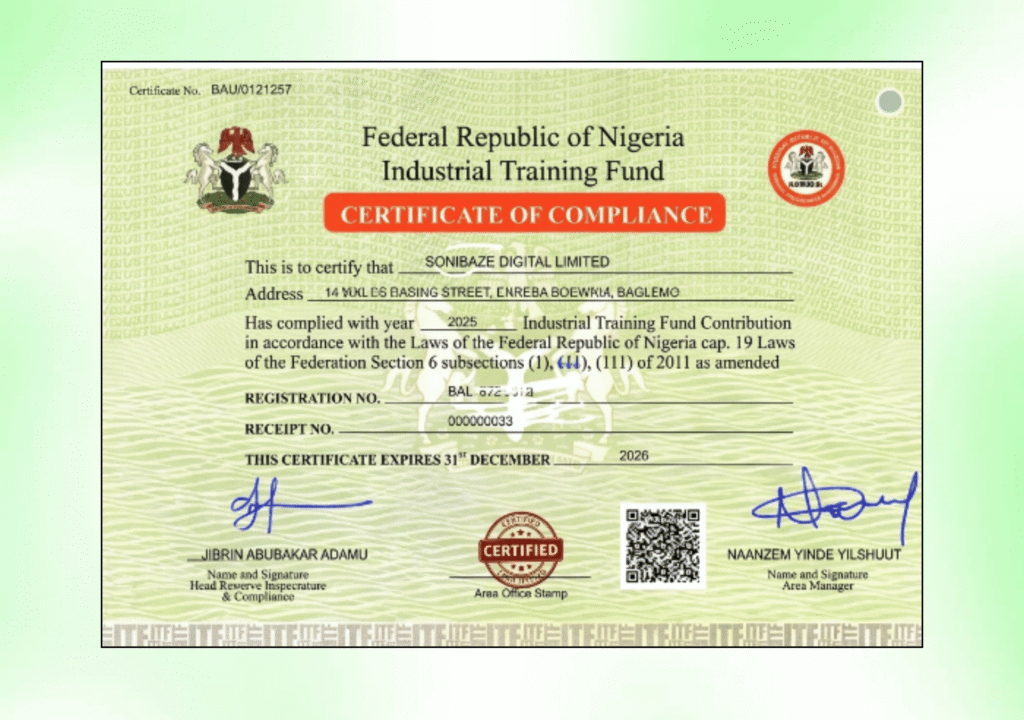
After the Area Office confirms your payment, the ITF Compliance Certificate is issued. This certificate serves as evidence of compliance with the ITF Act and is what you will attach to tender documents, BPP applications, and other regulatory submissions.
The processing timeline averages 10 working days from the point of submission and assessment, though this can vary by office and application volume.
Obtain Your ITF Certificate
Let us help you obtain your Industrial Training Fund (ITF) Compliance Certificate quickly and hassle-free. Our experts provide reliable support throughout the application process, ensuring your business meets all statutory compliance requirements.
Registration Process at a Glance
| Step | Action | Where |
|---|---|---|
| 1 | Gather documents | Internal preparation |
| 2 | Complete ITF Form 7A | Available at itf.gov.ng or Area Office |
| 3 | Submit form and documents | Nearest ITF Area Office |
| 4 | Assessment by ITF officers | ITF Area Office |
| 5 | Generate RRR and pay 1% contribution | ITF Pay-Portal or Remita, then bank |
| 6 | Submit payment evidence | ITF Area Office |
| 7 | Collect Compliance Certificate | ITF Area Office |
Already Registered? Annual Renewal Process
Companies that are already registered do not use Form 7A again. Instead, they complete ITF Form 5A, the annual return form for existing contributors.
Submit Form 5A to the ITF Area Office where the company is registered. Generate a new RRR, make the annual training contribution payment through the bank, submit evidence of payment, and collect the updated Compliance Certificate. The Area Office issues the certificate after confirming payment.
How to Register on the ITF SUPA Portal (For Artisans)
If you are an individual artisan, vocational learner, or someone seeking ITF’s skills certification rather than an employer compliance certificate, the SUPA portal is the right route.
Visit supa.itf.gov.ng and click the registration link. Create an account by providing your personal details, contact information, and relevant background information. Once registered, you can access skills training programmes, apply for certifications, and track your training progress through the platform.
ITF Online Portal and Contact
The main ITF website is itf.gov.ng. For the Pay-Portal and Remita payments, use the payment links accessible from the same domain or through remita.net directly. For support on employer registration and area office locations, contact ITF headquarters at Miango Road, P.M.B. 2199, Jos, Nigeria, or reach the relevant zonal office for your region.
For the SUPA skills programme specifically, the portal is supa.itf.gov.ng.
Frequently Asked Questions
Is ITF registration free?
The registration process itself does not have a government fee for creating your account or submitting the form. The actual cost is the 1% training contribution calculated on your total annual payroll, paid through the bank after generating a Remita Retrieval Reference. If you engage a consultant to handle the process, their professional fee is a separate charge.
What is the penalty for not registering with ITF?
Employers who fail, neglect, or refuse to remit the required ITF contributions are liable to penalties under the Act. A corporate body found guilty of a first offence faces a fine of N500,000, and N1,000,000 for each subsequent breach. Individual officers such as the company’s chief executive or secretary face a fine of N50,000 or two years imprisonment for a first offence, and three years imprisonment without the option of a fine for subsequent offences.
Can a company with three employees register voluntarily?
Yes. A company below the threshold can voluntarily register and contribute to ITF. This is sometimes done because some clients, particularly in the private sector, request an ITF Compliance Certificate as part of their vendor qualification process even when the company is not legally obligated.
How long is the ITF Compliance Certificate valid?
The certificate covers the year for which the contribution was made. It must be renewed annually by filing Form 5A, paying the new year’s contribution, and collecting an updated certificate. There is no grace period for late renewal, and a lapsed certificate is not accepted for tender purposes.
Do I need to visit an area office in person?
For employer registration, yes. The current process requires physical submission of documents to the ITF Area Office where the company is registered, and the Compliance Certificate is also collected from the same office. The online portal primarily handles the payment generation step through Remita. ITF has been expanding its digital capacity, but the core employer registration and compliance process still involves an office visit.
What if there is no ITF Area Office near my business location?
ITF has 42 Area Offices across Nigeria, covering every state. If the nearest office is in a different city from your registered business address, you may need to contact the nearest zonal office for guidance on the appropriate area office to use. Contact details for area and zonal offices are available on itf.gov.ng.
Conclusion: Documents First, Then the Process Moves Fast
The ITF employer registration process is not complicated. It follows a clear sequence: prepare documents, complete Form 7A, submit to the Area Office, get assessed, generate RRR, pay through the bank, and collect your certificate.
Where most companies lose time is arriving at the Area Office without the audited accounts or tax clearance certificate, then having to return. Get the documents right before you go, and the rest of the process follows within a predictable timeline.
Obtain Your ITF Certificate
Let us help you obtain your Industrial Training Fund (ITF) Compliance Certificate quickly and hassle-free. Our experts provide reliable support throughout the application process, ensuring your business meets all statutory compliance requirements.