A Tax Clearance Certificate has a shorter shelf life than most business owners expect. Get one in January and it might still feel new by December, but it is already approaching expiry. Miss the renewal window and your company cannot bid on a tender, process certain bank transactions, or satisfy regulatory checks that come up without warning.
This article answers exactly how long a TCC is valid in Nigeria, what that means in practice, and what to do before it expires.
Obtain Your Tax Clearance Certificate (TCC)
Let us help you obtain your Tax Clearance Certificate (TCC) quickly and hassle-free. Our experts provide reliable support throughout the application process, ensuring your business meets all tax compliance requirements.
What Is a TCC?
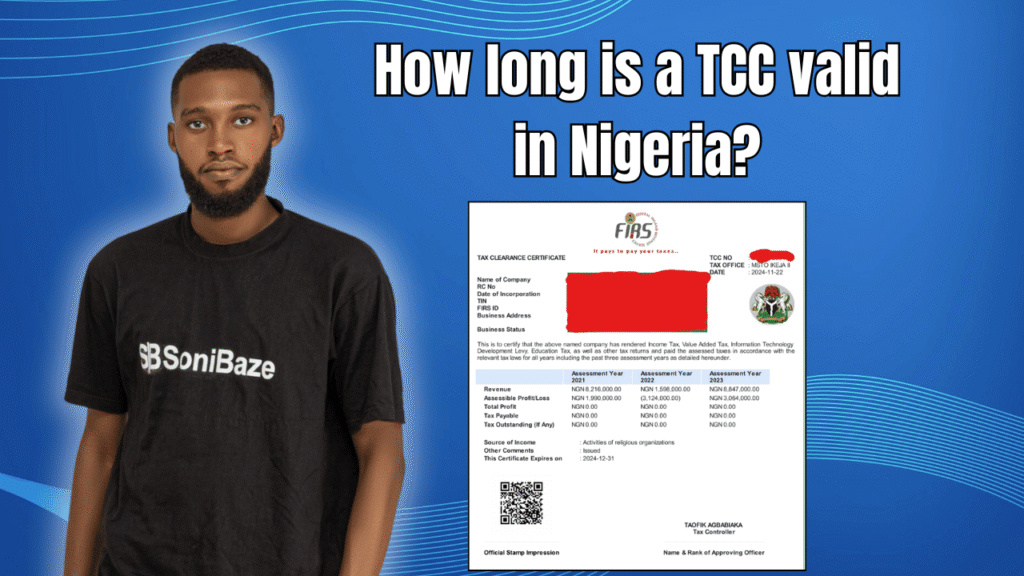
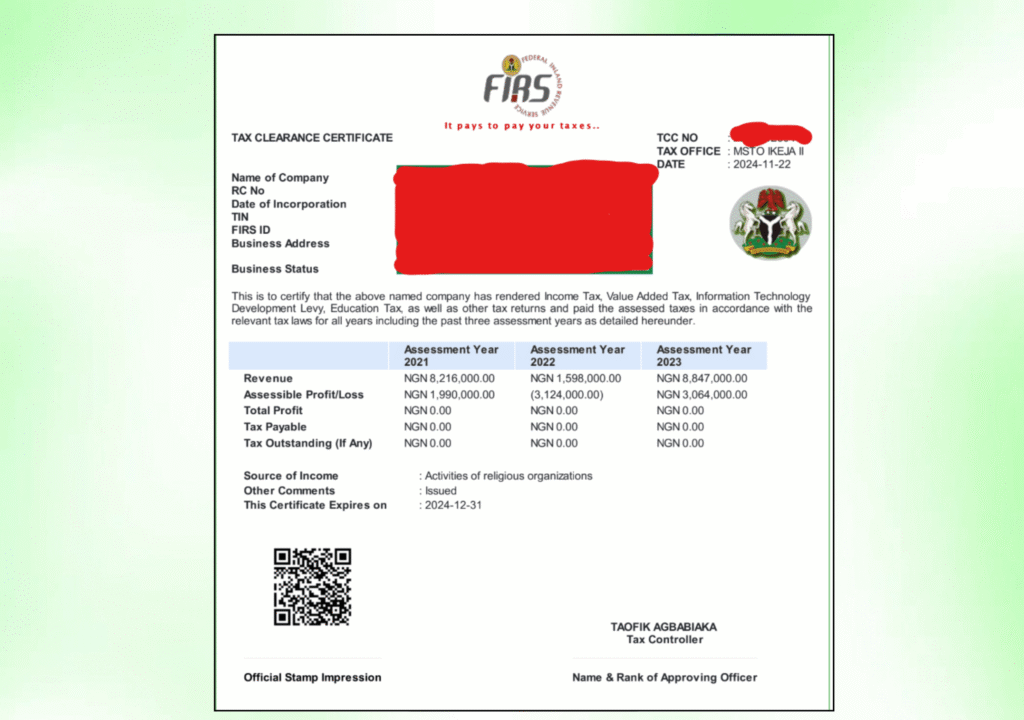
A Tax Clearance Certificate is an official document issued by the relevant tax authority confirming that an individual or company has declared income, filed tax returns, and settled all applicable taxes for a specified period. In Nigeria, it covers the three years immediately preceding the current year of assessment.
For companies, the Nigeria Revenue Service (formerly FIRS) issues the TCC. For individuals, the relevant State Internal Revenue Service in your state of residence handles it. The certificate details the taxpayer’s name or company name, Tax Identification Number, total assessable income or profit, tax due, and tax paid for each of the three years covered.
How Long Is a TCC Valid in Nigeria?
A TCC in Nigeria is valid for one year. After that period, it expires and must be renewed.
However, there are two ways to understand validity, and confusing them is one of the most common mistakes businesses make.
| Term | What It Means |
|---|---|
| Coverage period | The three tax years the certificate confirms you paid, for example 2022, 2023, and 2024 |
| Validity period | How long the certificate is accepted as current proof of compliance, typically 12 months from the date of issue |
A certificate that covers 2022 to 2024 does not mean it remains valid until the end of 2024. It means the compliance confirmed in the certificate lasts for one year from the date it was issued, regardless of the years it covers.

Does a TCC Expire on December 31 or on the Issue Date?
This is where sources differ slightly, and the distinction matters depending on the situation.
One widely cited position is that a TCC expires on December 31 of the year it was issued, regardless of when in the year it was obtained. Under this interpretation, a certificate issued in June 2026 expires on December 31, 2026, giving a business as little as six months of usable validity if applied for late in the year.
The other position, also commonly stated, is that a TCC is valid for 12 months from the date of issue, meaning a certificate issued in June 2026 remains valid until June 2027.
In practice, most government ministries, agencies, and banks treat the TCC as current within the year of issuance, and many require renewal at the start of each new year. The safest approach is to treat December 31 as your practical expiry date each year and plan your renewal accordingly, regardless of when you originally received the certificate.
What Happens When a TCC Expires?
An expired TCC does not mean the business has become non-compliant with its taxes. It means the proof of compliance is outdated. The consequence is practical rather than punitive in most cases, but the impact is real.
| Situation | Impact of Expired TCC |
|---|---|
| Government contract bids | Disqualification from tendering until a valid certificate is presented |
| Federal contractors database | Account may be flagged as dormant if annual renewal is missed |
| Bank transactions | Certain banking transactions that require TCC compliance confirmation may be delayed or rejected |
| Property transactions | Some property-related regulatory requirements specify a current TCC |
| Expatriate quota and work permits | Processing or renewal may stall without a valid TCC |
| CBN Form A applications | Foreign exchange transactions require a valid TCC covering three years |
Some organisations accept an expired TCC on a short-term basis while the renewal application is in progress, particularly if evidence of the renewal submission can be shown. But this is not guaranteed and should not be relied on for time-sensitive bids.
Obtain Your Tax Clearance Certificate (TCC)
Let us help you obtain your Tax Clearance Certificate (TCC) quickly and hassle-free. Our experts provide reliable support throughout the application process, ensuring your business meets all tax compliance requirements.
Who Issues the TCC in Nigeria?
The issuing authority depends on whether you are a company or an individual.
| Taxpayer Type | Issuing Authority |
|---|---|
| Limited liability companies | Nigeria Revenue Service (NRS), formerly FIRS, through the e-TCC portal or Rev360 portal |
| Individuals (employed or self-employed) | State Internal Revenue Service in the state of residence, for example LIRS for Lagos, FCT-IRS for Abuja |
| New companies with less than two years of filing history | Manual application at NRS office may be required |
It is also worth noting that a TCC from FIRS or NRS covers federal tax compliance only. It does not cover state tax obligations, and a state-level TCC does not cover federal obligations. Some tenders and regulatory requirements now ask for both, so check the specific requirements before assuming one certificate is sufficient.
When Should You Renew Your TCC?
The renewal window for most companies opens at the start of each new year, from January. Waiting until a tender deadline is approaching before starting the renewal process is one of the most avoidable compliance mistakes Nigerian businesses make.
The NRS e-TCC portal allows companies with at least two years of filing history to generate their TCC online once all returns are filed and taxes paid. The automated system can issue a draft TCC within 24 hours of a successful submission. Manual applications at the NRS office take longer, sometimes up to two weeks if outstanding issues need to be resolved.
The practical advice is to begin renewal in January of each year and treat it the same way you treat filing annual returns, as a fixed calendar task that cannot be left until the last quarter.
Is the TCC Free?
Obtaining a TCC directly through the NRS or State IRS portal does not attract a government fee. If you engage a tax consultant or compliance firm to handle the process, their professional service fee applies separately. That fee varies by firm and complexity of the tax position but typically ranges from ₦30,000 to ₦150,000 depending on the service scope.
Frequently Asked Questions
Can a new company get a TCC?
Yes. A company that has been incorporated for less than three years can still apply for a TCC. The certificate will reflect “NIL” or actual figures for the years since incorporation. Companies less than six months old and with revenue below ₦25,000,000 are generally not required to remit taxes yet, but can still obtain a certificate showing their compliance status to date.
Is a TCC required to open a corporate bank account?
Not for the account opening itself, which primarily requires CAC documents. However, certain banking transactions, particularly those involving foreign exchange, loan applications, and regulated credit facilities, require a valid TCC as part of due diligence.
What is the difference between a TCC and a tax compliance certificate?
A TCC confirms that all taxes due up to the date of issuance have been paid. A tax compliance certificate confirms that a taxpayer is up to date with filing obligations but may still have outstanding liabilities. They are not the same document and are not always interchangeable, depending on what a requesting party specifies.
Can a TCC be revoked?
Yes. If a company or individual is found to have unpaid taxes or provided false information during the application process, the issuing tax authority can revoke the TCC. Sanctions under the relevant tax laws can include penalties and in serious cases debarment from federal procurement.
Does a state TCC work for federal contract bids?
No. A state-issued TCC covers state tax compliance only. Federal government contracts and BPP registration require a TCC issued by the NRS at the federal level. Some tenders ask for both, so read the specific documentation requirements carefully before submitting.
How can a TCC be verified?
The NRS e-TCC system includes a unique QR code on every certificate issued. Third parties including banks and procuring entities can scan the QR code or enter the certificate’s reference number on the NRS verification portal to confirm it is genuine. This feature significantly reduced the circulation of forged certificates that was common under the old paper-based system.
Conclusion: One Year Is Shorter Than It Sounds
A TCC lasts one year. For many businesses, that window passes faster than expected, especially when renewals are only remembered at the point when a certificate is needed. The businesses that stay ahead of this are the ones that treat TCC renewal as an annual fixed-date task rather than a reactive compliance step.
File your returns on time, settle outstanding liabilities before year end, and start your TCC renewal process in January. That sequence keeps the certificate current and removes one compliance problem from your list entirely.
Obtain Your Tax Clearance Certificate (TCC)
Let us help you obtain your Tax Clearance Certificate (TCC) quickly and hassle-free. Our experts provide reliable support throughout the application process, ensuring your business meets all tax compliance requirements.