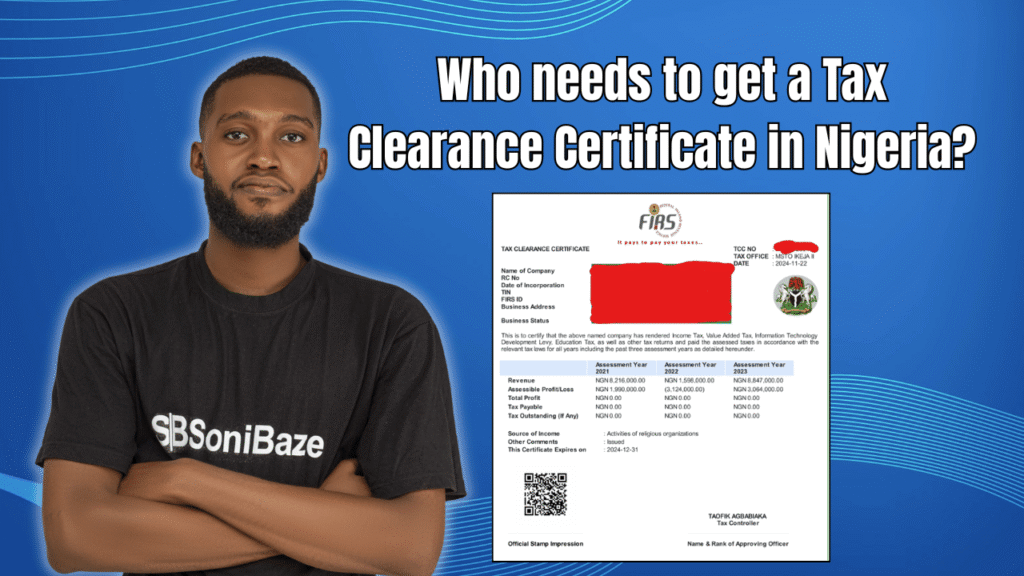
A Tax Clearance Certificate quietly sits behind more transactions in Nigeria than most people realise. You need it for a government contract. Your bank asks for it when you apply for a business loan. The embassy wants it before issuing a visa. Yet a lot of business owners and professionals only discover this when they are already under deadline pressure and the certificate is nowhere near ready.
This article covers who needs a Tax Clearance Certificate in Nigeria, what it is used for, and what happens when you do not have one.
Obtain Your Tax Clearance Certificate (TCC)
Let us help you obtain your Tax Clearance Certificate (TCC) quickly and hassle-free. Our experts provide reliable support throughout the application process, ensuring your business meets all tax compliance requirements.
What Is a Tax Clearance Certificate?
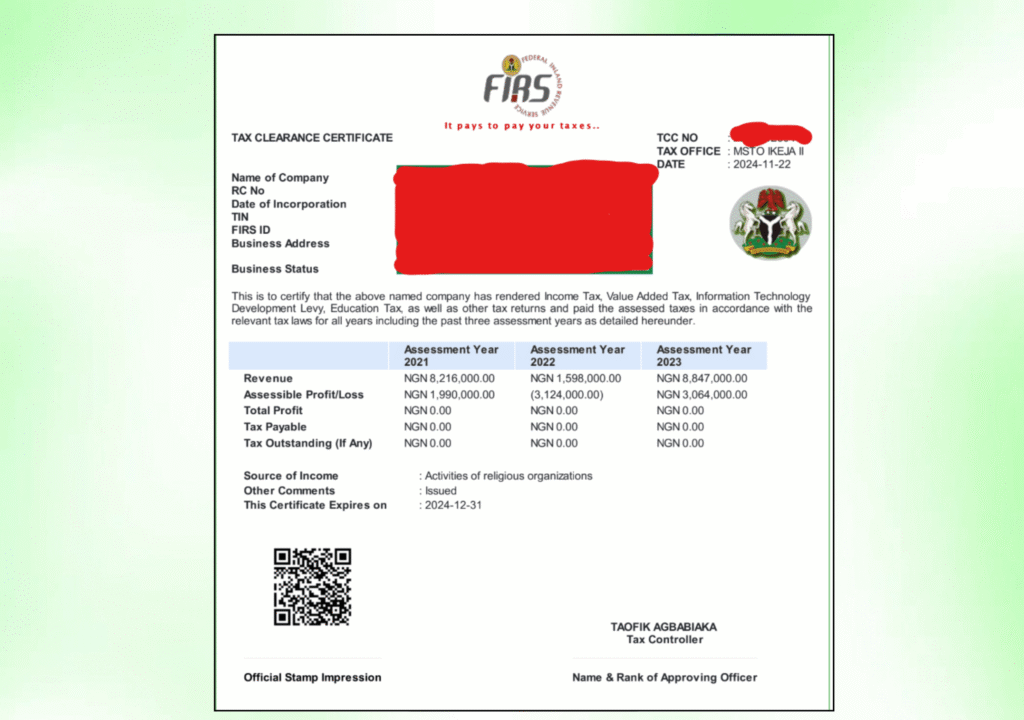
A Tax Clearance Certificate, commonly shortened to TCC, is an official document issued by the Federal Inland Revenue Service or the relevant State Internal Revenue Service. It confirms that an individual or company has fulfilled all tax obligations for a specified period, usually the three years immediately preceding the current assessment year.
The certificate contains the taxpayer’s name, tax identification number, the name of their employer (for individuals) or nature of business (for companies), and a record of income assessed and taxes paid for the three years covered. It is the end product of a tax compliance process, not a document that can be requested without a track record of filing and payment.
Two authorities issue TCC in Nigeria depending on who the applicant is. The Federal Inland Revenue Service covers companies and individuals whose tax affairs are handled at the federal level. State Internal Revenue Services handle personal income tax for residents and employees under the Pay As You Earn scheme.
Who Needs a Tax Clearance Certificate in Nigeria?
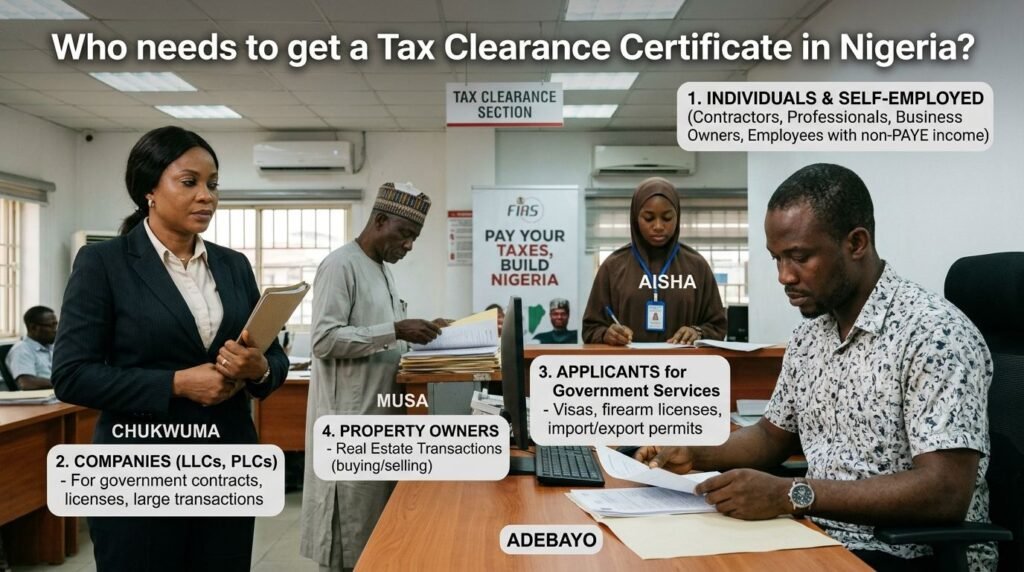
The short answer is: most people and businesses whose financial or regulatory activities touch the government, financial institutions, or foreign missions. Here is the full breakdown.
Registered Companies
All companies registered in Nigeria are required to obtain an annual Tax Clearance Certificate as proof of compliance with corporate income tax obligations. This applies whether the company is active, dormant, or newly incorporated. A new company that has filed returns for fewer than three years can still obtain a TCC, and the certificate will reflect the actual figures for the years since incorporation. The process for new companies typically requires a manual application at the relevant tax office rather than the automated online portal.
Business Owners and Self-Employed Individuals
Business owners, freelancers, consultants, and self-employed professionals earning taxable income in Nigeria fall under the TCC requirement. Self-employed persons obtain their certificate from the State Internal Revenue Service in the state where they reside, and they must have filed self-assessment returns for the three preceding years with all taxes settled before the certificate can be issued. Tech workers, creatives, and independent contractors are included in this category regardless of whether they operate under a registered business name.
Salaried Employees in Certain Situations
Employees whose income tax is deducted at source through Pay As You Earn may assume the TCC does not concern them. That assumption is incorrect. Many employers in senior or executive roles, individuals verifying employment history, and employees applying for loans or visas will encounter situations where a personal TCC is required. Personal income tax compliance still falls on the individual even when PAYE is in operation.
Government Contractors and Service Providers
Any individual or company bidding for government contracts or intending to provide services to a Federal Ministry, Department, or Agency must present a valid TCC as part of the tender documentation. This is one of the most common situations in which Nigerian businesses first encounter the TCC requirement. It applies to contractors in construction, IT, consulting, supply, and every other category that deals with public sector procurement.
Expatriates and Foreign Nationals Working in Nigeria
Foreign nationals working or investing in Nigeria need a TCC to process and renew expatriate quotas and work permits. The certificate must be obtained from the authority responsible for the employer’s tax remittance, either the Federal Inland Revenue Service or the relevant State Internal Revenue Service. Expatriates from countries with bilateral tax agreements with Nigeria can also use the TCC to avoid double taxation under those treaties.
Individuals Applying for Visas
Some embassies and foreign missions request proof of tax compliance as part of visa processing, particularly for business visas and investor visa categories. The specific requirement varies by country and visa type, but having a current TCC ready reduces complications during applications.
Loan Applicants
Financial institutions often request a TCC as part of their due diligence before approving business loans and certain personal credit facilities. The certificate serves as evidence that the applicant has no outstanding tax liabilities and is in good financial standing with the relevant authorities.
Property Transactions
Obtaining a Certificate of Occupancy, approving building plans, and transferring real property require a TCC in many states across Nigeria. Individuals buying land or completing real estate transactions will encounter this requirement at the point of documentation and title registration.
Non-Governmental Organisations
NGOs seeking donor compliance, government grants, or formal registration renewals may also need to demonstrate tax compliance through a valid TCC, depending on the nature of the funding or transaction involved.
Obtain Your Tax Clearance Certificate (TCC)
Let us help you obtain your Tax Clearance Certificate (TCC) quickly and hassle-free. Our experts provide reliable support throughout the application process, ensuring your business meets all tax compliance requirements.
Summary: Who Needs a TCC in Nigeria
| Category | When TCC Is Required |
|---|---|
| Registered companies | Annually, for compliance and most formal transactions |
| Self-employed individuals and freelancers | For contracts, loans, visa applications, and regulatory filings |
| Salaried employees (senior roles) | Employment verification, loan applications, visa applications |
| Government contractors | Every tender and contract bid with Federal or State agencies |
| Expatriates and foreign workers | Work permit processing and renewal, immigration filings |
| Visa applicants | Business and investor visa applications to certain countries |
| Loan applicants | Business loans and certain personal credit facilities |
| Property buyers and sellers | Certificate of Occupancy, title transfers, building approvals |
| NGOs | Grant compliance, government funding applications |
Key Transactions That Require a TCC in Nigeria
Beyond knowing who needs one, it helps to understand the specific transactions where a TCC is compulsory. The Personal Income Tax Act and associated regulations make TCC a requirement for the following:
| Transaction | Detail |
|---|---|
| Government contract awards | Any contract from a Federal or State Ministry, Department, or Agency |
| Business licence applications and renewals | Includes agent, trade, business, pools, gaming, import, and export licences |
| Certificate of Occupancy | And approval of building plans and transfer of real property |
| Stamp duties on share capital | Stamping of nominal share capital for new companies, increases in share capital, and loan capital documentation |
| Expatriate quota and work permit | Required for foreign nationals working in Nigeria |
| BPP registration | Bureau of Public Procurement registration for government vendors |
| SCUML compliance | Relevant for Designated Non-Financial Businesses and Professions |
| Visa applications | For business and investor categories at certain embassies |
What Happens If You Do Not Have a Valid TCC?
Operating without a current TCC creates practical problems at multiple points. Companies without one cannot be shortlisted for government contracts regardless of their technical capability. Banks can decline loan applications. Regulatory bodies can withhold licence renewals. Using an expired TCC where a current one is required can attract a fine of up to N50,000 and disqualification from the transaction in question.
Beyond the immediate penalties, the bigger risk is waiting until a deadline forces the issue. TCC processing can take two to four weeks depending on the accuracy of filings, the completeness of documentation, and current processing volumes at FIRS or the State IRS. Businesses that wait until they need it urgently are regularly caught short.
Common Mistakes to Avoid
Several errors consistently slow down or block TCC applications. Filing returns late, even in years where no profit was made, can disqualify an application because the requirement covers the filing itself, not just the payment. Using a TIN that does not match your actual tax records creates processing delays. Mismatched names or business details between CAC records and FIRS or State IRS records trigger compliance flags that require correction before the certificate is released.
The most avoidable mistake is treating the TCC as something to worry about when you need it rather than as an annual compliance routine. Companies that file returns consistently, pay their obligations as they fall due, and keep their records accurate with FIRS or the State IRS can obtain or renew a TCC quickly because the underlying compliance is already in place.
Frequently Asked Questions
Can a new business with no tax history get a TCC?
Yes. New companies that have not yet completed three years of filing can still obtain a TCC. The certificate will reflect the periods since incorporation and show “NIL” where applicable. New companies typically need to apply manually at the FIRS office rather than through the automated online portal.
Who issues the TCC for individuals versus companies?
The Federal Inland Revenue Service issues TCC for companies and for individuals whose tax is handled at the federal level. State Internal Revenue Services issue TCC for individuals subject to personal income tax in their state of residence, including self-employed persons and employees under the PAYE scheme.
How long does TCC processing take?
Processing times vary. FIRS estimates for the e-TCC system can be faster, while manual applications at State IRS offices typically take two to four weeks. Delays are almost always caused by incomplete documentation, unresolved tax liabilities, or mismatched records. Getting your records in order before applying is the single most effective way to reduce waiting time.
Is TCC the same as a Tax Identification Number?
No. A Tax Identification Number is a unique number assigned to a taxpayer when they register with the tax authority. It is a prerequisite for obtaining a TCC, not a substitute for it. You need a TIN before you can apply for a Tax Clearance Certificate.
Does a TCC expire?
Yes. A Tax Clearance Certificate covers a specific period, typically the three preceding years of assessment. It must be renewed annually to remain current. An expired TCC is not accepted for formal transactions and can attract penalties if presented as a valid document.
Do PAYE employees need to obtain their own TCC separately?
In many cases, yes. While an employer handles PAYE deductions, the employee’s individual TCC depends on their personal filings being in order. Employees who need a TCC for a visa application, loan, or personal transaction must apply for it themselves through the relevant State Internal Revenue Service or FIRS.
Conclusion: Treat It as an Annual Routine, Not an Emergency
The TCC question is not really “do I need one?” Most people and businesses in Nigeria that engage in any formal transaction eventually do. The more practical question is whether your underlying tax compliance is in a state that allows you to obtain one quickly when required.
Companies and individuals that file returns on time, pay their tax obligations as they fall due, and keep their records accurate with the relevant authority can request a TCC with confidence and receive it without drama. Those who have been putting off compliance find themselves scrambling when a contract bid, bank application, or visa appointment suddenly makes the certificate urgent.
Obtain Your Tax Clearance Certificate (TCC)
Let us help you obtain your Tax Clearance Certificate (TCC) quickly and hassle-free. Our experts provide reliable support throughout the application process, ensuring your business meets all tax compliance requirements.