Most business owners in Nigeria know the ITF certificate exists. Very few know exactly what it costs, how that cost is calculated, or why the final amount varies from one company to the next.
The short answer is that ITF compliance has two separate cost components. One is a fixed registration fee. The other is an annual contribution calculated from your company’s total payroll, and this is the number that changes depending on the size of your workforce and what you pay them.
This article breaks down both costs, explains how the contribution is calculated, covers what documents you need, and walks through how the process works from registration to certificate.
Obtain Your ITF Certificate
Let us help you obtain your Industrial Training Fund (ITF) Compliance Certificate quickly and hassle-free. Our experts provide reliable support throughout the application process, ensuring your business meets all statutory compliance requirements.
What Is the ITF Certificate?
The Industrial Training Fund is a federal government parastatal established under the Industrial Training Fund Act, operating under the Federal Ministry of Industry, Trade and Investment. Its mandate is to promote the acquisition of industrial and commercial skills across Nigeria’s public and private sectors.
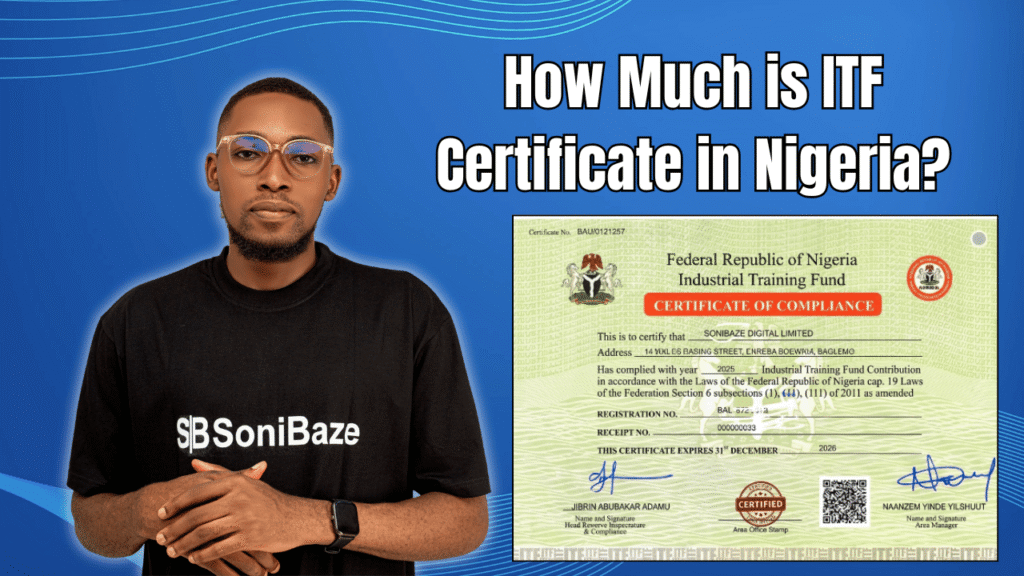
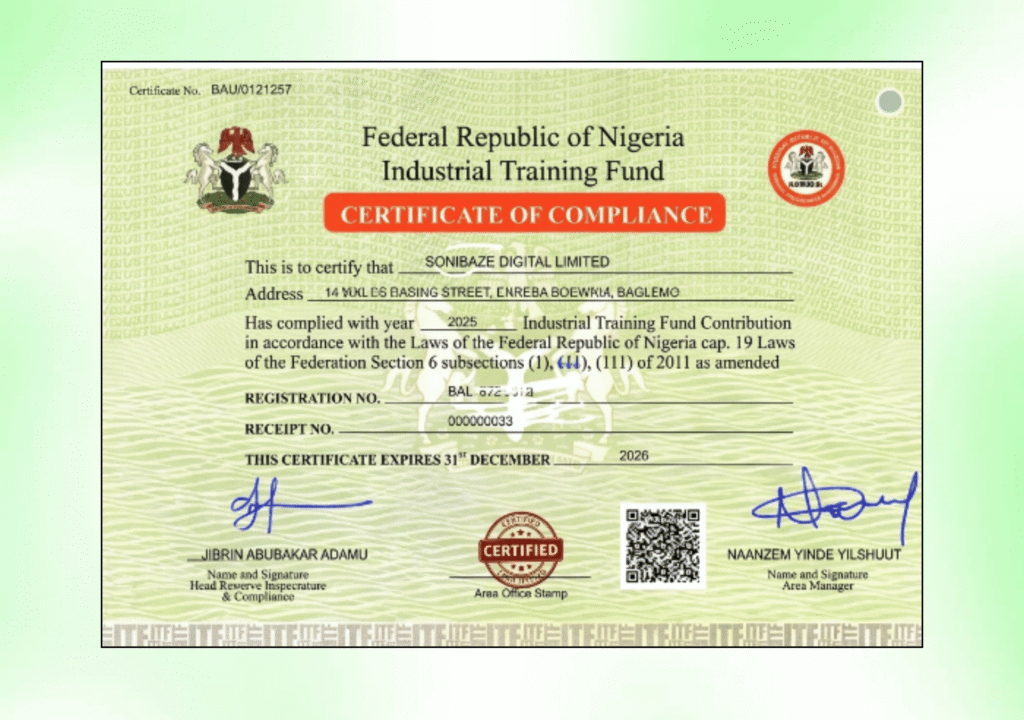
The ITF Compliance Certificate is issued to employers who have registered with the Fund and paid their mandatory annual training contribution. It is one of the standard compliance documents required for bidding on federal government contracts, alongside NSITF, PENCOM, and BPP certificates.
Who Is Required to Pay?
The obligation to register and contribute applies to any employer with five or more employees in its establishment, or any employer with fewer than five employees but with an annual turnover of 50 million naira or above.
If your company falls below both thresholds, you are not required to register or pay, and you do not need an ITF certificate. However, any company that intends to grow past these thresholds, or that bids for government contracts where the certificate is listed as a requirement, should factor registration into their planning.

How Much Does the ITF Certificate Cost?
There are two amounts to account for.
One-Time Registration and Compliance Certificate Fee
The fixed cost for obtaining the ITF Compliance Certificate is 100,000 naira. This is a one-time payment made during the initial registration process and covers issuance of your ITF National Number and the Certificate of Compliance.
Some sources put this figure at around 300,000 naira when factoring in professional or consultant fees. The ITF fee itself is 100,000 naira. The difference represents what a compliance consultant charges to handle the paperwork on your behalf.
Annual Training Contribution
Beyond the registration fee, every qualifying employer must pay an annual training contribution equal to 1 percent of their total annual payroll. This is the ongoing obligation that continues every year after initial registration.
Total annual payroll here means all salaries, wages, allowances, and other cash emoluments paid to all employees across the full calendar year. Every naira paid to every employee on your payroll counts toward this figure.
The contribution is due by the 1st of April each year, covering the preceding year’s payroll. A company that misses this deadline is exposed to a penalty of 5 percent of the outstanding amount for every month or part of a month that payment remains overdue.
Cost Examples by Company Size
The table below shows how the annual contribution varies based on payroll size.
| Monthly Payroll | Annual Payroll | Annual ITF Contribution (1%) |
|---|---|---|
| ₦500,000 | ₦6,000,000 | ₦60,000 |
| ₦1,000,000 | ₦12,000,000 | ₦120,000 |
| ₦2,500,000 | ₦30,000,000 | ₦300,000 |
| ₦5,000,000 | ₦60,000,000 | ₦600,000 |
| ₦10,000,000 | ₦120,000,000 | ₦1,200,000 |
A small business paying a total monthly payroll of 500,000 naira will owe 60,000 naira per year in ITF contributions. A company with a 10 million naira monthly payroll will owe 1.2 million naira annually.
The Reimbursement Facility
One aspect of ITF compliance that many employers are not aware of is the reimbursement facility. Employers who contribute to the Fund are entitled to apply for reimbursement of up to 50 percent of qualifying training expenditure incurred in the preceding contribution year. This means that companies running structured in-house training programmes for their staff can recover a meaningful portion of their contribution costs.
The reimbursement is subject to the Fund’s annual budget and eligibility criteria, but it makes the effective net cost of ITF compliance lower than the headline 1 percent suggests for employers who take advantage of it.
Obtain Your ITF Certificate
Let us help you obtain your Industrial Training Fund (ITF) Compliance Certificate quickly and hassle-free. Our experts provide reliable support throughout the application process, ensuring your business meets all statutory compliance requirements.
Documents Required for ITF Registration
Before you can be issued a certificate, the following documents are needed.
Certificate of Incorporation. Your CAC Certificate of Incorporation confirms the legal existence of your company and is the starting document for registration.
ITF Form 7A. This is the Employer Registration and Payment of Training Contribution form. It is available for download from the ITF website at itf.gov.ng and must be completed before submission to your nearest ITF area office.
Audited accounts. Certified true copies of your company’s audited financial statements are required. ITF uses these to assess your liability, since the contribution is based on actual payroll figures rather than estimates.
Tax Clearance Certificate. A valid TCC from FIRS is required to confirm your company’s tax compliance. If your TCC is not yet available, a Tax Identification Number slip may suffice as a temporary alternative at the registration stage.
Staff details and remuneration schedule. A schedule of all employees and their salaries is needed for the liability assessment. This must reconcile with the figures in your audited accounts.
How the Registration Process Works
Step 1: Download and Complete ITF Form 7A
Obtain Form 7A from the ITF website or from your nearest ITF area office. The form covers your company’s details, sector category, and employee remuneration schedule.
Step 2: Submit to the Nearest ITF Area Office
Submit your completed form along with all required documents to the ITF area office closest to your company’s location. ITF has 42 area offices and 6 zonal offices spread across all 36 states and the FCT. ITF officials will assess your liability based on the total annual payroll in your audited accounts.
Step 3: Generate Your RRR and Make Payment
Once your liability assessment is complete, a Remita Retrieval Reference number is generated through the ITF Pay portal or the Remita platform. Take this RRR to any bank and make payment. Return your Remita payment receipt and the duplicate bank teller to the ITF area office, where you will receive a hard copy receipt and an acknowledgement letter.
Step 4: Receive Your ITF National Number and Certificate
The ITF area office forwards your details to headquarters for issuance of your ITF National Number. This number is then sent back to the area office, where your Certificate of Compliance is scripted and issued.
The full process takes an average of 10 working days when all documents are complete and accurate. This is longer than NSITF and BPP registration, both of which average around 5 working days, so build this lead time into your procurement planning.
ITF Cost Summary at a Glance
| Cost Component | Amount | Frequency |
|---|---|---|
| Registration and Compliance Certificate fee | ₦100,000 | One-time |
| Annual training contribution | 1% of total annual payroll | Every year, due by 1 April |
| Late payment penalty | 5% of outstanding amount per month | Applied if payment misses the deadline |
| Consultant or professional fee | Variable | Optional, paid to a third-party agent |
Frequently Asked Questions
Is the ITF contribution the same as the ITF certificate fee?
No. They are two separate obligations. The ₦100,000 fee is a one-time payment for registration and issuance of the certificate. The 1 percent annual payroll contribution is an ongoing statutory payment made every year by the 1st of April. Both must be met for the certificate to be issued and renewed.
Does a small business with fewer than five employees need to pay ITF?
Not unless the business has an annual turnover of 50 million naira or above. Below both thresholds, there is no legal obligation to register or contribute. Once either threshold is crossed, however, the obligation applies regardless of which one triggers it first.
Can I verify an ITF certificate online?
Yes. ITF operates an e-certificate verification portal at ecert.itf.gov.ng. Procurement officers and partner organisations use this portal to confirm the authenticity of any ITF certificate presented during a bid or vendor onboarding process.
What happens if I miss the April 1st contribution deadline?
A penalty of 5 percent of the unpaid contribution is applied for each month or part of a month that payment remains outstanding after the due date. This compounds over time, so late payment consistently increases the total amount owed beyond the original contribution figure.
How often does the ITF certificate need to be renewed?
The certificate is renewed annually. Each renewal requires payment of the current year’s training contribution, which is recalculated based on your most recent audited payroll figures. Gaps in annual payment will result in certificate suspension and can block your eligibility for government contracts.
Can the ITF contribution be recovered or offset?
Yes, partially. Compliant employers can apply to ITF for reimbursement of up to 50 percent of qualifying training expenditure from the previous contribution year. This reduces the effective cost of compliance for companies that run structured staff training programmes and document them correctly.
Conclusion: Know Your Number Before Bidding Season Arrives
The ITF certificate is not expensive relative to the value of the government contracts it unlocks. A company with a 2.5 million naira monthly payroll pays 300,000 naira per year in contributions plus a one-time 100,000 naira registration fee. For context, that is a small fraction of even a modest procurement contract.
What catches companies out is not the cost. It is the timing. Registration takes up to 10 working days, contributions are due by the 1st of April each year, and an expired or missing certificate disqualifies a bid regardless of everything else the company brings to the table. Plan ahead, keep your audited accounts current, and treat the April deadline as a fixed point in your annual compliance calendar.
Obtain Your ITF Certificate
Let us help you obtain your Industrial Training Fund (ITF) Compliance Certificate quickly and hassle-free. Our experts provide reliable support throughout the application process, ensuring your business meets all statutory compliance requirements.