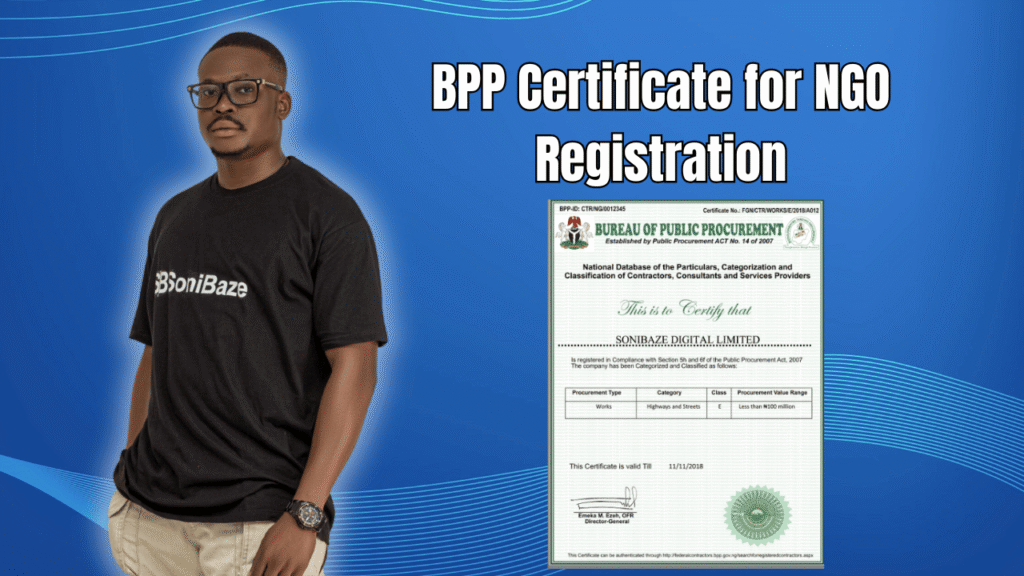
Most NGOs in Nigeria focus on CAC registration, tax exemption, and SCUML compliance. The BPP certificate rarely comes up in early conversations about setting up a non-governmental organisation. But the moment an NGO starts engaging with federal government funding, grants, or project execution contracts, it shows up on every requirements list.
This article explains what the BPP certificate means for NGOs in Nigeria, when it is required, what documents are involved, and how the process differs from what a for-profit company goes through.
Obtain Your BPP Certificate
Let us help you obtain your Bureau of Public Procurement (BPP) Registration Certificate quickly and hassle-free. Our experts provide reliable support throughout the registration process, ensuring your business is ready to participate in public procurement opportunities.
What Is the BPP Certificate?
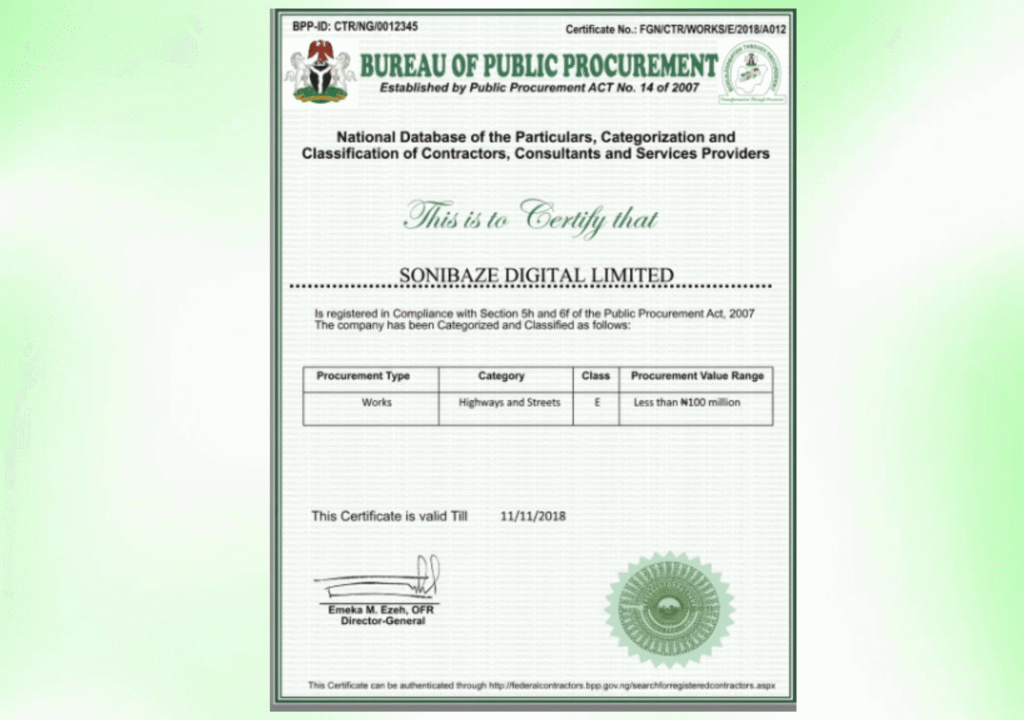
The Bureau of Public Procurement was established under the Public Procurement Act of 2007 to regulate and oversee public procurement across federal government agencies in Nigeria. The BPP maintains the National Database of Federal Contractors, Consultants and Service Providers, commonly called the CCSP database, and the certificate issued after successful registration is proof that your organisation is listed on that database as an eligible entity.
For a company, this certificate is the gateway to bidding for government contracts. For an NGO, the logic is the same. Any organisation seeking to receive federal government funding, execute government-backed projects, or participate in procurement processes run by ministries, departments, and agencies needs to be registered on the BPP database. The certificate confirms that registration is in place.
Do NGOs Need a BPP Certificate?
The short answer is yes, in specific circumstances.
NGOs that operate purely on private donations, international grants routed through their own accounts, and partnerships with private sector organisations may never encounter a BPP requirement. But once an NGO starts engaging with the Federal Government, the requirement kicks in.
If an NGO intends to receive Federal Government funding or execute Federal contracts, BPP registration applies. Some compliance requirements like the Tax Clearance Certificate may not apply to NGOs depending on their tax-exempt status, but the core registration process is the same as for any other organisation on the database.
In practice, federal MDAs specify BPP registration as a mandatory requirement in their tender documents and grant disbursement conditions regardless of contract or grant size. An NGO that is not on the BPP database will be disqualified from consideration before any other part of its application is evaluated.
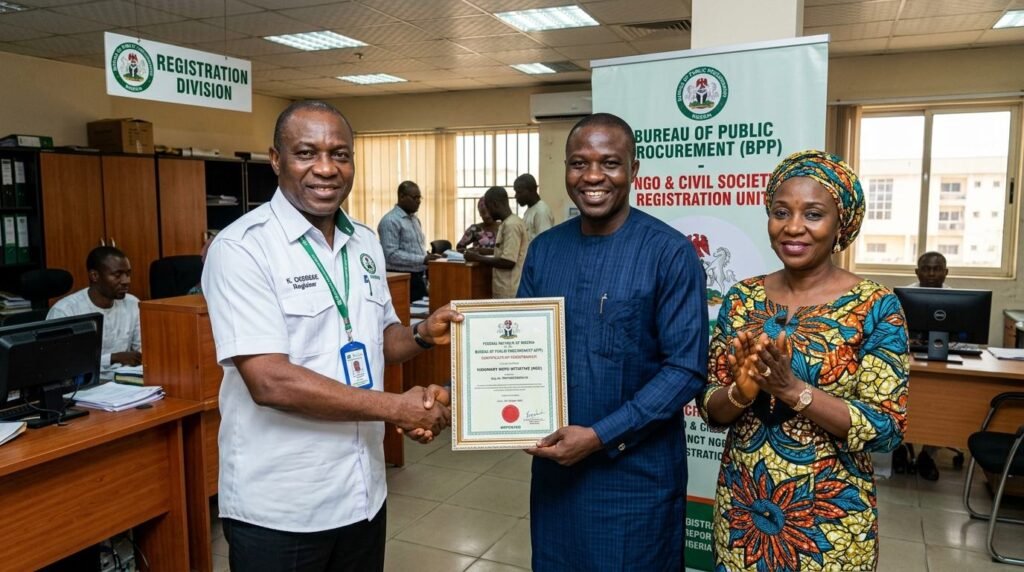
When an NGO Needs BPP Registration
| Situation | BPP Required? |
|---|---|
| Receiving federal government grants or funding | Yes |
| Executing contracts for federal MDAs | Yes |
| Partnering with federal agencies on development projects | Yes |
| Operating only on private or international donations | Generally not required |
| Bidding for state government contracts | Depends on the state’s own procurement rules |
How BPP Registration for NGOs Differs From Company Registration
The registration portal and the overall process are the same for NGOs and for-profit companies. Both go through the National Database at federalcontractors.bpp.gov.ng. Where the difference lies is in the specific documents submitted and some of the compliance requirements.
For a standard company, the foundational documents are a CAC Certificate of Incorporation, a Memorandum and Articles of Association, and a current CAC Status Report. For an NGO registered as an Incorporated Trustee under CAMA 2020, the equivalent documents are a Certificate of Registration of Trustees from the CAC, the organisation’s constitution rather than MEMART, the names and addresses of the Board of Trustees, and the relevant CAC status confirmation for the organisation.
Tax clearance is another area where NGOs can differ. An NGO that has obtained tax-exempt status from FIRS may submit evidence of that exemption in place of a standard tax clearance certificate. However, this should be confirmed with BPP at the point of application, since individual MDA requirements can vary.
The SCUML certificate is also a requirement for NGOs registering for BPP. NGOs are explicitly listed among the Designated Non-Financial Institutions required to hold SCUML compliance, and this certificate is expected as part of the compliance document package.
Obtain Your BPP Certificate
Let us help you obtain your Bureau of Public Procurement (BPP) Registration Certificate quickly and hassle-free. Our experts provide reliable support throughout the registration process, ensuring your business is ready to participate in public procurement opportunities.
Documents NGOs Need for BPP Registration
Certificate of Registration of Trustees from the Corporate Affairs Commission, confirming the NGO is legally registered as an incorporated trustee body in Nigeria.
Organisation Constitution setting out the aims, objectives, governance structure, and operating rules of the NGO. This is the NGO equivalent of a company’s Memorandum and Articles of Association.
CAC Status Report for the organisation, showing the current list of trustees, the registered office address, and the organisation’s status as at the date of application.
Names and Addresses of the Board of Trustees, with valid identification for each trustee. BPP uses this to verify governance structure and confirm the people behind the organisation.
SCUML Certificate issued by the Special Control Unit Against Money Laundering under the EFCC. This is a standard requirement for all NGOs and must be current and valid at the time of application.
Evidence of Tax Exempt Status or Tax Clearance from FIRS, depending on the NGO’s specific tax position. NGOs with approved tax exemptions should submit the exemption letter. Those that have not obtained exemption status will need a standard tax clearance certificate.
NSITF and ITF Compliance Certificates, where the NGO has employees. An NGO with staff on payroll is expected to be current on NSITF contributions and ITF levies in the same way a company is.
PENCOM Evidence, where the NGO has three or more employees. The Pension Reform Act 2014 applies to NGOs as employers, so pension remittance evidence is expected for qualifying organisations.
List of Key Personnel with their names, roles, qualifications, and experience. BPP assesses the capacity of the organisation through its people, not just its paperwork.
Financial Capacity Documentation, such as audited financial statements or bank statements showing the organisation’s financial position and ability to execute the kind of engagements it is registering for.
A Unique Contact Email Address that is actively monitored, since login credentials for the BPP portal are sent to this address after initial registration.
Documents at a Glance
| Document | Notes |
|---|---|
| CAC Certificate of Registration of Trustees | Core incorporation document for NGOs |
| Organisation Constitution | Replaces MEMART for incorporated trustees |
| CAC Status Report | Must be current, not from years ago |
| Board of Trustees Names and IDs | Identification required for each trustee |
| SCUML Certificate | Mandatory for all NGOs |
| FIRS Tax Exemption Letter or Tax Clearance | Depends on the NGO’s tax status |
| NSITF Certificate | Required if the NGO has employees |
| ITF Certificate | Required if the NGO has employees |
| PENCOM Evidence | Required if the NGO has three or more staff |
| Key Personnel List | Names, roles, qualifications |
| Financial Statements or Bank Statements | Demonstrates financial capacity |
Step-by-Step: The Registration Process for NGOs
The registration process follows the same steps as for a company. The portal is at federalcontractors.bpp.gov.ng.
Start by accessing the portal and creating an account using your organisation’s CAC registration number, organisation type, FIRS tax number, address, and contact email. Your login credentials will arrive at the email address you provide, so make sure it is one your team actively uses.
Once logged in, complete the full organisational profile. This includes entering trustee details, key personnel, your operational focus areas, financial capacity, and the categories of contracts or engagements you intend to pursue.
After the profile is complete, upload all supporting documents. Each file should be clearly legible and correctly labelled. BPP reviewers see a high volume of applications, and poorly labelled or blurry files slow down the verification stage.
Submit the application and wait for BPP to cross-check the submitted information against CAC records, SCUML data, FIRS records, and the other compliance certificates. If there are mismatches or missing documents, a query will be raised and the application held pending correction.
Once verification is completed without outstanding issues, BPP issues the registration certificate with a unique number. This certificate needs to be renewed periodically, so track the expiry date and initiate renewal before it lapses.
Common Issues NGOs Run Into
The most frequent problem is document inconsistency. If the trustee names on the constitution differ from those on the CAC status report, or if an ID submitted for a trustee does not match the name as registered, the verification process flags it.
The second common issue is an expired or missing SCUML certificate. NGOs sometimes complete CAC registration and tax filing and assume compliance is done. SCUML is a separate requirement entirely, and many NGOs applying for BPP registration for the first time discover their SCUML certificate has not been obtained or has since expired.
A third issue specific to NGOs is tax status confusion. An NGO that has not formally applied for FIRS tax exemption, but is not filing regular tax returns either, sits in an ambiguous position that BPP’s verification process is likely to flag. Sorting out the tax position with FIRS before applying for BPP is the cleaner path.
Frequently Asked Questions
Is BPP registration free for NGOs?
Yes. BPP registration is free for all entities, including NGOs. There is no government fee for the certificate itself. The costs an NGO typically encounters are for obtaining the compliance documents such as SCUML, NSITF, and ITF, and any professional fees if a consultant is engaged to manage the process.
Can an unregistered NGO apply for BPP?
No. BPP registration requires a valid CAC registration. An NGO must first be registered as an Incorporated Trustee with the CAC before it can apply for the BPP database. Operating as an unregistered association is also illegal in Nigeria for purposes of owning property, opening bank accounts, or entering contracts.
Does an NGO need a PENCOM certificate for BPP registration?
If the NGO has three or more employees, it falls within the scope of the Pension Reform Act 2014 and is expected to have evidence of pension contributions. This evidence is part of the compliance document package expected during BPP registration.
How long does BPP registration take for an NGO?
There is no fixed processing time. Applications with complete, consistent, and clearly presented documents tend to move through verification faster than those with missing items or mismatches. A realistic expectation, assuming all documents are ready and accurate, is two to four weeks from submission to certificate issuance.
Does BPP registration mean an NGO can receive any federal government funding?
Registration on the BPP database makes your NGO eligible to participate in federal procurement processes and apply for certain categories of government funding. It does not guarantee funding or contract awards. Each MDA has its own evaluation criteria, and registration is one of several requirements organisations must meet.
What if an NGO’s tax status is unclear?
Resolve it with FIRS before applying for BPP. An NGO with neither a tax exemption letter nor a current tax clearance certificate will encounter a gap in its compliance package that BPP’s verification will flag. The FIRS application for tax exemption is a separate process from CAC registration and should be initiated early.
Conclusion: Sort Compliance First, Then Register
BPP registration for an NGO is not complicated in itself. The portal is straightforward and the process follows a logical sequence. What creates delays is arriving at the registration stage with outstanding compliance gaps, most commonly an expired or missing SCUML certificate, unresolved tax status, or trustee information that does not match across documents.
NGOs that want to engage with federal government funding should treat BPP registration as part of the standard setup process, alongside CAC registration, SCUML, and FIRS tax status, rather than something to sort out when a funding opportunity already has a deadline attached.
Obtain Your BPP Certificate
Let us help you obtain your Bureau of Public Procurement (BPP) Registration Certificate quickly and hassle-free. Our experts provide reliable support throughout the registration process, ensuring your business is ready to participate in public procurement opportunities.