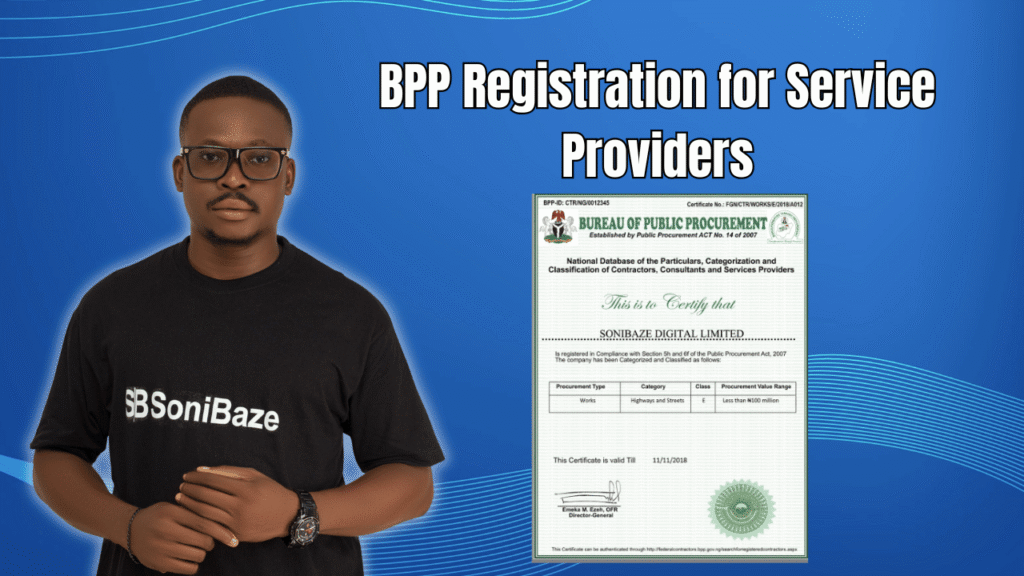
Service providers are often the category that feels most uncertain about BPP registration. Contractors and suppliers have a clearer mental picture of what government work looks like for them. Service providers, particularly those in consulting, IT, training, facility management, and professional services, sometimes assume the registration is for construction companies and suppliers of goods.
It is not. Service providers are explicitly named in the BPP framework, and skipping registration closes off a significant portion of the federal government market.

Obtain Your BPP Certificate
Let us help you obtain your Bureau of Public Procurement (BPP) Registration Certificate quickly and hassle-free. Our experts provide reliable support throughout the registration process, ensuring your business is ready to participate in public procurement opportunities.
What the BPP Means for Service Providers
The Bureau of Public Procurement was established under the Public Procurement Act of 2007 to regulate and oversee how the Federal Government of Nigeria spends money on goods, works, and services. The National Database of Federal Contractors, Consultants and Service Providers, commonly called the CCSP database, is where every company that wants to do business with any federal ministry, department, or agency must be listed.
The three letters in CCSP stand for Contractors, Consultants, and Service Providers. Service providers are not an afterthought in this framework. They are a named and recognised category.
All federal government contracts above 100 million naira require BPP No Objection certification, and any supplier or service provider involved must be registered on the National Database. In practice, most federal MDAs go further and specify BPP registration as a mandatory requirement in their tender documents regardless of contract size.
Which Service Providers Need to Register?
The BPP database covers service providers across every sector where the federal government procures services. This includes IT and software companies, management consultants, training and capacity development firms, facility and property management companies, security services providers, catering and hospitality vendors, legal and professional advisory firms, healthcare service providers, logistics and courier companies, media and advertising agencies, and audit and accounting firms.
Foreign companies providing services to the Federal Government are also required to register. Local companies register at no cost, while foreign companies may face a verification fee.
There is one specific exclusion worth noting. Manufacturers who are not directly supplying their manufactured products are not covered by this database. If your business manufactures goods but does not itself supply them to government, the CCSP registration requirement does not apply to you in that capacity. Service providers, however, have no equivalent exclusion.

What BPP Registration Gives a Service Provider
The most direct benefit is eligibility. Without registration, your company cannot be considered for federal government service contracts. The procurement process at the federal level is structured, and BPP registration is checked early in that process. A company that is not on the National Database is effectively invisible to MDAs looking for service providers through the procurement system.
Beyond eligibility, registration also signals credibility. Being listed on the BPP database means your company has passed a verification process and meets the baseline requirements for doing business with government. For private sector clients who follow similar procurement standards, this carries weight even outside of direct government contracting.
Registered companies also gain access to a wider range of tender opportunities across multiple federal agencies simultaneously, since the database is used across all MDAs rather than being sector-specific.
Documents Service Providers Need for BPP Registration
The document requirements for service providers follow the standard CCSP checklist, with some elements carrying particular weight depending on the nature of the services offered.
Certificate of Incorporation from the Corporate Affairs Commission. Only registered companies can apply. Sole proprietorships and business names are not eligible.
Current CAC Status Report reflecting the company’s directors, shareholders, and registered address as they currently stand.
Tax Identification Number and Tax Clearance Certificate from the Federal Inland Revenue Service, covering the most recent three years of tax assessment.
Audited financial statements or bank statements demonstrating the company’s financial capacity. For service providers, this is particularly important because government contracts often require evidence that the company can sustain operations through the payment cycle.
List of key personnel with their names, roles, qualifications, and relevant experience. For service-based businesses, the quality and experience of personnel is often the primary measure of capacity. This section of the application deserves careful attention.
Evidence of professional association membership, where applicable. A training company affiliated with a recognised professional body, an IT firm with relevant industry certifications, or a legal firm with Nigerian Bar Association registration should include this evidence. It strengthens the application significantly.
NSITF and ITF compliance certificates. Both are standard requirements across all CCSP categories, including service providers.
PENCOM compliance certificate, where applicable. Companies with fewer than 15 employees are not required to provide a PENCOM certificate under the current BPP guidelines, since pension contributions are only mandatory for organisations above that staff threshold. Companies with 15 or more employees should have this certificate ready.
Obtain Your BPP Certificate
Let us help you obtain your Bureau of Public Procurement (BPP) Registration Certificate quickly and hassle-free. Our experts provide reliable support throughout the registration process, ensuring your business is ready to participate in public procurement opportunities.
Service Provider Categories on the BPP Portal
When completing the registration profile, service providers must select the business category that best describes their work. The BPP database is category-specific, meaning your registration and classification determine which kinds of tenders your company appears eligible for.
Selecting the right category matters because procurement officers searching the database for vendors often filter by category before reaching individual company profiles. A company categorised incorrectly may not show up in relevant searches even after successful registration.
If your company provides services across more than one category, such as both IT services and management consulting, you can specify multiple categories during profile completion rather than registering separately for each.
Common Issues Service Providers Face During Registration
Personnel information is where many service provider applications run into trouble. The BPP requires specific details about key staff, and vague entries such as a generic job title without qualifications or years of experience tend to trigger queries during verification. Prepare a detailed list of your core team before starting the application.
Professional association membership is another area where service providers are sometimes caught off guard. The requirement is marked as applicable “where applicable,” but for many service categories including IT, legal, audit, and healthcare, having no professional association evidence while claiming to operate in that sector raises questions that slow down verification.
Financial capacity documentation is sometimes underestimated by smaller service firms. Bank statements that show irregular inflows, significant overdrafts, or very limited operating balances can lead to queries about whether the company can sustain a government contract through the typical government payment schedule. Prepare statements that reflect genuine operational activity.
After Registration: What Service Providers Should Know
Registration is not a one-time event. BPP registration has an expiration period and needs to be renewed periodically. Service providers who win contracts and then let their registration lapse can find themselves in a difficult position at renewal or extension stages of those contracts.
Debarment is also a real consequence of non-compliance. BPP can revoke registration or debar a company from public procurement if it provides false information, breaches the Public Procurement Act, or fails to meet its obligations during contract execution. Debarred companies are listed publicly on the BPP website. The reputational effect of that listing extends well beyond government contracts.
From March 2025, BPP moved to a fully digital submission portal for all official correspondence. Service providers managing their registration renewal or responding to verification queries must do so through the portal rather than by physical submission or email.
Registration at a Glance for Service Providers
| Requirement | Detail | Notes for Service Providers |
|---|---|---|
| Certificate of Incorporation | CAC-issued, companies only | Sole proprietorships not eligible |
| CAC Status Report | Current, reflecting today’s directors and shareholders | Pull a fresh one close to application date |
| TIN and Tax Clearance Certificate | Three most recent years of assessment | Must be current and active |
| Audited Financial Statements | Demonstrates financial capacity | Shows ability to sustain operations through payment cycles |
| Key Personnel List | Names, roles, qualifications, experience | Critical for service providers; detail matters here |
| Professional Association Membership | Where applicable to your sector | Strengthens application for IT, legal, audit, healthcare |
| NSITF and ITF Certificates | Both required across all CCSP categories | Standard compliance requirement |
| PENCOM Certificate | Required for companies with 15 or more employees | Not required below 15 staff threshold |
Frequently Asked Questions
Do media and advertising agencies need BPP registration to work with federal government?
Yes. Media and advertising companies are service providers under the BPP framework and need to be registered on the National Database to bid for or execute federal government communication contracts.
What category should a management consulting firm select during BPP registration?
Management consulting firms typically register under the consultants category. If the firm also provides specific services such as training or IT, it can select multiple categories during profile completion.
Can a startup with limited financial history register with BPP?
Yes, a startup can register, but limited financial history can raise questions during verification. If audited financial statements are not yet available, bank statements showing operational activity are typically submitted instead. Being transparent about company age and providing whatever financial documentation exists is better than submitting incomplete information.
Is PENCOM really not required for small service firms?
According to BPP’s own guidelines, companies with fewer than 15 employees are not required to provide a PENCOM compliance certificate, since pension contribution obligations become mandatory at that staff level. Service firms below this headcount can note this clearly in their application rather than scrambling to obtain a certificate they may not legally need.
How do I know which professional association to list?
List any professional body relevant to your primary service area that your company or its key personnel are members of. Examples include the Nigerian Bar Association for legal firms, the Institute of Chartered Accountants of Nigeria for audit firms, the Computer Professionals Registration Council of Nigeria for IT companies, and the Chartered Institute of Personnel Management for HR consultancies.
Can a foreign service provider register with BPP?
Yes. Foreign companies providing services to the Federal Government of Nigeria are required to register on the National Database. Local companies register at no cost, while foreign companies may face a verification fee during the process.
Conclusion: Service Providers Cannot Afford to Skip This
The federal government is one of the largest buyers of services in Nigeria. Training, consulting, IT, logistics, legal, media, and facility management contracts run across hundreds of MDAs every year. None of that is accessible to a service provider that is not on the BPP National Database.
The registration is free, the portal is online, and the document requirements are knowable in advance. The only real barrier is preparation, and that barrier disappears once you treat the document gathering with the same seriousness you would give any major contract deliverable.
Obtain Your BPP Certificate
Let us help you obtain your Bureau of Public Procurement (BPP) Registration Certificate quickly and hassle-free. Our experts provide reliable support throughout the registration process, ensuring your business is ready to participate in public procurement opportunities.