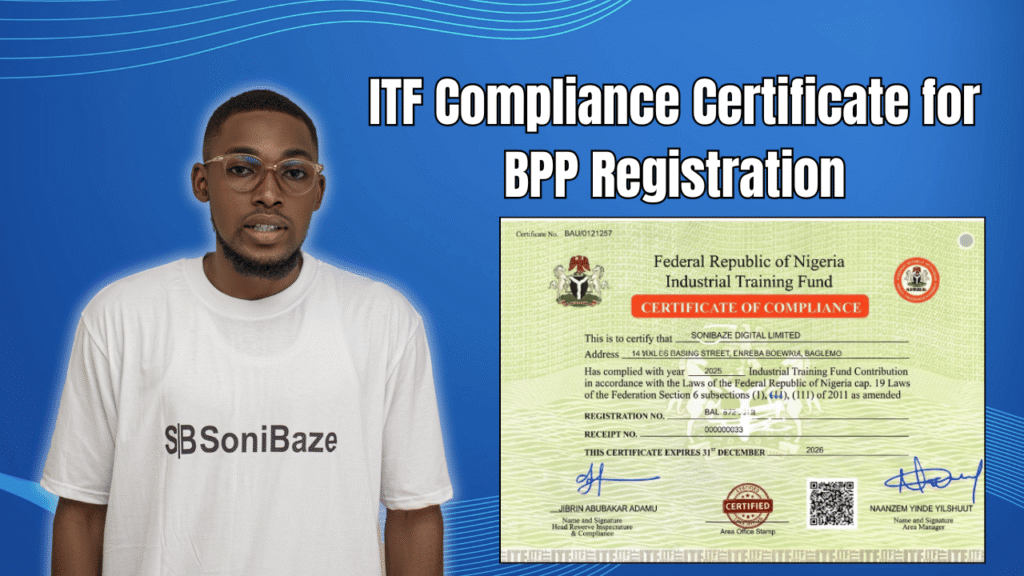
A lot of Nigerian businesses start the BPP registration process only to realise midway through that the ITF Compliance Certificate is one of the documents standing between them and completion. For companies that have never dealt with the Industrial Training Fund before, this creates an unexpected detour. For companies that are already ITF-registered but have a lapsed certificate, it creates a race against a tender deadline.
This article explains exactly why the ITF certificate is required for BPP registration, who needs it, how to get it, and what to do if your company falls below the ITF threshold.
Obtain Your ITF Certificate
Let us help you obtain your Industrial Training Fund (ITF) Compliance Certificate quickly and hassle-free. Our experts provide reliable support throughout the application process, ensuring your business meets all statutory compliance requirements.
What Is the ITF Compliance Certificate?
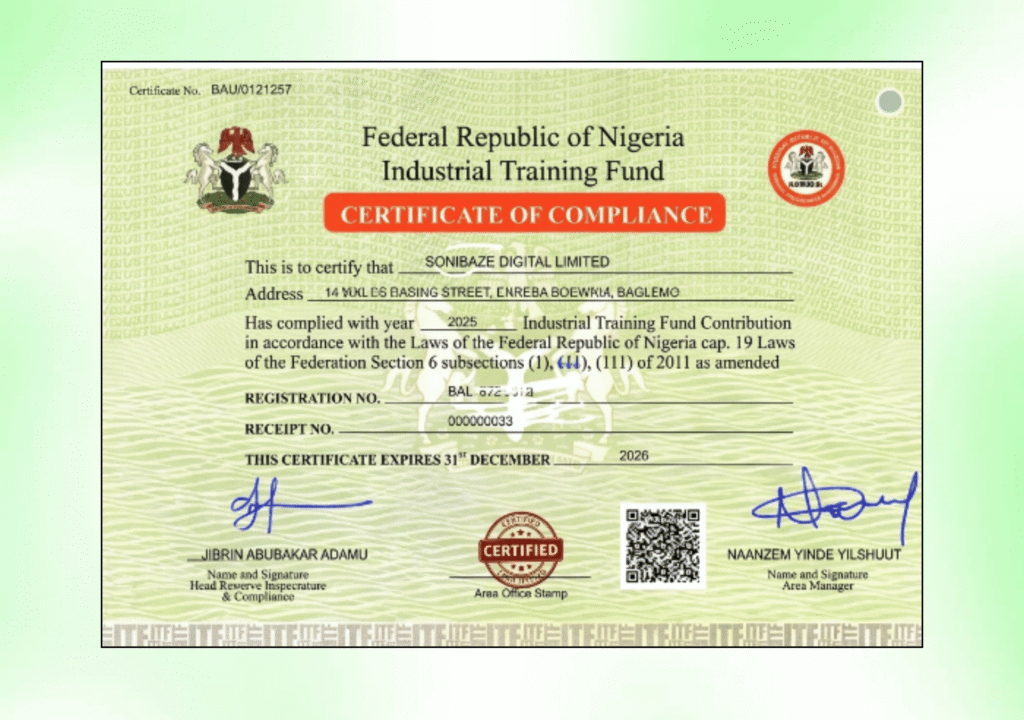
The ITF Compliance Certificate, formally called the ITF Training Compliance Certificate, is the document the Industrial Training Fund issues to an employer as proof that the company has met its annual contribution obligation under the Industrial Training Fund Act.
The ITF was established to promote and encourage the acquisition of skills in industry and commerce across Nigeria, with the goal of building a pool of trained indigenous manpower for both the public and private sectors. Every qualifying employer contributes 1% of their total annual payroll to the fund. The compliance certificate confirms that this obligation has been fulfilled for the current year.
The certificate is valid for one calendar year, from January to December of the year in which it is issued.
Why BPP Requires the ITF Certificate
The Bureau of Public Procurement was established under the Public Procurement Act 2007 to ensure accountability, transparency, and efficiency in how the Federal Government awards and executes contracts. Part of that mandate is making sure that companies on the National Database of Federal Contractors, Consultants and Service Providers are themselves compliant with Nigerian law.
Every company registering or renewing its registration on the BPP contractor database must provide a valid ITF Compliance Certificate, provided the company meets the five-employee or N50 million turnover threshold. The logic is straightforward: a business that cannot meet its basic statutory obligations to train its workforce is not considered fully compliant for the purpose of executing government contracts.
The ITF certificate sits alongside the NSITF Compliance Certificate, the PENCOM Clearance Certificate, and the Tax Clearance Certificate as the four core compliance documents required for BPP registration. All four must be valid at the time of submission. A lapsed or missing ITF certificate blocks the BPP application from being completed.

Who Needs the ITF Certificate for BPP Registration
The ITF Act obliges every employer that has five or more employees, or that has fewer than five employees but an annual turnover of N50 million or above, to contribute to the fund and obtain the compliance certificate.
| Employer Category | ITF Obligation |
|---|---|
| 5 or more employees (any turnover) | Required to contribute 1% of annual payroll and obtain certificate |
| Fewer than 5 employees but turnover of N50m or above | Required to contribute and obtain certificate |
| Fewer than 5 employees AND turnover below N50m | Exempt from contribution but can still obtain certificate via the startup route |
For BPP purposes, companies below both thresholds are exempt from the ITF requirement at the registration stage. However, this exemption must be verifiable. Simply claiming exemption without documentation does not automatically clear the requirement on the BPP portal.
Documents Required for ITF Certificate Registration
The document requirements differ depending on whether the company is registering with ITF for the first time or renewing an existing registration.
New Employer Registration (First-Time Applicants)
| Document | Notes |
|---|---|
| Completed ITF Form 7A | Employer Registration and Payment of Training Contribution Form. Download from itf.gov.ng or collect at the nearest ITF Area Office |
| CAC Certificate of Incorporation | Or Certificate of Registration for business names |
| Certified True Copy of Audited Accounts | Used to assess the company’s payroll liability |
| Tax Clearance Certificate or TIN Slip | Issued by FIRS |
| Evidence of payment of prescribed contribution | Payment made via the ITF Pay-Portal or Remita platform |
Once Form 7A is completed and submitted along with these documents at the nearest ITF Area Office, ITF officials assess the company’s liability based on the total annual payroll in the audited accounts. Upon successful review, the ITF National Number is issued, sent to the Area Office, and the Certificate of Compliance is processed.
Obtain Your ITF Certificate
Let us help you obtain your Industrial Training Fund (ITF) Compliance Certificate quickly and hassle-free. Our experts provide reliable support throughout the application process, ensuring your business meets all statutory compliance requirements.
Existing Registered Employers (Annual Renewal)
Already-registered employers do not use Form 7A. The renewal process uses a different form.
| Document | Notes |
|---|---|
| Completed ITF Form 5A | Used for annual renewal by existing registered employers |
| Evidence of current year payroll contribution payment | Generated via the ITF Pay-Portal or Remita |
| Updated audited accounts (where required) | Confirms current payroll figures for reassessment |
Submit Form 5A to the ITF Area Office where the company is registered, along with proof of payment. Where payroll figures have changed significantly from the previous year, updated supporting documentation will be requested.
Small Companies Below the ITF Threshold Seeking a Certificate
Companies with fewer than five employees and turnover below N50 million are not required to contribute, but some require the certificate for BPP registration or private sector vendor onboarding. A concession route exists for these companies.
| Step | Detail |
|---|---|
| Write an application letter | On company letterhead, addressed to the Area Manager of the relevant ITF Area Office |
| Attach CAC Certificate of Incorporation | As proof of business registration |
| Make a payment of N100,000 | Paid to the ITF account as a registration fee in lieu of the percentage contribution |
| Await certificate issuance | Upon review and satisfaction of the Area Office |
This route is specifically for startups and small companies that need the certificate for compliance purposes but have not yet crossed the obligated threshold.
How the Registration Process Works
The ITF registration and certificate process is handled physically at the ITF Area Office covering the jurisdiction where the company is registered. Unlike some other compliance registrations, the process is not fully online. Most Area Offices require in-person submission of forms and supporting documents.
The process runs as follows. Download and complete Form 7A for new applicants, or Form 5A for renewals. Gather the required documents. Submit at the nearest ITF Area Office in person. Pay the applicable contribution via the ITF Pay-Portal or Remita and retain the payment receipt. ITF officials assess the liability, raise any queries, and upon clearance the ITF National Number is assigned. The Area Office then scripts and issues the Certificate of Compliance.
New registrations take an average of 10 working days from the date of complete submission. Renewals by existing registered employers can be processed in five to seven working days where documentation is complete and no queries arise.
How the ITF Certificate Connects to BPP Registration
During BPP registration on the federalcontractors.bpp.gov.ng portal, the compliance documents section requires the ITF certificate to be uploaded as part of the submission. The certificate number and validity dates are entered into the system.
If the ITF certificate has expired, the BPP application cannot be completed. If the company is genuinely exempt based on staff count and turnover, this must be confirmed through the appropriate channel rather than simply left blank. Some companies document the exemption basis in a signed letter attached to the BPP submission.
The ITF certificate validity runs to December 31 of the year of issue. For companies doing BPP renewal at the start of a new year, the ITF certificate from the previous year will have expired. This means the ITF renewal must be completed before or alongside the BPP renewal, not after.
Penalty for Non-Compliance With ITF
Companies that are obligated but fail to contribute face a penalty of 5% of the outstanding contribution amount for each month or part of a month that the payment remains unpaid. Beyond the financial penalty, non-compliant companies lose the right to apply for a 50% reimbursement of their contribution, which is available to compliant employers who document qualifying staff training during the year.
For BPP purposes, operating without a valid ITF certificate where one is required means the BPP registration cannot be completed or renewed, which in turn blocks the company from bidding on any Federal Government contract.
Frequently Asked Questions
Does the ITF certificate expire at the end of every year?
Yes. The ITF Training Compliance Certificate is valid for one calendar year. It covers January to December of the year it is issued, and must be renewed annually. A certificate issued in 2025 is not valid for 2026 procurement purposes, even if the BPP registration is still current.
Can a company upload an expired ITF certificate for BPP registration?
No. The BPP portal requires a currently valid certificate. Uploading an expired one will not satisfy the compliance requirement. BPP renewal must be timed alongside ITF renewal to avoid a gap.
What if my company has fewer than five employees?
If your company has fewer than five employees and annual turnover below N50 million, you are not obligated to contribute to ITF. For BPP purposes, companies below both thresholds are exempt from the ITF requirement at the registration stage. If you need the certificate despite falling below the threshold, the concession route through the ITF Area Office applies, with a flat payment of N100,000.
Is ITF registration done online or in person?
The ITF registration and certificate process requires physical submission at the nearest ITF Area Office. While the contribution payment can be made via the ITF Pay-Portal or Remita, the form submission and document review are handled in person at the Area Office covering the company’s registered address. For businesses in Abuja, the FCT Area Office handles all FCT-based employer registrations.
How much does the ITF contribution cost?
The contribution is 1% of the company’s total annual payroll. For a company with a N10 million annual payroll, the contribution is N100,000. For a company with a N50 million annual payroll, it is N500,000. The actual amount varies entirely based on what the company pays its employees across the year.
Can ITF contributions be reclaimed?
Yes, partially. Employers who have paid their contributions and conducted qualifying staff training during the year can apply for a reimbursement of up to 50% of what they contributed. The reimbursement application requires documentary evidence including course fee receipts, certificates of attendance, and proof of the levy payment to ITF. Non-compliant employers lose access to this reimbursement entirely.
Conclusion: Get ITF Done Before You Start BPP
The ITF certificate is not optional for qualifying companies attempting to register or renew on the BPP contractor database. It is a prerequisite, and it takes time to process. New registrations average 10 working days. Renewals can take five to seven. Building in at least two to three weeks before a contract deadline is the minimum buffer any company should allow.
The smarter approach is to treat ITF renewal as part of an annual compliance calendar, renewed every January alongside the Tax Clearance Certificate, PENCOM, and NSITF certificates. Doing all four at once keeps the company contract-ready throughout the year without scrambling every time a tender comes up.
Obtain Your ITF Certificate
Let us help you obtain your Industrial Training Fund (ITF) Compliance Certificate quickly and hassle-free. Our experts provide reliable support throughout the application process, ensuring your business meets all statutory compliance requirements.