A Lagos construction company won a Federal Government contract worth NGN 48 million in early 2025. They had the capacity, the equipment, and the track record. What they did not have was an NSITF Compliance Certificate. The contract was withdrawn at the procurement stage, and by the time they had registered and obtained the certificate, the client had moved to the next bidder.
That story repeats itself more than most business owners realise. This article covers what the NSITF ECS Compliance Certificate is, who needs it, and every document required to get one in 2026.

Obtain Your NSITF Certificate
Let us help you obtain your Nigeria Social Insurance Trust Fund (NSITF) Compliance Certificate quickly and hassle-free. Our experts provide reliable support throughout the application process, ensuring your business meets all statutory compliance requirements.
What Is the NSITF ECS Compliance Certificate?
NSITF stands for the Nigeria Social Insurance Trust Fund, a Federal Government parastatal under the Federal Ministry of Labour and Employment. It administers the Employees Compensation Scheme under the Employees Compensation Act 2010, which replaced the older Workmen’s Compensation Act.
The scheme provides medical treatment, rehabilitation, and financial compensation to employees who suffer work-related injury, disease, or death, and pays death benefits to dependants when a workplace fatality occurs. It is funded entirely by employer contributions. Employees contribute nothing.
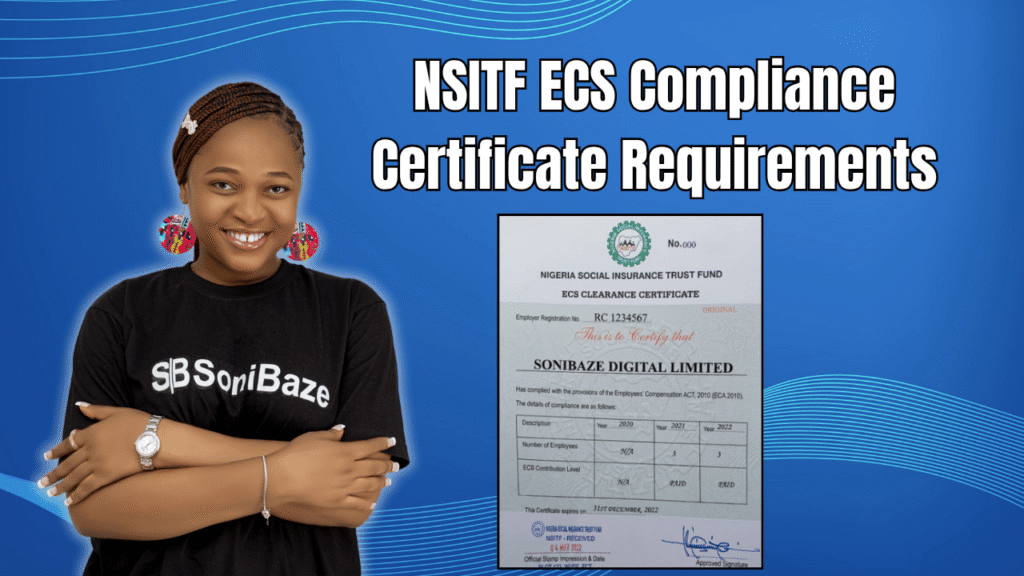
The ECS Compliance Certificate is the document NSITF issues to confirm that an employer has registered with the scheme and is current on its contributions. Without it, the company cannot bid for Federal Government contracts, and in many cases cannot open or maintain certain corporate banking relationships.
Who Must Register With NSITF?
Registration is not limited to large companies or government contractors. Any employer in Nigeria with at least one employee on its payroll is legally required to register and contribute. This covers public sector organisations, private companies, sole proprietorships, partnerships, NGOs, and businesses of every size.
Workers engaged through labour contractors, on fixed-term contracts, on casual arrangements, or through agency placements are all covered from day one. The Employees Compensation Act uses a broad definition of worker: any person employed under a contract of service, whether written or oral, express or implied. If a person works under your direction and control, they are covered regardless of how the engagement is documented.
The only categories of workers exempted from the scheme are certain non-citizen employees engaged for less than six years who are already covered under another country’s social security arrangement, and ministers of religion engaged in propagating their faith.

Documents Required for NSITF ECS Compliance Certificate
The documentation requirements split across two stages: registration as an employer, and then certification once contributions are in place.
Documents for Initial Registration (New Employers)
| Document | Details |
|---|---|
| Form ECS RE01 | Registration of Employer form, obtainable from any NSITF office nearest to your business location |
| Form ECS RE03 | Employer Schedule of Payment form, issued after ECS RE01 is submitted and used to document the company’s payroll and remuneration structure |
| CAC Certificate of Incorporation | For limited liability companies. Business names submit the Certificate of Registration instead |
| Particulars of the business | Company name, incorporation number, address, phone number, and email |
| Particulars of directors or owners | Full names, positions, and contact details of directors (for companies) or owners (for sole proprietorships and partnerships) |
| Business sector category | The industry or sector under which the company operates, used by NSITF to classify the business for contribution assessment |
| Evidence of payment | Payment receipt confirming the contribution remitted via the Remita platform after NSITF’s assessment of the company’s payroll |
Upon successful completion of registration, NSITF issues a Letter of Notification containing a 10-digit registration number. This number is used in all subsequent dealings with the Fund.
Documents for Certification (Obtaining the Compliance Certificate)
Once registered and contributing, a company applies separately for the compliance certificate. These are the documents required at that stage.
| Document | Details |
|---|---|
| Official request letter | A formal letter on the company’s letterhead addressed to the Managing Director and CEO of NSITF, Plot 794 Muhammadu Buhari Way, Central Business District, Garki, Abuja |
| CAC Certificate of Incorporation | A copy of the incorporation or registration document confirming the company’s legal status |
| Completed ECS forms | The ECS RE01 and ECS RE03 forms submitted during registration |
| Evidence of monthly contribution remittances | Documentation showing contributions have been paid, presented on the company’s letterhead |
| Tax Identification Number (TIN) | Issued by the Federal Inland Revenue Service |
| NSITF payment receipt | Proof of the contribution payment made via Remita |
| Previous NSITF certificate | Required for renewal applications only, not for first-time certification |
Obtain Your NSITF Certificate
Let us help you obtain your Nigeria Social Insurance Trust Fund (NSITF) Compliance Certificate quickly and hassle-free. Our experts provide reliable support throughout the application process, ensuring your business meets all statutory compliance requirements.
How the Contribution Is Calculated
NSITF requires 1% of total monthly payroll from every employer. Payroll for this purpose means total remuneration as defined in the Employees Compensation Act, but excludes pension contributions, bonuses, overtime payments, and one-off payments such as a 13th-month salary.
This contribution is not deducted from employees’ salaries. It is entirely an employer obligation on top of the payroll figure.
For a company with a total monthly payroll of NGN 2 million, the NSITF contribution is NGN 20,000 per month. Contributions are due on the last day of each month. Late payment attracts a penalty of 5% of the unpaid amount for each month or part thereof that the payment remains outstanding, and this compounds.
Costs Involved
| Fee Type | Amount |
|---|---|
| Monthly employer contribution | 1% of total monthly payroll |
| Initial registration and certification processing fee | Approximately NGN 50,000 |
| Late payment penalty | 5% to 10% per month on unpaid or unremitted contributions |
| Consultant professional fee (if using a consultant) | Typically NGN 20,000 to NGN 80,000 depending on the firm |
How Long Does It Take?
According to NSITF’s official published timelines, the compliance certificate is typically processed within 5 working days from the date all required documents are submitted and payment is verified. Some applicants working through consultants report completion in two to three days. Delays usually arise from incomplete documentation or discrepancies between the payroll figures submitted and what NSITF’s assessment produces.
Registration with NSITF takes an average of 5 working days as well, meaning a company starting from scratch can reasonably expect the full process to take one to two weeks when all documents are prepared in advance.
What Happens If You Do Not Comply
Non-compliance with the Employees Compensation Act carries real consequences. An employer who fails to register commits an offence punishable by a fine of not less than NGN 50,000 or imprisonment of not less than one year, or both.
Beyond the statutory penalties, an unregistered employer who experiences a workplace accident loses the protection the scheme provides and faces unlimited common-law liability for the employee’s injuries or death. Nigerian courts have been issuing larger damages awards in workplace injury cases in recent years. The ECS exists precisely to cap that exposure through a pooled insurance mechanism. Without registration, that protection does not exist.
How to Renew the NSITF Certificate
The NSITF ECS Compliance Certificate is issued annually. Renewal requires the same certification documents as the initial application, plus the previous year’s certificate. Companies registered on the database are expected to keep contributions current and renew at the start of each new year.
Allowing the certificate to lapse without renewal creates gaps in compliance history that can affect procurement eligibility, particularly when a procuring entity reviews prior-year compliance records during due diligence.
Frequently Asked Questions
Is NSITF the same as PENCOM or ITF?
No. NSITF, PENCOM, and ITF are three separate statutory obligations. NSITF covers workplace injury compensation under the Employees Compensation Act. PENCOM administers retirement savings under the Pension Reform Act 2014. ITF funds vocational and industrial training under the Industrial Training Fund Act. All three are mandatory and must be complied with independently. Compliance with one does not substitute for the others.
Can employees contribute to NSITF?
No. The scheme is funded entirely by the employer. It is a statutory payroll obligation placed on businesses, not a shared contribution like pension. No deduction from employee salaries is permitted or required.
Does the certificate cover all employees including contract staff?
Yes. The Employees Compensation Scheme covers all workers employed under a contract of service, whether full-time, part-time, casual, or through a labour contractor. If a person works under your direction and control, they fall within the scheme regardless of how their engagement is structured.
Can a small business with two or three employees afford NSITF?
The contribution is 1% of total monthly payroll, so the amount scales with the size of the company. A micro-business with a combined monthly payroll of NGN 300,000 owes NGN 3,000 per month. The registration and certification processing fee of approximately NGN 50,000 is the more significant upfront cost for very small businesses, but this is a one-time fee at the point of initial registration.
Where can the NSITF certificate be verified?
NSITF provides an online certificate verification facility at ecsa.nsitf.gov.ng where employers and contractors can verify certificates using the certificate number. This is the recommended channel for any procuring entity or bank that needs to confirm the authenticity of a submitted certificate.
Can a company register with NSITF and BPP at the same time?
Yes. There is no sequencing requirement that forces one to be completed before the other. In practice, many consultants process NSITF, ITF, and BPP registrations concurrently to save time, since all three are typically required together for Federal procurement.
Conclusion: Sort the Documents Before You Approach the Office
The NSITF ECS Compliance Certificate is not difficult to obtain. The process becomes slow and frustrating only when companies arrive at the NSITF office without the right documents, or when they have not set up their Remita payment before attending.
The preparation order that saves the most time is to gather CAC documents and TIN first, then complete forms ECS RE01 and ECS RE03, then make the assessed payment via Remita, and then submit the full certification package with the request letter. Done in that order, with complete documents, the certificate arrives within the official five-day window.
Obtain Your NSITF Certificate
Let us help you obtain your Nigeria Social Insurance Trust Fund (NSITF) Compliance Certificate quickly and hassle-free. Our experts provide reliable support throughout the application process, ensuring your business meets all statutory compliance requirements.