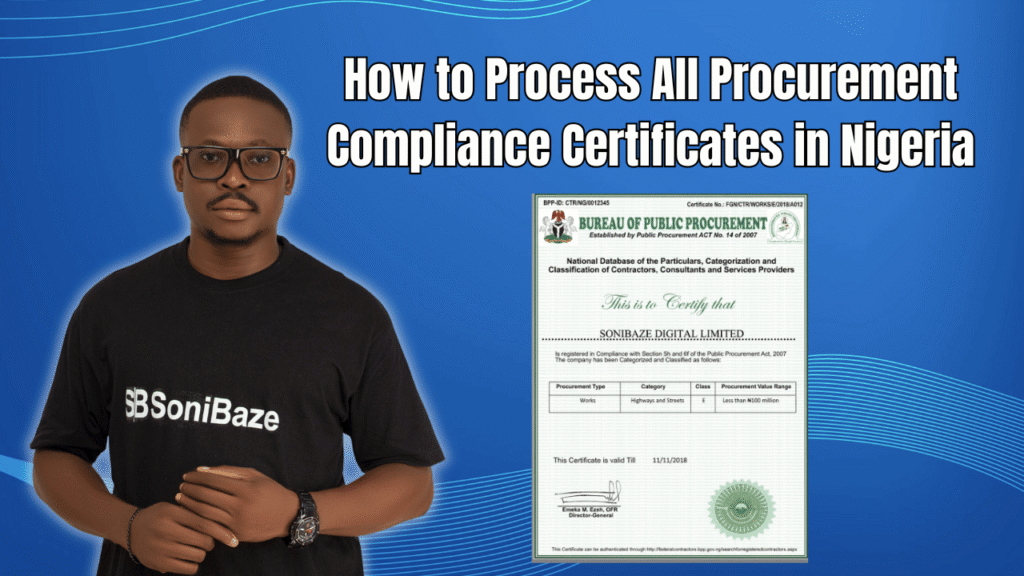
Every Nigerian company that wants to bid for Federal Government contracts needs a stack of compliance certificates before its bid can even be considered. Most businesses discover this only after they have already lost a tender or been disqualified at the document stage.
The certificates involved are PENCOM, ITF, NSITF, BPP, and SCUML, each issued by a different government agency, each with its own requirements, timelines, and contribution rates. This guide covers all of them in one place so you know exactly what to get, in what order, and what it takes to process each one.
Obtain Your BPP Certificate
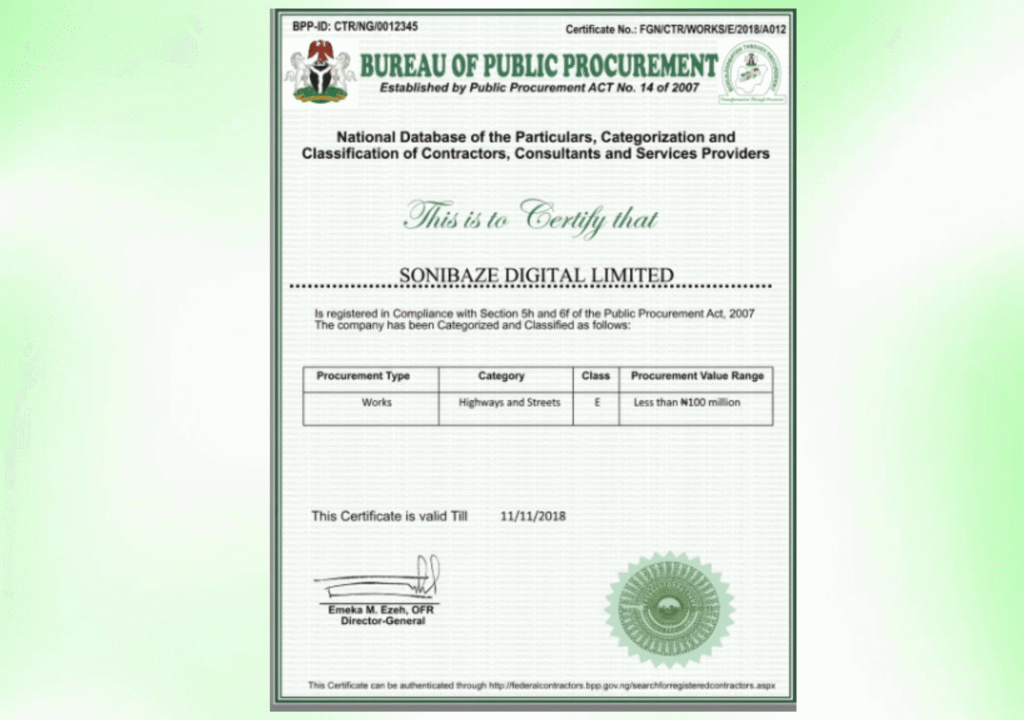
Let us help you obtain your Bureau of Public Procurement (BPP) Registration Certificate quickly and hassle-free. Our experts provide reliable support throughout the registration process, ensuring your business is ready to participate in public procurement opportunities.
Why These Certificates Matter
Under the Public Procurement Act 2007, any supplier, contractor, or consultant bidding for contracts from Federal Government Ministries, Departments, and Agencies must demonstrate compliance with specific statutory obligations. These include contributions to employee welfare funds, pension remittances, and registration on the national contractor database.
Missing even one certificate disqualifies a bid. Most of these certificates are also time-bound, expiring at the end of each calendar year, which means compliance is not a once-and-done exercise. It is an annual responsibility.
Overview of All Procurement Compliance Certificates
| Certificate | Issuing Body | Who Needs It | Validity |
|---|---|---|---|
| PENCOM Compliance Certificate | National Pension Commission | Companies with 3 or more employees | Annual |
| ITF Certificate of Compliance | Industrial Training Fund | Companies with 5 or more employees or over N50m turnover | Annual |
| NSITF Compliance Certificate | Nigeria Social Insurance Trust Fund | All private sector employers | Annual |
| BPP Interim Registration Report | Bureau of Public Procurement | All contractors and consultants bidding for Federal contracts | Annual renewal |
| SCUML Certificate | Special Control Unit Against Money Laundering (EFCC) | Designated Non-Financial Businesses and Professions | No fixed expiry, but records must be kept current |
Start with the ones that take the longest. PENCOM tends to involve the most steps, so begin there while you gather documents for the others.

1. PENCOM Compliance Certificate
What It Is
The National Pension Commission compliance certificate confirms that a company is remitting employee pension contributions as required under the Pension Reform Act 2004. All corporate entities with a minimum of five employees are required to comply, though some sources indicate three employees as the relevant threshold for compliance certificate purposes.
Requirements
Before applying to PENCOM for a compliance certificate, your company must already have an employer code. To get that code, submit the following to a Pension Fund Administrator:
- Certificate of Incorporation from CAC
- Evidence of FIRS Tax Identification Number
- A letter requesting an employer code, addressed to PENCOM
The PFA forwards these to PENCOM, which issues the employer code. Once the code is in place, pension contributions must be registered for a minimum of three staff members at the contribution rate of 10% from the employer and 8% from the employee, totalling 18% of each enrolled staff member’s monthly salary.
Applying for the Certificate
After contributions have been set up and remitted, apply formally to PENCOM with the following:
| Document | Details |
|---|---|
| CAC Certificate of Incorporation | Current and valid |
| TIN from FIRS | Evidence of tax registration |
| Certified list of employees | Including monthly pension contribution rates, certified by at least two directors |
| Group Life Insurance policy | Current policy covering a minimum of three staff, specifying the sum assured |
PENCOM compliance certificates are valid until 31 December of the year they are issued. Renewal requires updated employee and contribution records.
2. ITF Certificate of Compliance
What It Is
The Industrial Training Fund certificate confirms that a company has paid its annual training contribution as required under the ITF Amendment Act 2011. Any supplier, contractor, or consultant bidding for government contracts must hold a valid ITF compliance certificate. The contribution rate is 1% of the company’s total annual payroll.
Who Is Exempt
Companies with fewer than five employees and an annual turnover below N50 million are exempt from ITF contributions and do not need this certificate.
How to Process It
Download ITF Form 7A from the ITF website or the nearest ITF area office. Submit the completed form in person at the nearest ITF area office along with the following:
| Document | Details |
|---|---|
| ITF Form 7A | Employer Registration and Payment of Training Contribution Form |
| CAC Certificate of Incorporation | Issued by the Corporate Affairs Commission |
| Certified True Copy of Audited Accounts | Used to assess the annual payroll and calculate the 1% contribution |
| Tax Clearance Certificate | Current and valid |
At the area office, a revenue inspectorate and compliance officer will assess the company’s liability based on the total annual payroll in the audited accounts. Payment is made through the Remita platform. After payment, submit the receipt to ITF, and the agency issues an ITF National Number and Certificate of Compliance.
ITF certificates are valid until 31 December of the relevant year and must be renewed annually.
Processing time averages around 10 working days.
3. NSITF Compliance Certificate
What It Is
The Nigeria Social Insurance Trust Fund compliance certificate confirms that a company has registered and is remitting monthly contributions under the Employee Compensation Act. The NSITF covers all private sector employers in Nigeria, and the contribution rate is 1% of the total monthly payroll.
Who Is Exempt
Public service employees, diplomats, non-Nigerian employees on assignments shorter than six years, and ministers of religion engaged in propagating their faith are exempt from NSITF contributions.
How to Process It
The company first signals its intention by writing a request letter on its official letterhead to NSITF. That letter is submitted together with the following:
| Document | Details |
|---|---|
| Letter of request on company letterhead | Addressed to the NSITF, stating intention to obtain the compliance certificate |
| CAC Certificate of Incorporation | Current copy |
| Completed ECS RE 01 Registration Form | NSITF employer registration form |
| Payroll Form RE 03 | Schedule of employee payroll |
| 10-digit NSITF Registration Number | Issued upon initial registration with the fund |
| NSITF payment receipt | Evidence of contribution payment via Remita |
The liability assessment is based on 1% of five staff total salaries for the number of months applicable to the applying company. Upon successful registration, NSITF issues a Letter of Notification with a 10-digit registration number. The compliance certificate follows after confirming current contributions.
Monthly contributions become due on the last day of each month. Late payments attract a 5% penalty on the unpaid amount for each month of delay.
Processing time for NSITF registration and certificate issuance averages 5 working days.
4. BPP Interim Registration Report
What It Is
The Bureau of Public Procurement Interim Registration Report, commonly called the BPP certificate, is issued to contractors, consultants, and service providers registered on the National Database of Federal Contractors, Consultants and Service Providers. Registration is free and done entirely online at federalcontractors.bpp.gov.ng.
Requirements
| Document or Information | Details |
|---|---|
| CAC Certificate of Incorporation | For companies. Certificate of Registration for business names |
| Tax Identification Number | From FIRS |
| Tax Clearance Certificate | Current and valid |
| NSITF Certificate | Required as part of the compliance section |
| PENCOM Certificate | Required. Exempt for companies with fewer than three employees |
| ITF Certificate | Required. Exempt for companies with fewer than five employees or below N50m turnover |
| Board of directors details | Names and qualifications of current directors |
| Business category information | Goods, works, or services |
| Professional association details | For service-providing companies |
| List of completed jobs | Jobs executed in the last five years, from both public and private sectors |
| Key personnel CVs | Academic and professional qualifications of senior staff |
| Financial capacity information | Audited accounts and bank reference where applicable |
Obtain Your BPP Certificate
Let us help you obtain your Bureau of Public Procurement (BPP) Registration Certificate quickly and hassle-free. Our experts provide reliable support throughout the registration process, ensuring your business is ready to participate in public procurement opportunities.
How to Register
Provide basic company details on the BPP portal to receive a temporary contractor ID and password via email. Log in, complete all sections including compliance, directors, business category, personnel, completed jobs, and financials, then submit. The Interim Registration Report can only be printed after the application is successfully completed and approved.
Registration with BPP takes an average of 5 working days. The database requires annual renewal starting from the first month of each new year.
5. SCUML Certificate
What It Is
The Special Control Unit Against Money Laundering certificate is issued by the EFCC to Designated Non-Financial Businesses and Professions. These include real estate agencies, legal practices, accounting firms, car dealers, hotels, consultants, jewellery dealers, and other businesses that handle large financial transactions. Commercial banks require this certificate before opening corporate accounts for qualifying businesses.
Requirements
| Document | Details |
|---|---|
| CAC Certificate of Incorporation or Certificate of Registration | For companies or business names respectively |
| Tax Identification Number printout | From FIRS |
| BVN of all proprietors or directors | Bank Verification Number |
| Valid means of identification | Of at least one proprietor or director |
| Bank account details | Of at least one proprietor |
| Status report or Form CAC 1.1 | For newly registered companies |
| MEMART | Memorandum and Articles of Association |
| Company profile | Describing the nature of the business and key personnel |
How to Register
Registration is done online at scuml.efcc.gov.ng. Upload all required documents, complete the registration form with accurate business and owner details, and submit. The certificate is issued digitally and downloaded from the portal. There is no physical collection. The official processing time is 7 working days from the date a complete application is received, though real-world timelines vary from 5 to 15 working days depending on document accuracy and application volume.
SCUML registration is free.
Recommended Processing Order
The certificates build on each other in some cases. NSITF and ITF documents are required for BPP registration, for example. Processing in the right order prevents having to pause mid-way for a certificate you should have gotten first.
| Order | Certificate | Why This Position |
|---|---|---|
| 1 | CAC and TIN | Foundation for all other registrations |
| 2 | Tax Clearance Certificate | Required by PENCOM, ITF, NSITF, and BPP |
| 3 | PENCOM | Most steps involved. Start early |
| 4 | NSITF | Required for BPP. Takes about 5 working days |
| 5 | ITF | Required for BPP. Takes about 10 working days |
| 6 | BPP | Requires NSITF, PENCOM, and ITF to be complete |
| 7 | SCUML | Independent process. Run parallel if your business type requires it |
Cost Summary
| Certificate | Direct Cost | Processing Time |
|---|---|---|
| PENCOM | Contribution-based (18% of enrolled staff salaries) | Varies |
| ITF | 1% of total annual payroll | About 10 working days |
| NSITF | 1% of total monthly payroll | About 5 working days |
| BPP | Free for local companies | About 5 working days |
| SCUML | Free | 7 to 15 working days |
Consultant fees for assisted applications typically range from N20,000 to N80,000 per certificate depending on the firm and scope of assistance.
Frequently Asked Questions
Do all five certificates apply to every business?
Not necessarily. SCUML applies only to Designated Non-Financial Businesses and Professions. ITF and PENCOM have employee threshold exemptions. However, any company bidding for Federal Government contracts will generally need PENCOM, ITF, NSITF, and BPP at a minimum. SCUML applies if the business type falls under the categories regulated by the EFCC.
Can I process all certificates at the same time?
You can run most of them in parallel once you have your CAC documents and Tax Clearance Certificate in hand. PENCOM takes the most time because of the employer code step, so starting that first while processing NSITF and ITF simultaneously is the most efficient approach.
What happens if a compliance certificate expires before a tender deadline?
An expired certificate is treated the same as no certificate at all. Procurement evaluators check validity dates, and an expired PENCOM or ITF certificate will disqualify a bid. Set renewal reminders for October each year to avoid scrambling in November and December when most agencies are processing high volumes.
Is there a penalty for not registering with NSITF?
Yes. Under the Employee Compensation Act, failure to register and remit contributions is a statutory breach. Late payments attract a 5% penalty per month on the unpaid amount, and unpaid contributions are recoverable as a debt owed to the fund.
Do state government contracts require the same certificates?
State government contracts vary by state and by the procuring entity. Most major state procurement processes require at minimum the PENCOM, ITF, and NSITF certificates. BPP registration is specifically for Federal Government contracts. Check the specific tender document for the list of required compliance documents.
How long before a tender deadline should I start processing these certificates?
At least 6 to 8 weeks before the deadline, assuming you are starting from scratch. PENCOM alone can take several weeks if your company does not already have an employer code and registered staff with a PFA. For companies that already have existing registrations and just need renewals, 3 to 4 weeks is usually sufficient.
Conclusion: Compliance Is an Annual Commitment, Not a One-Time Task
Each of these certificates expires, renews, and requires updated information every year. The companies that consistently win government contracts are not the ones that scramble for compliance documents two weeks before a deadline. They are the ones that treat annual renewal as a routine part of business operations, the same way they handle tax filing or audited accounts.
Get the foundation right first: CAC registration, TIN, and Tax Clearance Certificate. Everything else builds on those three. Once the full compliance stack is in place and renewed on schedule, bidding for Federal contracts becomes a process of preparation rather than a race against document expiry dates.
Obtain Your BPP Certificate
Let us help you obtain your Bureau of Public Procurement (BPP) Registration Certificate quickly and hassle-free. Our experts provide reliable support throughout the registration process, ensuring your business is ready to participate in public procurement opportunities.