If you studied architecture in Nigeria, ARCON is the body that decides whether your qualification counts, what title you can use, and whether you are legally allowed to put your name on a building plan. Getting that wrong is not a small inconvenience. It affects everything from securing projects to opening a professional bank account.
This article covers what ARCON is, the registration categories available, what each one requires, and how the practice license system works in 2026.
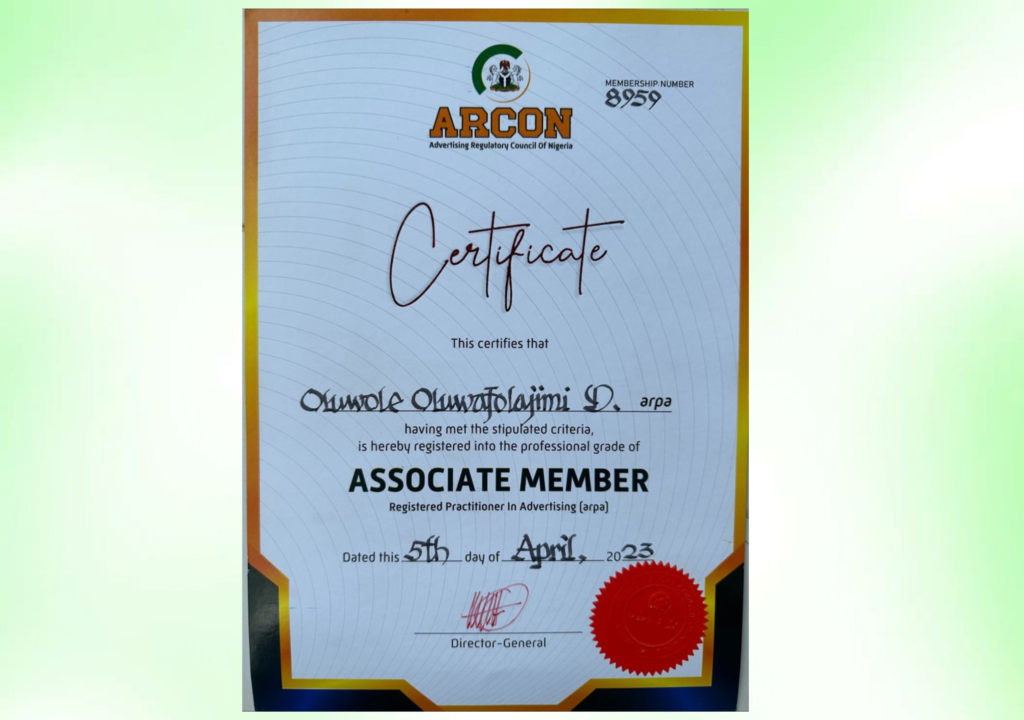
Obtain Your ARCON certificate
Let us help you obtain your Advertising Regulatory Council of Nigeria (ARCON) Certificate quickly and hassle-free. Our experts provide professional guidance throughout the registration and certification process, ensuring compliance with industry regulations.
What Is ARCON?
ARCON stands for the Architects Registration Council of Nigeria. It is a statutory body operating under the Federal Ministry of Housing and Urban Development, established to regulate the training and practice of architecture in Nigeria.
It is a regulatory agency headquartered at NULGE House in Utako, Abuja, and its mandate covers every aspect of architectural practice regulation in the country. The council’s authority comes from the ARCON Act, which gives it the power to set minimum educational standards, register practitioners, issue and renew practice licenses, and discipline those who fall short of its standards.
ARCON regulates both architects and architectural technologists, maintaining separate registers and licensing processes for each. This distinction matters because the two roles carry different responsibilities on a project and follow different registration pathways.
Why the Practice License Matters
A practice license is not decorative. Only fully registered and financially current architects and firms are eligible to prepare, produce, and submit architectural building plans for approvals and implementation. Without a valid, current license, you cannot legally sign off on building plans in Nigeria.
ARCON also issues the ARCON Project Registration Number (APRN), a mandatory registration number for each project an architect takes on. This number certifies that projects are being executed by Nigerian citizens who are fully registered and financially current architects. No APRN means no legal project execution, regardless of how experienced you are.
ARCON Registration Categories
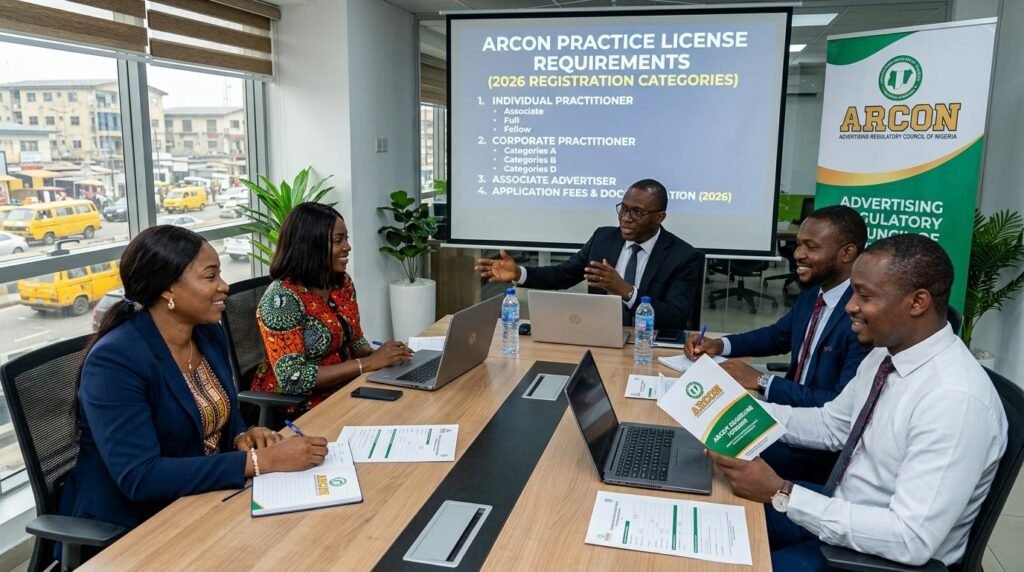
ARCON recognises several distinct registration categories. Each one has different requirements and grants different rights.
Student Registration
This is the entry point for architecture students enrolled in ARCON-accredited or NUC-accredited universities. It is open to students currently enrolled in NIA/ARCON-accredited Schools of Architecture in Universities or Polytechnics.
| Requirement | Detail |
|---|---|
| Enrolment status | Active student at an ARCON/NUC-accredited institution |
| Form cost | ₦1,000 |
| Purpose | Gives students access to ARCON portal and professional community |
Student registration does not grant any practice rights. It is a preparatory status while completing the academic phase.
Provisional Stage I Registration
This category is for graduates who have completed their first degree but have not yet fulfilled all requirements for full registration.
| Requirement | Detail |
|---|---|
| Academic qualification | First degree in Architecture from an ARCON/NUC-accredited university |
| Credential format | Original certificates only — no statement of results accepted |
| NYSC | Discharge certificate required |
| Form cost | ₦4,000 |
Provisionally registered architects shall not take responsibility for any building above two floors in height until they have passed the Professional Practice Competence Examination and have been fully registered. This is a firm limitation, not a recommendation.
Provisional Stage II Registration
Stage II is for candidates who have completed both their first and second degrees and are progressing toward the Professional Practice Competence Examination.
| Requirement | Detail |
|---|---|
| Nationality | Must be of Nigerian origin |
| First degree | From an ARCON/NUC-accredited Nigerian university, or a foreign degree verified by ARCON |
| Second degree | Same accreditation requirements apply |
| NYSC discharge | Required |
| Practical training | Minimum 2 years post-graduation under a registered architect or licensed firm |
| Form cost | ₦5,000 |
During the practical training period, candidates are expected to get exposure to live projects, documentation, site supervision, client meetings, contracts, and construction processes, and to record their experience via building portfolios and reports.
Foreign degrees are accepted only after ARCON verifies them. The applicant must write a formal letter authorising the institution to send transcripts to ARCON, and proof of payment of the transcript verification receipt must be uploaded.
Full Registration
Full registration is the status that grants unrestricted practice rights in Nigeria. It is what “Registered Architect” means in the legal sense.
| Requirement | Detail |
|---|---|
| Examination | Must have passed the PPCE (Professional Practice Competence Examination) |
| Practical experience | Minimum 2 years post-qualification experience |
| NIA membership | Full membership of the Nigerian Institute of Architects after passing the PPCE |
| Sponsors | Two sponsors who are financially current ARCON members with at least 5 years post-registration |
| Referees | Must be different from sponsors; same financial status requirement |
| Sponsor license | Current copy of sponsors’ practice license must be submitted |
| Character certification | Letter from an employer, registered architect, clergy, or civil servant at director level |
| Form cost | ₦10,000 |
Full registration grants the legal right to use the title Architect before your name. Without it, using that title professionally is a breach of the ARCON Act.
Firm Registration
Architectural firms operating in Nigeria must also register with ARCON as a separate requirement from the individual architect’s license.
| Requirement | Detail |
|---|---|
| Eligibility | Only fully registered architects can apply for firm registration forms |
| Ownership structure | All proprietors, subscribers, shareholders, and directors must be fully registered architects with Nigerian citizenship |
| Share control | Fully registered Nigerian architects must hold at least 60% of the shares |
| Operational control | Nigerian directors must demonstrate control commensurate with their shareholding |
| Form cost | ₦20,000 |
For architectural firms incorporated under the Companies and Allied Matters Act as limited liability companies, all directors and shareholders must be professional architects, and the Nigerian directors must show indisputable evidence of operational and financial control of the firm.
Obtain Your ARCON certificate
Let us help you obtain your Advertising Regulatory Council of Nigeria (ARCON) Certificate quickly and hassle-free. Our experts provide professional guidance throughout the registration and certification process, ensuring compliance with industry regulations.
Summary of Registration Categories
| Category | Who It Is For | Form Cost | Practice Rights |
|---|---|---|---|
| Student | Enrolled students at accredited institutions | ₦1,000 | None |
| Provisional Stage I | First degree graduates | ₦4,000 | Limited — no buildings above 2 floors |
| Provisional Stage II | Graduates completing PPCE pathway | ₦5,000 | Limited — same restriction as Stage I |
| Full Registration | PPCE passers with 2+ years experience | ₦10,000 | Full — unrestricted practice |
| Firm Registration | Registered architects forming a practice | ₦20,000 | Firm-level legal practice rights |
The Professional Practice Competence Examination (PPCE)
The PPCE is the gateway between provisional and full registration. Without passing it, an architect cannot move to full registration regardless of how many years of experience they have accumulated.
In 2026, the examination focuses on contract administration and professional ethics, building laws and regulations in Nigeria, and project management and office practice. The exam is conducted jointly by ARCON and the Nigerian Institute of Architects, and candidates sit for it after completing the mandatory two-year practical training.
Candidates who fail specific sections are listed as referred and must resit those sections. There is no shortcut around the PPCE — foreign qualifications, years of experience abroad, and professional standing in other countries do not exempt a Nigerian architect from this requirement.
The ARCON Regulatory Programme (ARP)
The ARCON Regulatory Programme is a mandatory ongoing compliance activity for registered architects. ARCON is currently accepting ARP 2026 registrations through its portal. Participation in the ARP is tied to being financially current, which in turn determines whether an architect can legally practise, sign building plans, or sponsor new registrants.
How to Pay and Register
All payments to ARCON go through Remita. The process works as follows: go to the Remita portal, select TSA and States, then Federal Government of Nigeria, search for ARCON as the payee, select the relevant service description, and complete payment by debit card or bank transfer. A Remita receipt bearing the ARCON account name is issued and serves as proof of payment before forms are processed.
Stamps for Lagos and other states can be obtained from either the Lagos or Abuja offices, but stamps for Abuja can only be obtained from the Abuja office.
General Document Requirements for Registration
Regardless of category, several document rules apply across all ARCON registrations.
| Document Rule | What It Means |
|---|---|
| Certificates only | No statement of results is accepted under any circumstances |
| Name consistency | If names differ across credentials, a sworn affidavit is required |
| Block letters | All forms must be completed in block letters except email addresses |
| Business address | Must be the address of your current employer, not personal address |
| Council member sighting | Documents must be sited by an ARCON council member only |
| Foreign degree | Applicant must authorise transcript request and upload proof of payment |
Frequently Asked Questions
Can a foreigner register with ARCON and obtain a practice license in Nigeria?
No. Only Nigerian citizens can obtain an ARCON license. Foreign architects living or working in Nigeria cannot register with ARCON regardless of their qualifications or professional standing in their home country.
How do I know if my university is accredited by ARCON?
ARCON maintains an online accreditation checker at arconigeria.gov.ng. You can search for your institution directly. If your school does not appear on the list, contact ARCON’s education department at education@arconigeria.gov.ng for clarification before applying.
What is the difference between ARCON and NIA?
The NIA is the professional association handling welfare, training, and advocacy, while ARCON is the government regulatory body responsible for licensing and legal control. Both are involved in the registration pathway, but ARCON’s registration is the one with legal force — NIA membership alone does not authorise you to practise.
What happens if I practise without a valid practice license?
Practising architecture without a current ARCON practice license is a breach of the ARCON Act. Only registered and financially current architects can sign off on building plans, obtain APRN numbers, and legally describe themselves as architects. Operating outside this framework exposes an individual or firm to regulatory action.
How do I renew my ARCON practice license?
License renewal is processed through the ARCON portal. Once logged in, the annual license fee and any outstanding payments are displayed on the dashboard. Payment is made through Remita following the same process used for registration fees.
Can I submit registration forms online or do I need to visit an ARCON office?
Online registration is now fully operational for all categories through the ARCON registration portal at register.arconigeria.gov.ng. Physical form submission is no longer required for the main registration process, though document sighting by a council member still applies.
Conclusion: Registration Category Determines What You Can Legally Do
The distinction between provisional and full registration is not administrative. It determines whether you can take on unrestricted projects, use the architect title, and sponsor candidates. Getting to full registration takes time — accredited degree, two years of documented practical training, and the PPCE — but each step is clearly defined.
For architects currently in provisional status, the priority is completing the practical training record, registering for the PPCE, and staying financially current with ARCON throughout. Letting your financial status lapse while waiting to sit the exam affects your standing in the register and your ability to be supported by sponsors who must themselves remain current.
Obtain Your ARCON certificate
Let us help you obtain your Advertising Regulatory Council of Nigeria (ARCON) Certificate quickly and hassle-free. Our experts provide professional guidance throughout the registration and certification process, ensuring compliance with industry regulations.