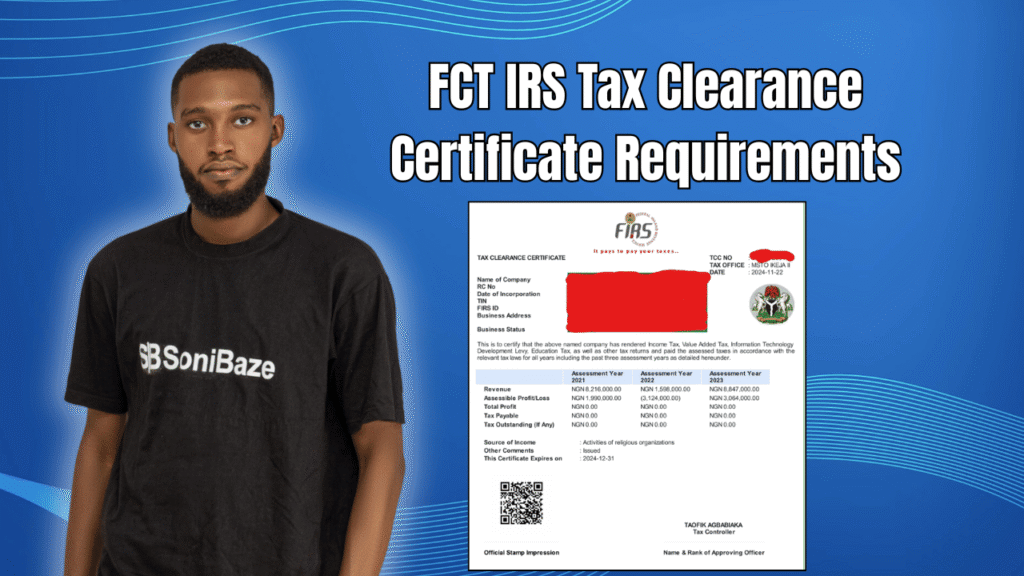
A Tax Clearance Certificate from the FCT Internal Revenue Service is one of those documents that businesses and individuals in Abuja cannot afford to ignore. It is required for government contracts, certain bank transactions, business licence renewals, and a range of other official processes. Yet the requirements for obtaining one are not always clearly laid out in one place.
This article covers the complete requirements for getting an FCT-IRS Tax Clearance Certificate, split by applicant type, so you know exactly what to prepare before you begin the process.
Obtain Your Tax Clearance Certificate (TCC)
Let us help you obtain your Tax Clearance Certificate (TCC) quickly and hassle-free. Our experts provide reliable support throughout the application process, ensuring your business meets all tax compliance requirements.
What Is the FCT-IRS Tax Clearance Certificate?
The FCT Internal Revenue Service, commonly called FCT-IRS, is the tax authority responsible for collecting personal income tax from individuals and non-corporate entities residing and operating in the Federal Capital Territory. This includes PAYE taxpayers, self-employed individuals, business names, and partnerships based in Abuja.
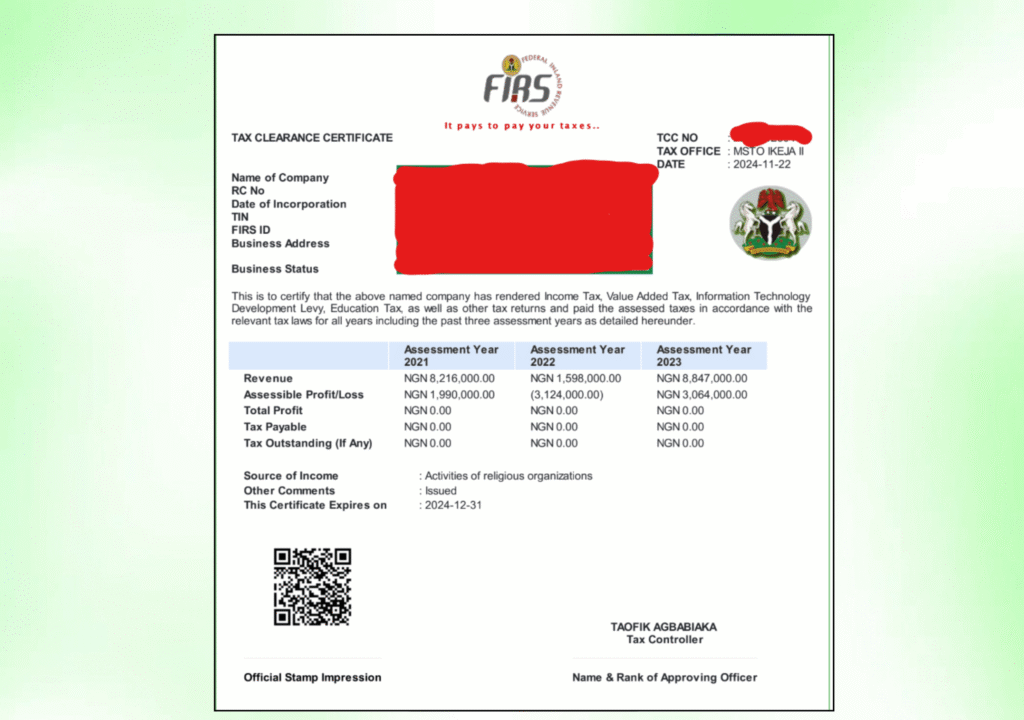
The Tax Clearance Certificate, or TCC, is the document FCT-IRS issues to confirm that a taxpayer has paid all taxes due for the three preceding years of assessment. A TCC issued in 2025, for instance, would cover the 2022, 2023, and 2024 tax years. The certificate is valid until 31 December of the year it is issued, though FCT-IRS has discretion to issue one for a shorter period.
FCT-IRS now issues an electronic TCC with a QR code, making verification faster and reducing the risk of forged certificates.
Who Gets Their TCC From FCT-IRS?
This is a point that confuses many people. Not all tax clearance certificates come from the same place.
| Applicant Type | Issuing Authority |
|---|---|
| Salaried employees (PAYE) in Abuja | FCT-IRS |
| Self-employed individuals in Abuja | FCT-IRS |
| Business names (enterprises) in Abuja | FCT-IRS |
| Partnerships in Abuja | FCT-IRS |
| Limited liability companies | Nigeria Revenue Service (formerly FIRS) |
If your business is registered as a limited liability company, your corporate Tax Clearance Certificate is processed through the Nigeria Revenue Service, not FCT-IRS. FCT-IRS handles individuals and non-corporate entities domiciled in the FCT. If you are a director of a company, you may need both a corporate TCC from the NRS and a personal TCC from FCT-IRS, and these are entirely separate applications.
Requirements: Individual and PAYE Employees
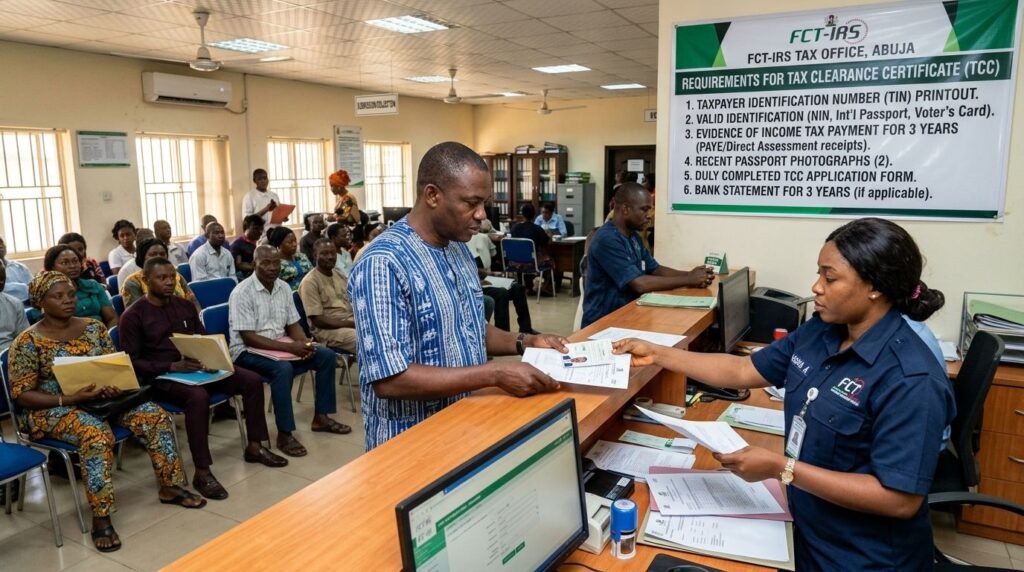
For salaried employees who pay tax through the PAYE system and individuals with personal income tax obligations in the FCT, FCT-IRS publishes an official checklist for TCC applications.
Employer Prerequisites (PAYE Applicants Only)
Before FCT-IRS will process a TCC for any employee, the employer must first be compliant. An individual’s application will not move forward if the employer has outstanding obligations.
| Employer Requirement | Details |
|---|---|
| Form H1 (Employers’ Annual Declaration) | Declares all employees and their earnings for the preceding year. Must be filed annually. Failure to submit disqualifies all listed employees from accessing TCCs |
| Form G (Employers’ Remittance Card) | Monthly PAYE remittance records showing that taxes deducted from employee salaries were actually paid to FCT-IRS |
| PAYE tax compliance | All monthly PAYE deductions must be up to date and remitted |
Individual Applicant Documents
Once employer compliance is confirmed, the individual applicant submits the following to FCT-IRS.
| Document | Details |
|---|---|
| FCT-IRS TIN | Tax Identification Number domiciled with the FCT-IRS tax office |
| Application letter | Addressed to the Tax Controller of the relevant FCT-IRS tax office (listed as optional on the official checklist) |
| Completed Form A | Personal Income Tax Annual Returns Form, including any Benefit in Kind (BIK). Downloadable from fctirs.gov.ng/downloads |
| Completed TCC Application Form (Form 802) | The official TCC application form from FCT-IRS |
| Valid means of identification | Staff ID card or other government-issued ID |
| Payslips for the previous three years | January, April, September, and December payslips only are required |
| Bank statement | Required if no payslips are available |
| Previous TCC photocopy | For renewal applications only |
| Other relevant documents | As requested by FCT-IRS on a case-by-case basis |
Obtain Your Tax Clearance Certificate (TCC)
Let us help you obtain your Tax Clearance Certificate (TCC) quickly and hassle-free. Our experts provide reliable support throughout the application process, ensuring your business meets all tax compliance requirements.
Requirements: Non-Individual Applicants (Business Names and Enterprises)
For business names, enterprises, and partnerships, FCT-IRS uses a separate TCC application form and requires a different set of documents.
| Document | Details |
|---|---|
| FCT-IRS TIN | Tax Identification Number registered with FCT-IRS |
| Non-Individual TCC Application Form | Available for download at fctirs.gov.ng/downloads under the Non-Individual section |
| CAC registration documents | Certificate of Registration for business names or relevant CAC document for the enterprise |
| Business Number (BN) | As issued by the Corporate Affairs Commission |
| Statement of income for three preceding years | The application form requires income figures covering annual turnover, gross income, expenses, tax reliefs, taxable income, and tax due for each of the three preceding assessment years |
| Evidence of tax payments | Receipts or records of personal income tax payments made for the preceding three years |
| Previous TCC | For renewal applications |
The Non-Individual TCC Application Form asks for business address details broken down by house or plot number, street, town or district, and area council within the FCT. All fields must match the business registration documents to avoid discrepancies that could trigger a query.
What the Form Covers: Income Statement Requirements
Whether you are an individual or a non-individual applicant, FCT-IRS will review your income across the three preceding assessment years. For non-individual applicants, the application form asks for the following income categories for each year.
| Income Category | Notes |
|---|---|
| Business income | Core revenue from trading or service activities |
| Partnership or venture income | Applicable to partnerships and joint ventures |
| Rent income | From property within or outside Nigeria |
| Dividends from Nigerian companies | As declared |
| Income from outside Nigeria | Including dividends from foreign companies |
| Tax reliefs applicable | Personal or business reliefs to be deducted |
| Taxable income | Net figure after expenses and reliefs |
| Tax due | Calculated liability for each year |
Accurate income declaration is critical. FCT-IRS has discretion under the FCT-IRS Act 2015 and the Personal Income Tax Act 2011 to issue or withhold a TCC based on its assessment of whether the taxpayer has adequately declared income.
How Long Does It Take?
FCT-IRS commits to issuing a TCC within a maximum of 14 calendar days from receipt of a complete application. In practice, the timeline depends on the accuracy and completeness of the documents submitted. Applications with discrepancies in income figures, missing forms, or outstanding employer PAYE obligations routinely take longer.
Renewal applications, where a previous TCC is already on file and tax payments are current, tend to move faster than first-time applications.
Where to Apply
FCT-IRS has its head office at 3 Abriba Close, Area 7, Garki, Abuja. Applications are submitted to the tax office where the applicant’s TIN is domiciled. For individuals, this is typically the tax office linked to their place of employment or residence. For business names and enterprises, it is the tax office covering their business address within the FCT.
The FCT-IRS Self Service Portal can be used to file annual tax returns. Payment of outstanding taxes is made through the Remita platform, either online or at any commercial bank.
For general enquiries, FCT-IRS can be contacted at contactus@fctirs.gov.ng.
Common Reasons Applications Are Rejected or Delayed
| Reason | How to Avoid It |
|---|---|
| Employer has not filed Form H1 | Confirm employer compliance before submitting personal TCC application |
| Outstanding PAYE remittances | Ensure all monthly remittances are up to date |
| Incomplete income declaration on Form A | Fill all sections of the form with accurate figures |
| TIN not domiciled with the correct tax office | Confirm your TIN is registered with the FCT-IRS office where you are applying |
| Missing payslips or income evidence | Prepare payslips for January, April, September, and December for each of the three years |
| Mismatch between business address and CAC records | Cross-check all details against registered documents before submitting |
Frequently Asked Questions
Does FCT-IRS issue TCC for limited liability companies?
No. Limited liability companies obtain their corporate Tax Clearance Certificate from the Nigeria Revenue Service, formerly FIRS. FCT-IRS handles individuals, PAYE employees, business names, and partnerships domiciled in the FCT. Directors of a limited liability company who also need a personal TCC would apply to FCT-IRS for that separately.
What is the validity period of an FCT-IRS TCC?
The certificate is valid until 31 December of the year it is issued. FCT-IRS has the discretion to issue a TCC for a shorter period depending on circumstances. For most compliance purposes such as government procurement and bank requirements, a TCC must be current and not expired.
Can I apply for a TCC if I have outstanding tax debt?
Outstanding tax liabilities will typically prevent FCT-IRS from issuing the certificate. The TCC is confirmation that all taxes have been settled. If there are arrears, clearing them before applying is the only way to move forward. A payment plan agreed with FCT-IRS may in some cases allow an application to proceed, but this is at the discretion of the service.
Where do I get the application forms?
All FCT-IRS TCC forms are available for download at fctirs.gov.ng/downloads. The page has separate sections for Individual forms, which include Form A and the TCC application form, and Non-Individual forms, which include the Non-Individual TCC Application Form and the Taxpayer Registration Form. Forms are also available in person at FCT-IRS tax offices.
Is the FCT-IRS TCC the same as the FIRS TCC?
No. They are different documents issued by different authorities covering different tax obligations. The FCT-IRS TCC covers personal income tax obligations within the FCT. The FIRS TCC covers corporate income tax obligations. Both may be required depending on the context in which the certificate is being used.
What happens if my employer has not filed Form H1?
An individual PAYE employee cannot obtain a TCC from FCT-IRS if their employer has not filed the Employers’ Annual Declaration, Form H1. The solution is to raise this with the employer and confirm that the form has been submitted and that all PAYE remittances are current before proceeding with a personal TCC application.
Conclusion: Prepare Documents Before Approaching FCT-IRS
The FCT-IRS Tax Clearance Certificate process is manageable when you arrive prepared. The most common delays come from missing employer forms, unfiled tax returns, and income figures that do not match what FCT-IRS has on record. Sorting those issues before submission, rather than after a rejection, is what keeps the 14-day processing window realistic.
For PAYE employees, the employer’s compliance is entirely outside your control, which means checking that your employer has filed Form H1 and remitted all PAYE deductions is the first step, not the last.
Obtain Your Tax Clearance Certificate (TCC)
Let us help you obtain your Tax Clearance Certificate (TCC) quickly and hassle-free. Our experts provide reliable support throughout the application process, ensuring your business meets all tax compliance requirements.