
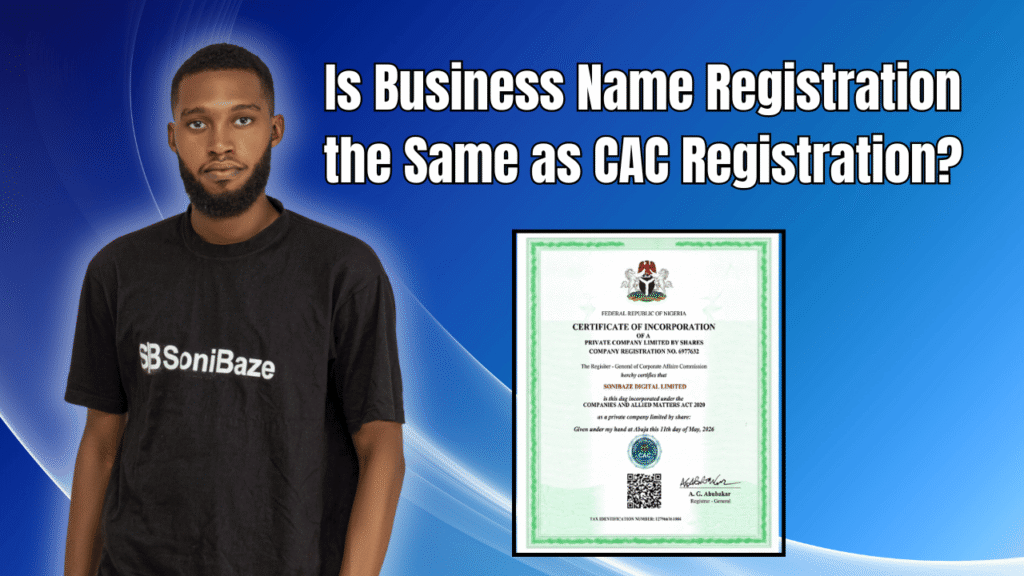
This question comes up constantly. Someone tells you to “register your business with CAC,” and you go ahead and register a business name. Later, a bank or a potential client asks for your Certificate of Incorporation, and suddenly the document you have is not what they were expecting.
The confusion is understandable. Both processes happen through the Corporate Affairs Commission. Both produce a CAC certificate. But they are not the same thing, and treating them as interchangeable can cause real problems as your business grows.

Obtain Your CAC Certificate
Let our team handle your CAC registration and help you obtain your certificate without stress. From business name registration to company incorporation.
What Is the CAC?
The Corporate Affairs Commission is the legal body authorised with the obligation to regulate the management and formation of companies and businesses in Nigeria. It was established under the Companies and Allied Matters Act, now updated as CAMA 2020, and every business registration in Nigeria, regardless of type, goes through the CAC.
So when someone says “CAC registration,” they are referring to the platform and process. They are not describing a specific type of registration. That distinction matters.
What Is Business Name Registration?
A business name refers to a name, other than one’s natural name, under which a person carries on business. Sole proprietorships and general partnerships often opt for this business name structure.
When you register a business name with the CAC, you are essentially telling the Nigerian government: this is the trading name under which I, as an individual, will do business. The business and the person remain legally the same. You own the business, you owe its debts, and you are personally liable for everything that happens in its name.
Upon registration, the proprietor is issued a Certificate of Registration of Business Name and an Application for Registration of Business, also known as a Status Report. These documents are legitimate and recognised, but they are not the same as a Certificate of Incorporation.
The base fee for business name registration is ₦10,000. In practice, a business owner can spend up to ₦20,000 in total, including name reservation and small incidental costs. Processing typically takes three to five working days.

What Is Company Registration?
Company registration, most commonly as a Private Limited Liability Company, is a different process entirely. A company is a separate legal entity different from its owners. Section 42 of CAMA 2020 confers a separate legal personality on a company, which means it can sue, be sued, own assets, and continue existing independently of its owners.
Upon incorporation, a company receives a Certificate of Incorporation, its Memorandum and Articles of Association, and a Status Report from the CAC. These are the documents that banks, government agencies, and serious corporate clients typically ask for when they say “CAC registration.”
The cost of registering a private limited liability company starts at ₦10,000 for businesses with a minimum share capital of up to ₦1 million, with additional fees applying as share capital increases. CAC registration for a company typically takes between five and fifteen working days.
The Key Differences Side by Side
| Feature | Business Name | Limited Liability Company |
|---|---|---|
| Legal personality | Not separate from owner | Separate legal entity under CAMA 2020 |
| Liability | Unlimited personal liability | Limited to share capital |
| Document issued | Certificate of Registration of Business Name | Certificate of Incorporation |
| Tax treatment | Personal Income Tax Act (PITA) | Companies Income Tax Act (CITA) |
| Ownership structure | Sole proprietor or partnership | Shareholders and directors |
| Compliance requirements | Annual Returns filing | Annual Returns, AGMs, statutory records |
| Government contracts | Lower priority | Higher priority in procurement |
| Ability to raise capital | Very limited | Can raise through shares |
| Processing time | 3–5 working days | 5–15 working days |
Why the Confusion Exists
Both registrations are done on the same CAC portal. Both produce a certificate. Both cost similar amounts at the base level. And in everyday conversation, most people refer to either process as “CAC registration,” which blurs the line further.
The confusion becomes a real problem when a business has been operating under a business name for years, then suddenly needs a Certificate of Incorporation to bid for a government contract, open a corporate account at certain banks, or attract a serious investor. You cannot directly convert a Business Name into a Limited Liability Company. To upgrade, you must register a new company with CAC and then transition your business operations, banking, contracts, and branding, from the business name to the new company.
That transition is not complicated, but it takes time and effort. Businesses that start with the right structure from the beginning avoid the disruption entirely.
Obtain Your CAC Certificate
Let our team handle your CAC registration and help you obtain your certificate without stress. From business name registration to company incorporation.
Which One Should You Register?
The honest answer depends on what you are building and who you plan to sell to.
A business name works well if you are a freelancer, a small trader, a local services provider, or someone testing a new idea. It is cheaper, faster, and comes with fewer compliance obligations. Business names are not required to hold meetings before making business decisions, and compliance requirements are simpler overall.
A limited liability company makes more sense if you plan to bid for government contracts, work with corporate clients, raise external investment, or build a business that can eventually operate independently of you as the founder. Companies are generally given higher priority in the award of government contracts, dealings with large organisations, and international business transactions.
A practical guide: if the people you want to sell to regularly ask for a “Certificate of Incorporation,” start with a company. If your clients are individuals or small businesses who will not ask that question, a business name may be enough for now.
Can You Have Both?
Yes. Nothing stops you from registering a business name and a company at the same time, or registering a business name first and incorporating a company later. There is no limit to how many business names you can register, and each requires a separate registration.
Some entrepreneurs maintain a business name for personal projects or side income while operating a separate limited company for their main business. Others register a business name early to secure a trading name they intend to use for a company they plan to incorporate later.
Frequently Asked Questions
If I register a business name with the CAC, am I officially a registered company?
No. A business name registration does not incorporate a company. It registers you as a sole proprietor or partnership trading under a specific name. The legal structure is entirely different from a limited liability company, and the documents you receive are different as well.
Does a business name registration protect my business name from being used by others?
Within the CAC’s database, yes. Once your business name is registered, the CAC will not approve a registration for a name that is identical or confusingly similar. However, the protection is limited compared to trademark registration, and a business name does not carry the broader legal protections that a registered company enjoys under CAMA 2020.
Can a business name open a corporate bank account in Nigeria?
Many banks will open a business account for a registered business name, though the requirements vary by bank. Some banks require a Certificate of Incorporation and insist on dealing only with limited companies for certain account types. If banking access is a concern, confirm your chosen bank’s requirements before deciding on a structure.
Is it more expensive to register a company than a business name?
At the base level, the registration fee for a private limited company with share capital of up to ₦1 million is ₦10,000, the same as a business name. The total cost becomes higher once you factor in name reservation, stamp duties, and the Memorandum and Articles of Association, which a business name registration does not require. Most businesses use a consultant for company registration, which adds a service fee on top of the statutory costs.
How do I know which type of CAC document I have?
Check the title on your certificate. A Certificate of Incorporation means you have a registered limited liability company. A Certificate of Registration of Business Name means you have a business name registration. These are different documents and are not interchangeable.
Can I bid for government contracts with a business name registration?
Technically, a registered business name can bid for certain contracts, but in practice, government procurement in Nigeria strongly favours incorporated companies. Many tenders specifically require a Certificate of Incorporation, and some compliance certificates such as PENCOM and ITF registration carry more weight when associated with a registered company. If government contracting is part of your plan, incorporating is the more practical starting point.
Conclusion: Same Platform, Different Outcomes
Both business name registration and company registration happen through the CAC. That is where the similarity ends. The legal protections, the documents issued, the tax treatment, the compliance requirements, and the doors each structure opens are all different.
Most Nigerian business owners start with a business name because it is faster and cheaper. That is a sensible choice early on. The important thing is understanding what you have and what it can and cannot do, rather than discovering the gap at a moment when a contract or banking requirement makes it urgent.
Obtain Your CAC Certificate
Let our team handle your CAC registration and help you obtain your certificate without stress. From business name registration to company incorporation.