

Many IT professionals in Nigeria know CPN exists. Fewer have actually registered. The question of whether registration is truly mandatory, or just one of those requirements that sounds official but nobody enforces, comes up regularly in tech communities across the country.
The honest answer is that the law says yes. Whether enforcement has kept pace with the law is a different conversation, and one that is changing fast.
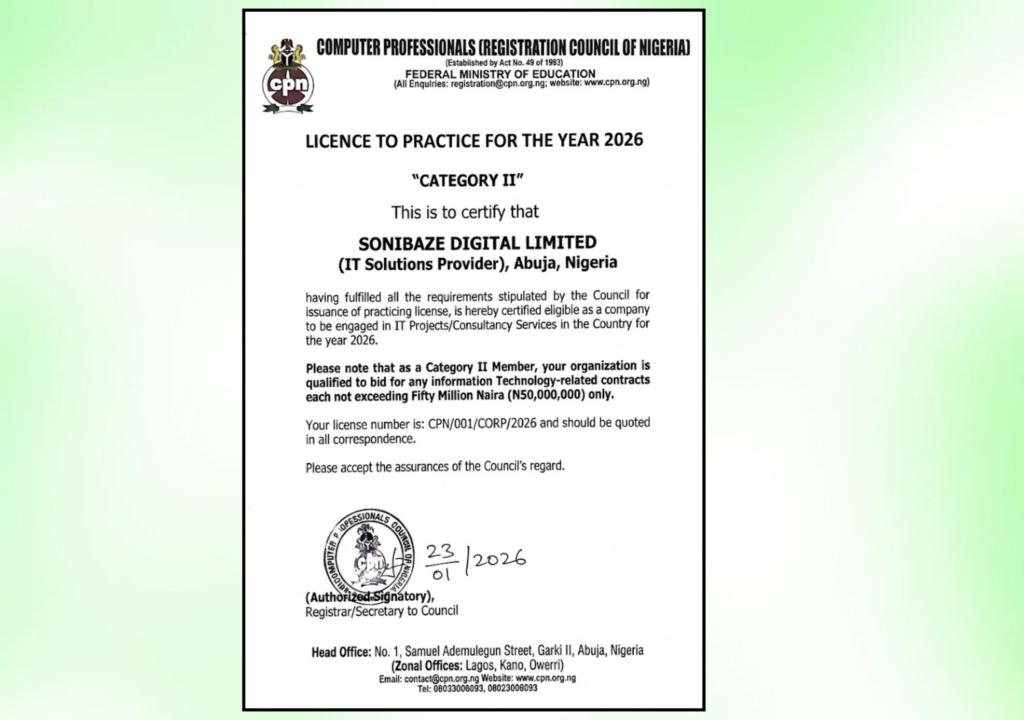
Obtain Your CPN certificate
Let us help you obtain your Computer Professionals Registration Council of Nigeria (CPN) Certification with ease. Our experts provide guidance throughout the application process, helping you achieve professional recognition and compliance.
What the Law Actually Says
The Computer Professionals Registration Council of Nigeria was established by Decree No. 49 of 1993, which later became an Act of the National Assembly. That Act does not frame CPN registration as optional.
According to the CPN Act, all persons and organisations involved in the sale or use of computing facilities, IT education, and professional computing services are mandated by law to register with the Council and obtain valid operational licences. The CPN president reinforced this in May 2026, stating plainly that “it is illegal to engage in computing and professional practice without registration and possession of a current valid license.”
That language is about as unambiguous as regulatory statements get.
Why Many IT Professionals Haven’t Registered
The gap between what the law says and what happens in practice has been wide for a long time. A developer building apps for private clients, a systems administrator working in a corporate IT department, or a freelance web designer has been able to operate without a CPN licence for years without facing any direct consequence.
Part of the reason is enforcement. Until recently, CPN’s capacity to identify and act against unregistered practitioners was limited. The other part is awareness. Many IT professionals simply do not know the requirement exists, and nobody told them when they started out.
That picture is shifting, and the shift is deliberate.

Enforcement Is Getting Stricter
In 2024, the Federal Ministry of Education directed CPN to enforce compliance with registration requirements. The CPN was tasked with identifying and prosecuting unregistered IT practitioners, including individuals and organisations, and the Minister warned that anyone found practising IT without proper registration would face the full weight of the law.
By May 2026, CPN had moved from making statements to issuing direct warnings. The CPN president announced that the council would not tolerate unlicensed practice in the sector and that regulatory enforcement would be strengthened in line with its statutory mandate.
This is not a future policy direction. It is happening now. IT professionals who have been comfortable operating without registration because nobody was checking are operating in a different environment than they were two years ago.
What “Mandatory” Looks Like in Practice
There are two ways CPN registration becomes practically mandatory, even if enforcement is imperfect.
The first is government contracts. Federal and state procurement processes for IT projects routinely require CPN registration on tender checklists. Without it, a bid is disqualified before technical evaluation begins. For freelancers and IT businesses that want to work with government clients, registration is effectively a prerequisite.
The second is professional legitimacy. CPN is the only body in Nigeria authorised by the government to license and issue the Chartered Information Technology Practitioner designation to IT professionals. If you want the highest formal recognition of your professional status as an IT practitioner in Nigeria, there is no alternative route.
Who the Requirement Covers
The scope of CPN’s mandate is broad. The council’s responsibilities include accreditation of computing programmes in tertiary institutions, evaluation of certificates, conduct of professional examinations, enforcement of ethical standards, registration of practitioners, and supervision of computing practice nationwide.
On the practitioner side, this covers software developers, systems analysts, network engineers, IT consultants, database administrators, IT trainers, and organisations selling or providing computing services. It is not limited to people with computer science degrees. It covers anyone practicing professionally in the computing field.
Obtain Your CPN certificate
Let us help you obtain your Computer Professionals Registration Council of Nigeria (CPN) Certification with ease. Our experts provide guidance throughout the application process, helping you achieve professional recognition and compliance.
The Argument Some Professionals Make
Some IT professionals argue that CPN registration is irrelevant to their work because they operate outside government procurement, their clients have never asked for it, and their skills speak for themselves through the products and systems they build.
That argument has some practical truth to it in sectors where CPN enforcement is still limited. But it is worth being clear about what it actually is: a calculation about the current risk of enforcement, not a claim that the legal obligation does not exist.
The calculation is also getting riskier. As CPN intensifies its enforcement drive and awareness grows among procurement officers and corporate clients, the number of situations where registration absence becomes a problem will increase, not decrease.
Is There Any Exemption?
The CPN Act does not carve out exemptions based on business size, client type, or the informal nature of an arrangement. The requirement applies to individuals and organisations engaged in computing practice, full stop.
The practical reality is that a student learning to code or someone building a personal project for fun is not the target of enforcement. The focus is on professional practice, meaning people who are being paid or who are deriving a livelihood from computing activities.
Mandatory vs Enforced: The Honest Position
| Aspect | Reality |
|---|---|
| Legal obligation to register | Yes, under the CPN Act |
| Historical enforcement | Inconsistent and limited |
| Current enforcement direction | Actively strengthening since 2024 |
| Practical impact for government contracts | Registration required on procurement checklists |
| Practical impact for private sector work | Growing, especially for larger organisations |
| Risk of operating unregistered | Lower than the law implies, but increasing |
Frequently Asked Questions
Can I legally operate as an IT professional in Nigeria without CPN registration?
Strictly speaking, no. The CPN Act makes registration mandatory for anyone engaged in professional computing practice. In practice, enforcement has historically been limited, but CPN is actively strengthening its compliance drive as of 2025 and 2026, so the practical risk of operating unregistered is increasing.
What happens if I practice IT in Nigeria without CPN registration?
The CPN Act and its enforcement machinery allow CPN to identify and prosecute unregistered practitioners. The Federal Ministry of Education has directed CPN to pursue non-compliant individuals and organisations. Beyond legal risk, unregistered practitioners can be disqualified from government contracts and may face reputational issues as CPN awareness grows in corporate procurement.
Does CPN registration apply to foreign IT companies operating in Nigeria?
Yes. Any organisation providing computing services in Nigeria falls within CPN’s mandate, regardless of where it is headquartered. Foreign IT companies operating commercially in Nigeria are expected to obtain CPN corporate registration.
I have an international IT certification. Does that replace CPN registration?
No. International certifications like AWS, Microsoft, Cisco, or CompTIA are widely respected and career-relevant, but they do not substitute for CPN registration. CPN is the statutory Nigerian regulatory body. Its registration requirement exists separately from any professional certification, whether local or international.
How do I know if my specific role requires CPN registration?
If your work involves developing software, managing IT infrastructure, providing IT consulting services, delivering IT training, or any other form of professional computing practice in Nigeria, you fall within CPN’s scope. The Act’s language covers anyone involved in the sale or use of computing services professionally.
Is CPN registration a one-time requirement?
No. CPN registration involves an initial application and certificate, but maintaining licensed practitioner status requires an annual licence fee renewal. Letting this renewal lapse means your licence is no longer current, even though your original registration record remains.
Conclusion: The Law Says Yes. The Trend Confirms It.
The question of whether CPN registration is mandatory has a clear legal answer. It is. The more practical question, whether the consequences of non-compliance are real and immediate, is one that depends on what kind of IT work you do and who your clients are.
For IT professionals targeting government contracts, the answer has always been that registration is non-negotiable. For those in the private sector, enforcement has historically been softer. That is changing, and the direction is clearly toward stricter compliance, not more flexibility.
Registering now rather than waiting for enforcement to reach you is the lower-risk position, and for IT professionals building a long-term career in Nigeria, it is the professional standard the country is moving toward.
Obtain Your CPN certificate
Let us help you obtain your Computer Professionals Registration Council of Nigeria (CPN) Certification with ease. Our experts provide guidance throughout the application process, helping you achieve professional recognition and compliance.