Radio advertising is still one of the most effective ways to reach Nigerians. Over 127 million people tune in to terrestrial radio stations across the country, and in cities like Lagos, Abuja, and Port Harcourt, morning commute hours alone deliver audiences that most businesses can only dream of through digital channels. But the pricing is murky. Stations rarely publish updated rate cards publicly, and the figures circulating online are often years out of date.
This article covers what radio advertising costs in Nigeria in 2026, how rates vary by station, time slot, and ad format, and what you actually need to budget before walking into a media booking conversation.
Get your brand on air across Abuja radio stations and beyond with powerful radio ads.
Why Radio Advertising Rates Vary So Much in Nigeria
Ask three different media buyers for a quote on the same station and you will likely get three different numbers. That is not accidental.
Radio advertising in Nigeria is priced dynamically. Stations adjust their rates based on demand, the time of year, whether you are buying directly or through an agency, and how much airtime you are committing to. A brand booking 30 spots a week across three months will negotiate a very different rate than one buying five spots on a weekend.
The market is also split between national and local stations. A national network like Cool FM, which broadcasts across Lagos, Abuja, and Kano, charges syndicated rates that are significantly higher than a single-city station like Rhythm 93.7 or Wazobia FM Abuja. Understanding this distinction before you start budgeting will save you from getting surprised when quotes come in.
Factors That Determine How Much You Pay
Station Reach and Audience Size
High-reach stations charge more. Cool FM, Wazobia FM, Beat FM, and Nigeria Info FM command premium rates because they have large, loyal listener bases with documented demographics. A smaller community or state radio station in Kogi or Ekiti will charge a fraction of what Lagos or Abuja stations charge, but the audience reflects that.
Time of Day: Peak vs Off-Peak
Peak hours are 6am to 11am and 4pm to 7pm on weekdays. These are the most expensive slots on any station because that is when the most people are listening, typically during their morning and evening commutes.
Off-peak runs roughly from 11am to 3pm and after 9pm. Prices drop by 10 to 25 percent during these windows. For businesses targeting stay-at-home audiences, small business owners, or less time-sensitive products, off-peak spots can deliver solid value at a lower rate.
Ad Format and Duration
Not all radio ads are the same. A 60-second spot costs more than a 30-second one. A live read by the on-air presenter costs more than a pre-recorded jingle. Programme sponsorship, where your brand is mentioned as a sponsor of a specific show, sits at a different price point entirely.
The main formats and their general price implications are covered in the rate tables below.
Production Costs
Most stations have in-house production teams that can write a script, record a voiceover, and produce a finished jingle. Jingle production at major stations runs between ₦40,000 and ₦120,000 depending on complexity. If you bring in a fully produced ad, production costs are not added. But if you need the station to produce it, factor that into your total campaign spend.
Direct Booking vs Media Agency
Booking directly through a station sales team is possible, but a media buying agency can often negotiate package rates and added-value spots that offset their commission. For campaigns running across multiple stations or cities, using a media buyer almost always works out more efficiently in terms of cost per spot.
Radio Advert Spot Rates in Nigeria: 2026 Price Guide
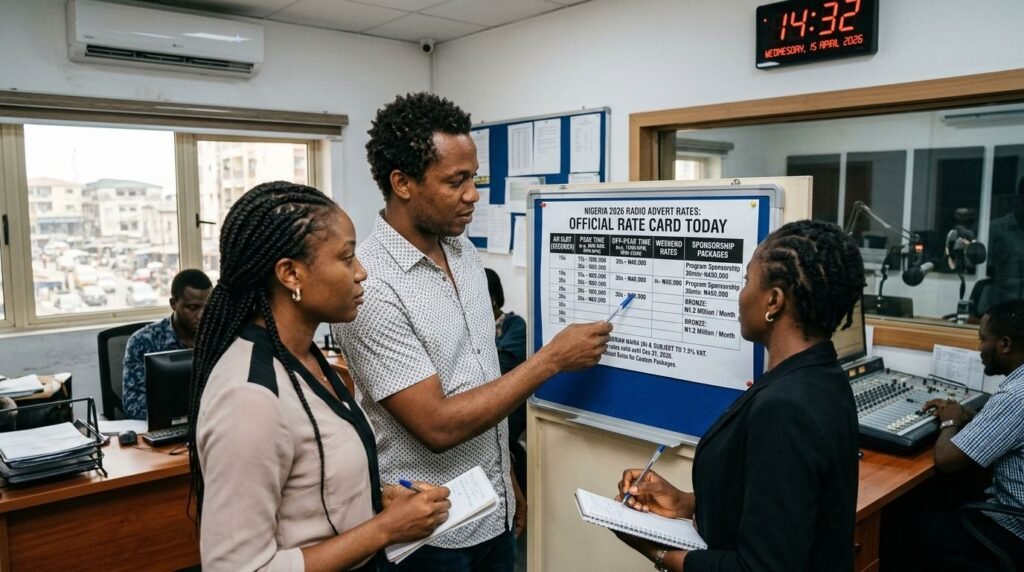
The figures below reflect current market rates across major Nigerian stations based on available rate cards and market pricing. All figures exclude VAT (7.5%) unless stated otherwise. Prices are indicative ranges. Final rates depend on the specific station, negotiation, and campaign volume.
Spot Placement Rates (Per Airtime Spot)
| Ad Duration | Peak Period | Off-Peak Period |
|---|---|---|
| 60 seconds | ₦25,000 – ₦85,000 | ₦20,000 – ₦65,000 |
| 45 seconds | ₦20,000 – ₦68,000 | ₦16,000 – ₦52,000 |
| 30 seconds | ₦15,000 – ₦55,000 | ₦12,000 – ₦42,000 |
| 15 seconds | ₦10,000 – ₦38,000 | ₦8,000 – ₦28,000 |
These are per-spot rates for pre-recorded adverts. Peak period rates apply during morning drive (6am to 11am) and evening drive (4pm to 7pm).
Programme Sponsorship Rates (Airtime Only)
| Sponsorship Duration | Peak Period | Off-Peak Period |
|---|---|---|
| 60 minutes | ₦180,000 – ₦420,000 | ₦150,000 – ₦320,000 |
| 30 minutes | ₦100,000 – ₦230,000 | ₦85,000 – ₦175,000 |
| 15 minutes | ₦60,000 – ₦130,000 | ₦50,000 – ₦100,000 |
Programme sponsorship means your brand is tied to a specific show. You get opening and closing mentions, and often mid-show tags. This format builds stronger brand association than individual spot placement.
Personal Paid Announcements (PPAs)
PPAs are short announcements read by a presenter or broadcast as a produced audio clip. They are priced by word count.
| Word Count | Peak Period | Off-Peak Period |
|---|---|---|
| 1 – 50 words | ₦18,000 – ₦32,000 | ₦14,000 – ₦25,000 |
| 51 – 75 words | ₦22,000 – ₦40,000 | ₦18,000 – ₦32,000 |
| 76 – 100 words | ₦28,000 – ₦48,000 | ₦22,000 – ₦38,000 |
Live Appearances and On-Air Hypes
| Format | Rate Range |
|---|---|
| Live appearance (60 minutes) | ₦300,000 – ₦700,000 |
| Live appearance (30 minutes) | ₦180,000 – ₦400,000 |
| Live appearance (15 minutes) | ₦100,000 – ₦200,000 |
| 2-minute on-air hype/mention | ₦55,000 – ₦110,000 |
| 5-second station check/mention | ₦14,000 – ₦25,000 |
News Coverage Rates
| Format | Rate Range |
|---|---|
| Commercial news item | ₦75,000 – ₦130,000 |
| News coverage (correspondent visit) | ₦110,000 – ₦200,000 |
| News sponsorship | Negotiable |
Production Costs
| Service | Rate Range |
|---|---|
| Jingle production (basic) | ₦40,000 – ₦75,000 |
| Jingle production (full production with music) | ₦80,000 – ₦150,000 |
| Script writing | ₦15,000 – ₦35,000 |
| Programme production | ₦35,000 – ₦70,000 |
Station Tier Breakdown: What You Pay at Each Level
Nigerian radio stations operate across tiers. Where a station sits in the market determines how its rates are set.
| Station Tier | Examples | 60-Second Peak Spot | Audience Profile |
|---|---|---|---|
| Tier 1 (National network) | Cool FM, Wazobia FM, Beat FM | ₦55,000 – ₦85,000 | Urban, 18-45, national reach |
| Tier 2 (Major city, high reach) | Nigeria Info FM, Rhythm FM, Smooth FM | ₦35,000 – ₦60,000 | City-specific, professional audience |
| Tier 3 (Mid-size city stations) | Brila FM, City FM, Naija FM | ₦20,000 – ₦40,000 | Targeted local audience |
| Tier 4 (Community/state radio) | State government stations, local FM | ₦8,000 – ₦20,000 | Hyper-local, language-specific |
Syndicated rates for national campaigns across multiple Cool FM or Wazobia FM stations (Lagos, Abuja, Kano, Port Harcourt) are priced separately and are significantly higher. A 60-second syndicated spot across four Cool FM cities can run from ₦120,000 to ₦200,000 per broadcast.

How Much Does a Full Radio Campaign Cost in Nigeria?
Single spots rarely make an impact. Radio advertising works through repetition. A practical campaign runs a minimum of 10 to 15 spots per week over four weeks.
| Campaign Scale | Weekly Spots | Estimated Monthly Cost |
|---|---|---|
| Entry-level (one station, off-peak) | 10 spots per week | ₦400,000 – ₦800,000 |
| Standard (one station, mixed peak/off-peak) | 20 spots per week | ₦900,000 – ₦1,800,000 |
| Multi-city (two to three stations) | 15 spots per week per station | ₦2,500,000 – ₦5,000,000 |
| National campaign (syndicated network) | 20 spots per week, syndicated | ₦6,000,000 – ₦15,000,000+ |
These estimates exclude production costs. If you are producing a jingle from scratch, add ₦80,000 to ₦150,000 to your budget.
Abuja-Specific Radio Stations and What They Charge
Abuja has a strong radio market. Several stations target the FCT’s predominantly professional and government-adjacent audience.
| Station | Format | Peak 60-Sec Spot (Est.) |
|---|---|---|
| Cool FM 96.9 Abuja | Contemporary hit radio, 15-45 audience | ₦45,000 – ₦70,000 |
| Nigeria Info FM 95.1 Abuja | News and talk radio | ₦40,000 – ₦65,000 |
| Wazobia FM 99.5 Abuja | Pidgin-English entertainment | ₦35,000 – ₦55,000 |
| Brilla FM 88.9 Abuja | Sports radio | ₦25,000 – ₦45,000 |
| FRCN Radio Nigeria | National broadcaster, Abuja | ₦20,000 – ₦40,000 |
Abuja stations tend to have a smaller but more affluent and educated listener base compared to Lagos equivalents. For businesses targeting civil servants, government contractors, real estate buyers, or the professional class, Abuja radio delivers a focused audience that other media channels have a harder time reaching at this price point.
How to Know If You Are Being Overcharged
A few signs that a quoted rate is inflated.
If a station quotes you a flat per-spot rate without distinguishing between peak and off-peak, they are either simplifying or padding. Legitimate stations have separate rates for different day parts. Ask to see the rate card.
A quote with no VAT line item is suspicious. All commercial advertising in Nigeria attracts 7.5% VAT. If the quote includes VAT and the rate still seems high, ask for a package discount. Stations almost always have room to negotiate if you are committing to a multi-week campaign.
Watch for production costs bundled into spot rates without explanation. Jingle production and airtime are separate line items. If they are presented together as a single number, ask for the breakdown before signing anything.
Finally, if you are quoted a rate significantly above the ranges in this article for a mid-size or regional station, use the figures here as a reference point in your negotiation. Rates have been verified against current market data and should reflect what most stations are actively charging in 2026.
Get your brand on air across Abuja radio stations and beyond with powerful radio ads.
Radio vs Digital: A Practical Comparison for Nigerian Businesses
Some business owners view radio and digital advertising as competing budget items. They are not. They complement each other.
Radio builds awareness fast, particularly in markets where internet access or smartphone ownership is still limited. A jingle for a consumer product broadcast on Wazobia FM can reach millions of Nigerians who may never see your Instagram ad. Digital campaigns, handled well by an agency like SoniBaze Digital, then capture the search traffic and social engagement generated by that radio awareness.
The two work best together. Budget for radio when you need mass local reach quickly. Budget for digital when you want precision targeting, lead generation, and trackable conversions.
| Criteria | Radio Advertising | Digital Advertising |
|---|---|---|
| Speed of reach | Fast, broad audience immediately | Builds over time (SEO) or immediate (paid ads) |
| Targeting precision | Low to medium (station format and time slot) | High (age, location, interest, behaviour) |
| Cost to start | ₦400,000+ per month for basic campaign | From ₦50,000/month depending on channel |
| Measurability | Limited (reach estimates, listenership data) | High (impressions, clicks, conversions) |
| Brand recall | High (repetition and audio branding) | Medium (depends on creative) |
| Best for | Consumer products, events, mass market launches | Lead generation, e-commerce, B2B, retargeting |
Frequently Asked Questions
How much does a radio advert cost in Nigeria in 2026?
A single 60-second spot on a major station in Lagos or Abuja during peak hours costs between ₦45,000 and ₦85,000. Off-peak rates on the same stations run from ₦20,000 to ₦65,000. Smaller city and community stations charge between ₦8,000 and ₦35,000 per spot. A realistic monthly campaign budget covering one station at 10 to 20 spots per week starts from around ₦400,000 and goes up quickly from there.
Which Nigerian radio station has the highest advertising rates?
Cool FM consistently commands the highest rates among commercial stations, particularly for the Lagos, Abuja, and Kano network. Syndicated national campaigns across all Cool FM cities can reach ₦120,000 to ₦200,000 per 60-second spot. Wazobia FM and Beat FM follow at similar national rate levels. Nigeria Info FM is priced slightly lower but targets a valuable professional and politically engaged audience.
Can I negotiate radio advert rates in Nigeria?
Yes, and you should. Almost all stations accept negotiation, particularly for volume bookings. Committing to a four-week or three-month package will almost always get you a better per-spot rate than booking individual spots. Buying directly from the station sales team avoids agency commission, but a media buying agency can sometimes access bulk rates that more than compensate for their fee. Always ask what added-value spots or bonus placements come with a package before agreeing.
When is the best time to run a radio advert in Nigeria?
Morning drive time from 6am to 10am delivers the highest listener numbers on most stations. It is also the most expensive window. Evening drive from 4pm to 7pm is the second most valuable slot. For consumer products, both windows work well. For business-to-business advertising, mid-morning slots between 9am and 11am can deliver a high proportion of decision-makers who are desk-bound and listening through office or computer speakers.
Do I need to produce a jingle before booking radio airtime in Nigeria?
No. Most major stations offer in-house production services. For a basic voiceover ad, production can be done within two to three working days at costs ranging from ₦40,000 to ₦75,000. If you want a fully produced jingle with background music, vocals, and audio branding, budget ₦80,000 to ₦150,000 and allow up to a week for production. Some stations waive or discount production costs for long-term advertisers. Ask about this during your booking conversation.
Is radio advertising still worth it in Nigeria in 2026?
For mass-market consumer products, event promotion, and building brand awareness in cities and across rural Nigeria, radio remains one of the most cost-effective channels available. With 127 million listeners across the country and average ad spend per listener still below $1, the cost-per-thousand-impressions on radio compares favourably with digital channels. For businesses that need precise targeting, conversion tracking, or lead generation, digital advertising delivers more measurable results. The strongest campaigns typically run both.
Conclusion: Budget for Radio Like a Media Professional
Radio advertising in Nigeria rewards people who plan. Walk in without a clear campaign brief, a realistic budget, and an understanding of the rate structure, and you will either overpay or underspend and wonder why the campaign did not move the needle.
Use the rates in this guide as your baseline. Know which tier of station matches your budget and target audience. Decide whether you need peak or off-peak spots, whether you want spot placement or programme sponsorship, and what production you require. Then negotiate.
If you are running a campaign that combines radio awareness with digital follow-through, getting both sides of that strategy right is the difference between advertising spend and advertising investment.
Get your brand on air across Abuja radio stations and beyond with powerful radio ads.