
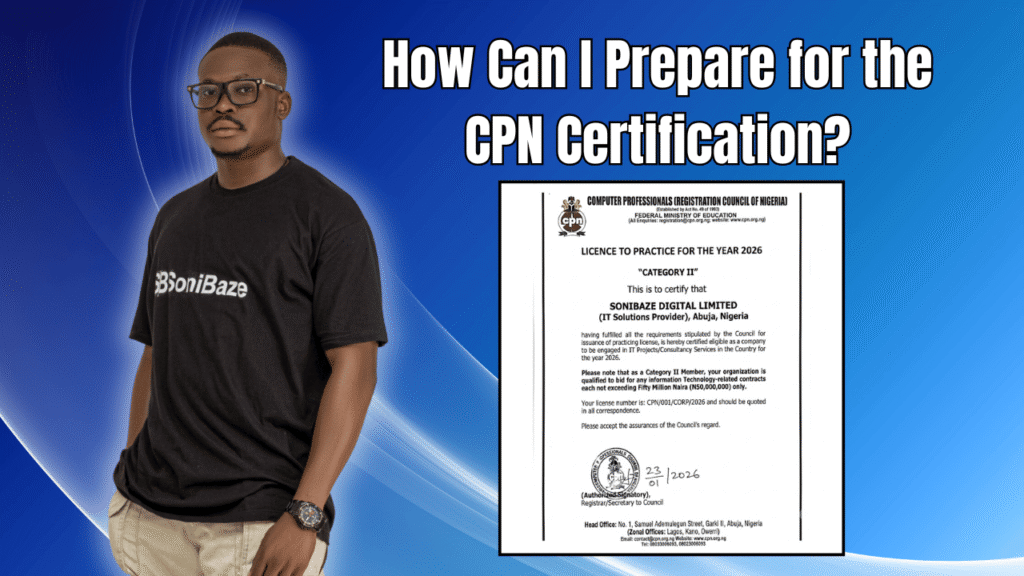
Getting a CPN certification is one of the clearest ways to establish yourself as a recognised computing professional in Nigeria. The exam route, known as the Computer Professional Examination or CPE, is what most IT practitioners without a formal university computing degree rely on to gain professional standing. Even those with degrees sometimes sit specific CPE stages to qualify for higher membership grades.
But preparation matters. The exam is not a formality. This guide walks through everything you need to know before you sit the CPN certification examination, from understanding which exam level applies to you, to what the papers cover and how to structure your study.
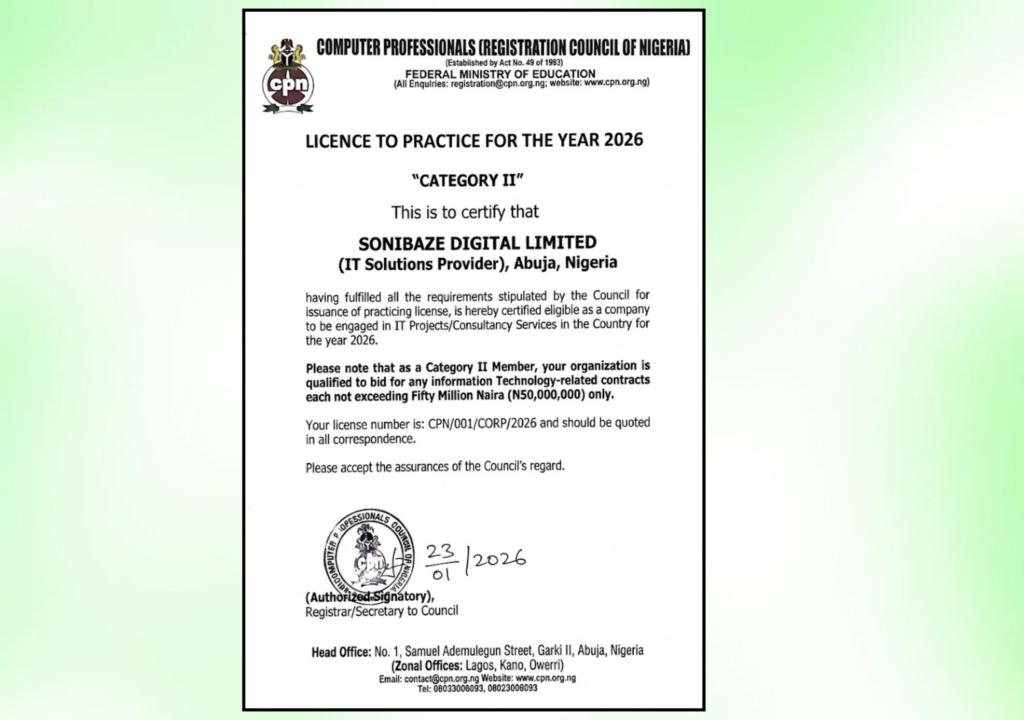
Obtain Your CPN certificate
Let us help you obtain your Computer Professionals Registration Council of Nigeria (CPN) Certification with ease. Our experts provide guidance throughout the application process, helping you achieve professional recognition and compliance.
What Is the CPN Certification Examination?
The Computer Professional Examination, conducted by the Computer Professionals Registration Council of Nigeria, is a structured professional qualification pathway. It allows IT practitioners to earn formal recognition as computing professionals even when their academic background is not in computer science.
The exam also gives room to those who have not gained admission into tertiary institutions but are working in or aspiring to work in the computing profession. Passing the relevant CPE stage qualifies a candidate for a specific membership grade within CPN, and each grade carries professional recognition in the Nigerian IT industry.
CPN’s own framework aligns the CPE certificates with equivalent academic qualifications as follows:
| CPE Stage | Equivalent Academic Level |
|---|---|
| CPN Foundation Certificate | SSCE (Senior Secondary) |
| CPE Stage I Certificate | OND |
| CPE Stage II Certificate | HND or BSc |
| CPE Stage III Certificate | Master’s degree level |
This alignment means CPE qualifications, when assessed by international credentials evaluation agencies, are recognised and accepted outside Nigeria as well.
Which CPE Stage Should You Register For?
The stage you register for depends on your academic background and your NYSC status. Getting this right before registration saves you from either starting below your level or attempting an exam you are not ready for.
| Your Situation | CPE Stage to Register |
|---|---|
| No formal computing qualification, SSCE only | Start from CPE Stage I |
| OND in computing or related field | May qualify for CPE Stage II |
| Graduate from 2013 onwards, with CPN induction at school | Start from CPE Stage II |
| Graduate from 2013 onwards, without CPN induction at school | Start from CPE Stage I |
| Graduate from 2010 to 2012 | Start from CPE Stage II |
| Associate member seeking upgrade to Full membership | Write CPE Stage III |
| ERP attendee (NYSC 2016-2017) seeking Full membership | Write CPE Stage III |
If you are unsure which stage applies to you, contact the CPN secretariat directly at info@cpn.gov.ng or call the head office in Gudu District, Abuja before submitting your application.
What Topics Does the CPN Exam Cover?
The examination covers a wide range of computing subjects. While the specific papers vary by stage, the general subject areas across the CPE examinations include programming, computer networking, database management, information security, and software engineering. CPN publishes a reviewed examination syllabus, last significantly updated in 2021, which is the authoritative source for what each stage covers.
The broad subject areas to build your knowledge around include the following:
| Subject Area | What to Focus On |
|---|---|
| Programming and software development | Core programming concepts, algorithms, data structures, software development lifecycle |
| Computer networking | Network types, protocols (TCP/IP, HTTP, DNS), OSI model, network security basics |
| Database management | Database design, SQL, normalisation, DBMS concepts |
| Information security | Cybersecurity principles, encryption, access control, threats and countermeasures |
| Software engineering | Requirements analysis, system design, testing methodologies, project management |
| Computer hardware and systems | System architecture, operating systems, maintenance concepts |
| IT ethics and professionalism | CPN code of conduct, professional responsibilities, legal frameworks governing IT in Nigeria |
Download the current CPN examination syllabus directly from cpn.gov.ng before you start studying. The syllabus is the most reliable guide to what each paper covers at your specific stage.
Step-by-Step: How to Prepare for the CPN Exam
Step 1: Confirm Your Eligibility and Register
Before you buy a single textbook, confirm which CPE stage you qualify for and complete your registration. The exam registration form costs ₦2,000. Sit down, check the table above, and if anything is unclear, call CPN directly. Registering for the wrong stage wastes time and money.
Once confirmed, submit your examination registration through the CPN portal or at the secretariat, and keep a copy of your registration acknowledgment.
Step 2: Obtain the Official Syllabus
Download the CPN examination syllabus from cpn.gov.ng. This document tells you exactly what topics are examinable at your stage. Everything else in your preparation should be built around this syllabus. Do not rely on someone else’s notes or a secondhand summary of what they covered when they sat the exam. Get the official document and use it as your roadmap.
Step 3: Gather Past Questions
Past examination questions are one of the most effective preparation tools for CPE. They reveal the pattern of how questions are framed, how deep the expected answers go, and which topics tend to recur across multiple sittings. Past questions for CPN are available through exam resource platforms like exampastquestions.com, and through peer networks of professionals who have already passed.
Consistent practice with past questions does more for exam readiness than reading alone.
Step 4: Build a Structured Study Plan
The CPE covers multiple subject areas, which means preparation cannot be unstructured. Map out the weeks between now and the exam date and assign each subject a dedicated block of study time. Give more time to subjects you are weak in, but do not neglect areas you feel comfortable with, since those are where marks can be lost through complacency.
A typical preparation window of eight to twelve weeks works well for candidates who can dedicate between one and two hours per day. Those with less time should extend the preparation window rather than trying to compress it.
| Week Range | Suggested Focus |
|---|---|
| Weeks 1 to 2 | Programming and software development |
| Weeks 3 to 4 | Computer networking and systems |
| Weeks 5 to 6 | Database management and information security |
| Weeks 7 to 8 | Software engineering and IT ethics |
| Weeks 9 to 10 | Past questions and weak area revision |
| Weeks 11 to 12 | Full mock practice and final review |
Adjust this to fit your specific stage and the subjects listed in your syllabus.
Obtain Your CPN certificate
Let us help you obtain your Computer Professionals Registration Council of Nigeria (CPN) Certification with ease. Our experts provide guidance throughout the application process, helping you achieve professional recognition and compliance.
Step 5: Use Accredited Training Programmes and Study Groups
CPN accredits training programmes specifically designed to prepare candidates for the professional examinations. Attending one of these programmes connects you with structured tuition and instructors who understand how the exam is marked. Check the list of CPN-accredited institutions on cpn.gov.ng to find one close to you.
Study groups work too. Sitting with peers who are preparing for the same exam forces you to explain concepts out loud, which exposes gaps in understanding that reading alone does not always reveal. Online communities of CPN candidates on WhatsApp and social media can also provide shared resources and encouragement through the preparation period.
Step 6: Practise Answering Under Exam Conditions
Reading and understanding the material is one thing. Answering questions accurately under time pressure is another. In the weeks before the exam, practise writing answers within the time limit per paper. This trains you to manage time across multiple questions and reduces the chance of going blank or running out of time in the actual sitting.
Step 7: Review the CPN Code of Ethics and Professional Conduct
One area candidates often overlook is the professional and ethics component of the examination. The CPN Code of Ethics and Professional Conduct is a document available on cpn.gov.ng that outlines the professional responsibilities of computing practitioners in Nigeria. Questions on ethics, professional behaviour, and the legal framework governing IT practice regularly appear in the exam. Read it. It is short and focused, and it can deliver marks that others miss.
Common Mistakes Candidates Make
Plenty of people sit the CPE and do not pass on the first attempt. Most of them make the same few mistakes.
Studying without the syllabus is the most costly one. Topics that feel important based on general knowledge do not always match what CPN actually tests at a given stage. The syllabus removes that guesswork.
Ignoring past questions until the last minute is another common error. Past questions should be part of your weekly routine from the start, not a cramming exercise in the final week.
A third mistake is underestimating the ethics and professional conduct paper. It reads like a soft subject, but marks lost there are just as expensive as marks lost in networking or programming.
Frequently Asked Questions
How many times is the CPN exam held per year?
CPN conducts its professional examinations periodically throughout the year. Check the current schedule on cpn.gov.ng or contact the secretariat for the specific dates in the current calendar year, as sitting dates can change.
How much does it cost to sit the CPE exam?
The exam registration form costs ₦2,000. The fees for the study and preparation materials, where applicable through accredited training programmes, are separate. The council publishes a full regime of fees on its website.
Can someone without a computing degree pass the CPE?
Yes. That is specifically one of the reasons the examination pathway exists. The CPE is designed to provide an equivalent route for practitioners who did not study computing in a formal tertiary institution. Many successful CPN members passed through the exam route.
What happens after passing the exam?
Passing the relevant CPE stage qualifies you for the corresponding membership grade. You then complete the membership registration process, pay the applicable fees, and receive your CPN membership certificate. Members are thereafter required to pay annual licence renewal fees to maintain active practice status.
Is the CPN exam computer-based or written?
CPN has CBT (Computer-Based Testing) centre registration on its platform, which suggests at least some examinations are conducted via CBT. Check the current format for your specific stage and sitting date on cpn.gov.ng, as the mode of examination can vary.
Do I need to retake the exam at every stage to upgrade my membership?
Upgrading from Associate to Full membership, for example, requires passing CPE Stage III. You do not need to repeat earlier stages, but you do need to pass the stage that corresponds to the grade you are seeking. The council’s membership upgrade guidelines are available at cpn.gov.ng.
Conclusion: Preparation Is the Difference Between One Sitting and Three
The CPN certification exam is achievable. The people who pass on the first attempt are not necessarily the most qualified. They are usually the ones who got the syllabus early, worked through past questions consistently, and did not skip the ethics component.
Start with your eligibility, get the official syllabus, build a realistic study plan, and treat past questions as a core part of your preparation rather than a final-week supplement. Eight to twelve weeks of structured preparation is enough for most candidates to enter the exam confident.
Obtain Your CPN certificate
Let us help you obtain your Computer Professionals Registration Council of Nigeria (CPN) Certification with ease. Our experts provide guidance throughout the application process, helping you achieve professional recognition and compliance.