
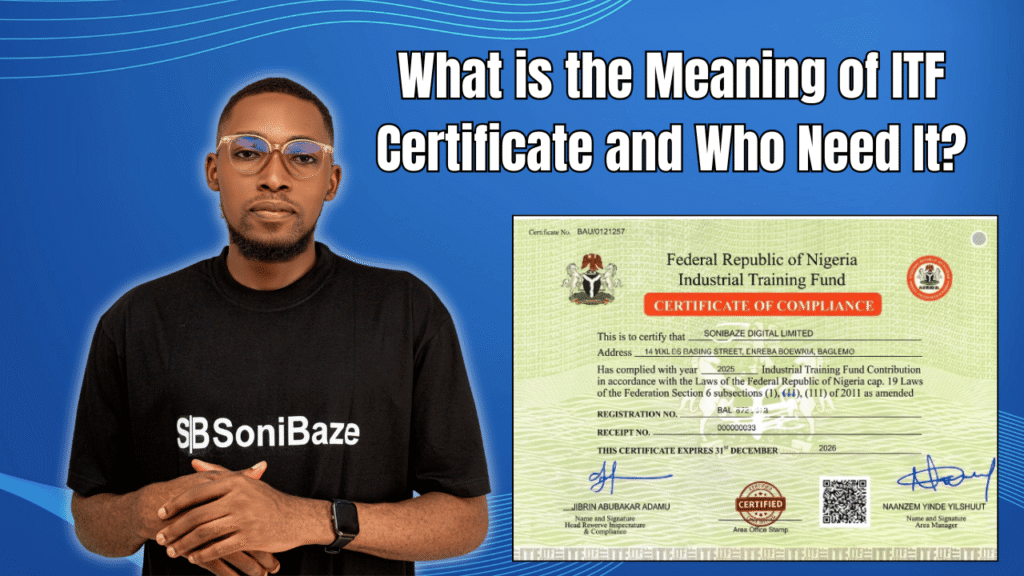
A lot of Nigerian business owners hear about the ITF certificate during a government procurement process and assume it is something only large companies worry about. Then they check the threshold and realise it applies to them too.
Understanding what the ITF certificate means, who is legally required to have it, and why it matters beyond government contracts is the purpose of this article.
Obtain Your ITF Certificate
Let us help you obtain your Industrial Training Fund (ITF) Compliance Certificate quickly and hassle-free. Our experts provide reliable support throughout the application process, ensuring your business meets all statutory compliance requirements.
What ITF Stands For
ITF stands for Industrial Training Fund. It is a Federal Government agency established on 8 October 1971 under Decree No. 47, now codified as the Industrial Training Fund Act Cap. I9 Laws of the Federation of Nigeria 2004. The fund operates under the Federal Ministry of Industry, Trade and Investment.
The ITF was created in response to a severe shortage of skilled manpower that was holding back Nigeria’s industrial and commercial growth at the time. Its core mandate is to promote and encourage the acquisition of skills in industry and commerce, with the goal of building a pool of indigenous trained manpower large enough to meet the needs of the Nigerian economy.
The ITF Amendment Act of 2011 expanded its scope significantly, lowering the employee threshold that triggers mandatory contribution and broadening the categories of organisations required to comply.
What the ITF Certificate Means
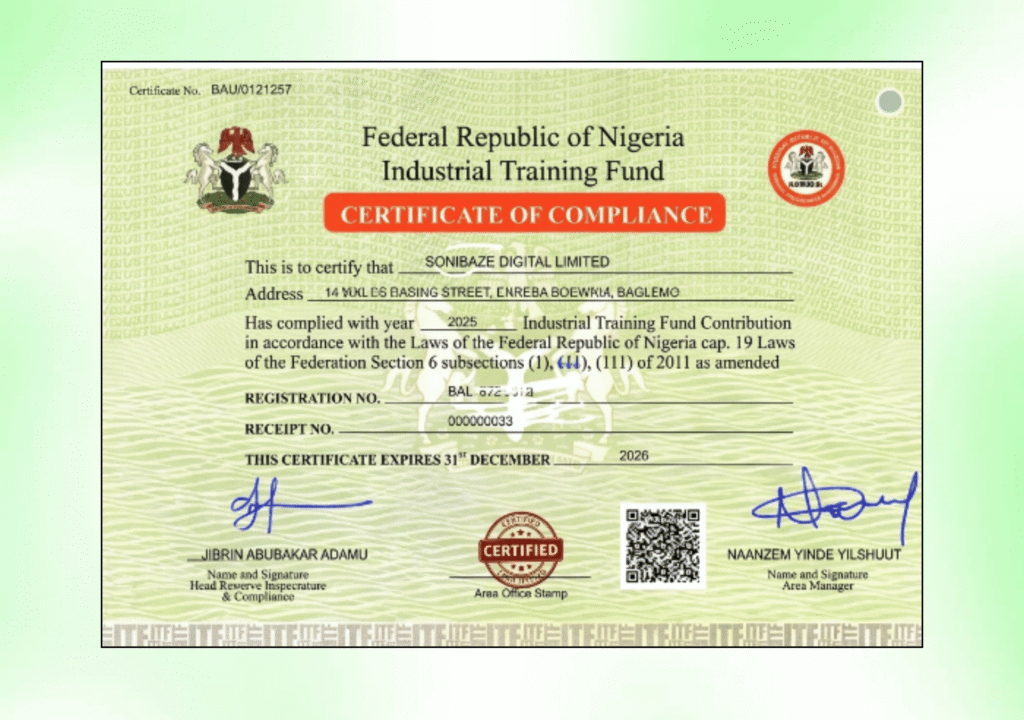
The ITF Certificate of Compliance is an official document issued by the Industrial Training Fund to organisations that have registered with the fund and paid their mandatory annual training contribution. It is not a training certificate for individuals. It is a compliance certificate for employers.
The certificate serves as proof that your organisation has met its statutory obligations under the ITF Act, specifically that you have enrolled with the fund, submitted the required documentation, had your payroll assessed, and remitted the applicable contribution.
It is renewed annually. A company that paid last year but has not remitted this year does not hold a valid ITF certificate for the current period, regardless of what the physical document says.

Who Needs an ITF Certificate in Nigeria?
Companies With Five or More Employees
Any employer with five or more employees in its establishment is required by law to register with the ITF and remit an annual training contribution. This is the most straightforward trigger.
The word “employees” under the ITF Act covers all persons employed in any establishment in return for salary, wages, or other consideration, whether employed full-time or part-time. It also includes temporary employees who work for periods of not less than 30 days in a year.
A company with five people on payroll, including part-time or temporary staff who have worked at least 30 days, crosses this threshold.
Companies With an Annual Turnover of 50 Million Naira or More
A company can have fewer than five employees and still be required to register, if its annual turnover is 50 million naira or above. This provision closes the gap for small but commercially active businesses that might otherwise argue they are exempt on headcount grounds alone.
Both thresholds are independent of each other. Meeting either one triggers the obligation.
Suppliers, Contractors, and Consultants Bidding for Government Contracts
Any organisation bidding for contracts with Federal Government ministries, departments, and agencies must present a valid ITF Compliance Certificate as part of the procurement requirements. This applies to suppliers of goods, service providers, and consultants equally.
The ITF Amendment Act 2011 specifically requires that organisations bidding or soliciting business from government and private entities must show evidence of compliance with their statutory obligations regarding payment of training contributions to the fund. This makes the certificate relevant not just for public contracts but increasingly for private sector procurement as well.
All Corporate Entities Registering With BPP
Every company registering or renewing its registration in the Bureau of Public Procurement contractor database must provide a valid ITF Compliance Certificate, provided the company meets the five-employee or 50-million-naira turnover threshold. Companies below both thresholds are exempt from this specific requirement at the BPP stage.
Who Is Exempt From ITF Contributions?
Two categories of organisations are currently exempt from ITF contribution obligations.
The first is employers with fewer than five employees and an annual turnover below 50 million naira. If both conditions are met simultaneously, the obligation does not apply.
The second is companies registered in any government-approved Free Trade Zone. These organisations operate under a separate regulatory framework that excludes them from standard ITF requirements.
Obtain Your ITF Certificate
Let us help you obtain your Industrial Training Fund (ITF) Compliance Certificate quickly and hassle-free. Our experts provide reliable support throughout the application process, ensuring your business meets all statutory compliance requirements.
What the Contribution Rate Is
Every employer required to contribute to the Industrial Training Fund pays 1 percent of its total annual payroll. The contribution covers the full payroll amount, not just certain categories of staff.
The due date for this contribution is April 1 of the year following the contribution year. For example, the contribution based on 2024 payroll figures is due by April 1, 2025. Late payment attracts a penalty of 5 percent for each month or part of a month on the outstanding contribution amount.
Employers who organise in-house training for their workers can apply for a partial reimbursement from ITF, provided they have documentary evidence such as course fee receipts, certificates of attendance, and receipts of the levy paid to the fund.
Why the Certificate Matters Beyond Government Contracts
The practical reality for most Nigerian businesses is that the ITF certificate comes up first during a government bid. But its relevance does not stop there.
An increasing number of large private sector organisations now include ITF compliance in their vendor onboarding requirements. International companies operating in Nigeria may ask for it as part of their supply chain due diligence. And the certificate sits within the broader cluster of compliance documents, alongside PENCOM, NSITF, and BPP registration, that collectively define whether a Nigerian business is fully compliant.
Gaps in any one of these documents can block opportunities across multiple channels at the same time, since BPP registration depends on ITF compliance, and BPP registration in turn is required for federal government procurement.
ITF Certificate Quick Reference
| Item | Detail |
|---|---|
| Full name | Industrial Training Fund Certificate of Compliance |
| Issuing body | Industrial Training Fund, under the Federal Ministry of Industry, Trade and Investment |
| Legal basis | ITF Act Cap. I9 LFN 2004, as amended by the ITF Amendment Act 2011 |
| Contribution rate | 1% of total annual payroll |
| Payment due date | April 1 of the following year |
| Late payment penalty | 5% per month or part of a month on the outstanding amount |
| Employee threshold | Five or more employees |
| Turnover threshold | Annual turnover of 50 million naira or above |
| Validity | Annual, must be renewed each year |
| Exemptions | Fewer than 5 employees AND turnover below 50 million naira; Free Trade Zone companies |
Frequently Asked Questions
Does an ITF certificate apply to businesses registered as a business name, or only to limited companies?
The ITF Act applies to employers of labour, which includes both companies incorporated with CAC and businesses registered under a business name, provided they meet the five-employee or 50-million-naira threshold. The legal form of the business does not determine the obligation; the headcount and turnover do.
What happens if a company does not register with ITF?
Non-compliance exposes the employer to penalties and legal action for recovery of outstanding contributions. Beyond the financial exposure, the company cannot obtain a valid ITF Compliance Certificate, which blocks BPP registration and disqualifies it from government contract bids. Enforcement action can be initiated by agents of the fund on behalf of the Director-General of the ITF.
Can a company claim reimbursement from ITF for training costs?
Yes. Organisations that train their staff and have documentary evidence, including course fee receipts, attendance certificates, and proof of ITF levy payment, can apply for a partial reimbursement of training expenses from the fund. The process requires advance notification and compliance with ITF’s reporting requirements.
Is the ITF contribution a tax or a levy?
It functions as a mandatory statutory levy on employers, not a tax in the traditional sense. Critics have noted that it amounts to a form of double taxation for employers who already bear the cost of training their own staff and then remit a further 1 percent of payroll to the fund. The ITF Act provides the partial reimbursement mechanism partly in acknowledgment of this concern.
How long does it take to get an ITF Compliance Certificate?
Processing time varies depending on whether documentation is complete and whether the assessment and payment process is handled promptly. When everything is in order, the process from submission to certificate issuance typically takes between two and four weeks. Delays usually arise from incomplete audited accounts, missing CAC documents, or payment receipts not being presented to the area office promptly.
Does the ITF certificate cover branch offices or only the head office?
The contribution obligation applies to the employer as a whole, covering all employees across locations. Compliance is registered at the company level, not per branch. The certificate issued reflects the employer’s overall compliance status, not the status of individual offices.
Conclusion: Compliance Is Simpler When You Know the Thresholds
The ITF certificate is straightforward once you understand the two triggers: five employees or 50 million naira in annual turnover. If your business meets either of these, the obligation exists, and the certificate is what proves you have met it.
For businesses planning to grow into government contracting, getting this compliance sorted early, rather than scrambling when a bid deadline appears, is the practical approach. The contribution itself is calculated on payroll, which makes it predictable. The compliance certificate that follows is what opens doors.
Obtain Your ITF Certificate
Let us help you obtain your Industrial Training Fund (ITF) Compliance Certificate quickly and hassle-free. Our experts provide reliable support throughout the application process, ensuring your business meets all statutory compliance requirements.