
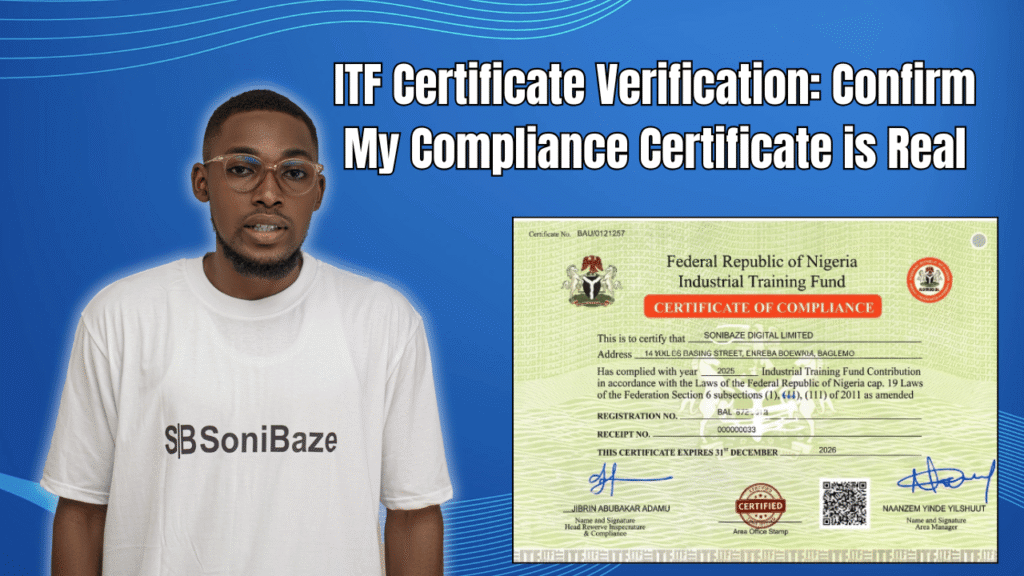
You have your ITF Compliance Certificate in hand. A procurement officer at a federal agency asks to verify it. You type in the certificate number on the ITF portal and nothing comes back. Or worse, a vendor you are about to pay claims to be ITF-compliant and hands you a certificate that looks right but you have no way to confirm.
Both situations happen more than they should. ITF certificate fraud is a real problem in Nigeria‘s procurement space, and even genuine certificates sometimes fail verification because of how the issuance process works on the ITF end. This article explains what the ITF Compliance Certificate is, how verification works, why it can fail, and what to do when it does.
Obtain Your ITF Certificate
Let us help you obtain your Industrial Training Fund (ITF) Compliance Certificate quickly and hassle-free. Our experts provide reliable support throughout the application process, ensuring your business meets all statutory compliance requirements.
What Is the ITF Compliance Certificate?
The Industrial Training Fund was established in 1971 under Decree 47 and has since operated under the ITF Act as amended in 2011. It sits under the Federal Ministry of Industry, Trade and Investment and is responsible for promoting the acquisition of skills in industry and commerce across Nigeria.
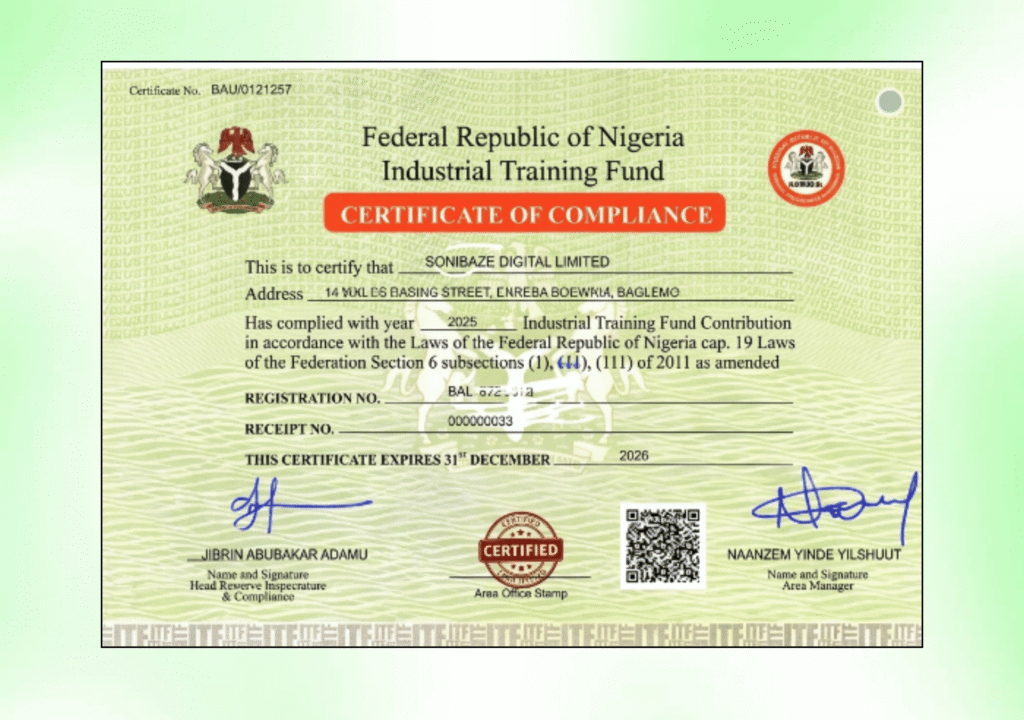
The ITF Compliance Certificate is the document that proves a company has registered with the Fund and paid its mandatory training contribution. It is one of the standard compliance documents required for federal government contracts, BPP database registration, and tender submissions to most ministries, departments, and agencies.
Who Is Required to Have One?
The obligation to contribute to the ITF is clear. Every employer with 5 or more employees must register and contribute. Every employer with fewer than 5 employees but an annual turnover of 50 million naira or above is also required to contribute, regardless of headcount.
The contribution rate is 1 percent of total annual payroll. It must be paid before the 1st of April each year. Contributions that are not paid by this date attract a penalty of 5 percent of the unpaid amount for each month or part of a month after the due date.
Companies with fewer than 5 employees and an annual turnover below 50 million naira are not required to contribute and do not need an ITF Compliance Certificate.

How to Verify an ITF Compliance Certificate
ITF has an electronic certificate verification portal available at ecert.itf.gov.ng. This is the official portal for checking whether a certificate is genuine and currently valid.
To verify a certificate, enter the ITF National Number or certificate reference number as printed on the document. A genuine, active certificate will return the company’s registered details, confirming the certificate is real and traceable in the ITF system.
If you are a procurement officer, a vendor manager, or any party that regularly receives ITF certificates from contractors, using this portal before accepting any certificate is the safest approach.
Why Verification Sometimes Fails on a Genuine Certificate
This is where things get complicated. Not every failed verification means the certificate is fake. Several technical and process-related reasons can cause a genuine certificate to return no result on the portal.
The National Number Has Not Been Linked to the Certificate Yet
The ITF issuance process involves multiple stages. After payment is made and documents are submitted at the Area Office, the Area Office forwards the employer’s details to ITF Headquarters for the issuance of an ITF National Number. That number is then sent back to the Area Office for scripting and certificate issuance.
In some cases, the certificate is physically produced and handed to the employer before the National Number has been fully entered into the electronic system at headquarters level. The document looks real because it is real. But it does not verify online yet because the database entry is not complete.
The Certificate Is Area Office-Issued but Not Headquarters-Confirmed
Some Area Offices have historically issued certificates at their level without waiting for full headquarters processing. These certificates are official documents but may not appear in the central verification system. If you receive one and it fails verification, this is worth raising directly with the ITF Area Office that issued it.
Data Entry Errors in the Certificate Number
ITF National Numbers and certificate reference numbers often contain a mix of letters, digits, and formatting characters. A single transposed digit or missed character when entering the number on the portal will return no result even for a perfectly valid certificate. Always copy the number directly from the certificate rather than typing it from memory.
The Certificate Has Expired
ITF Compliance Certificates are renewed annually. A certificate from a previous year that has not been renewed will not return a valid result on the portal, even though it was genuine when issued. Always check the validity period printed on the certificate before attempting verification.
Obtain Your ITF Certificate
Let us help you obtain your Industrial Training Fund (ITF) Compliance Certificate quickly and hassle-free. Our experts provide reliable support throughout the application process, ensuring your business meets all statutory compliance requirements.
Signs an ITF Certificate May Be Fraudulent
While verification failures can have innocent explanations, some patterns are consistent with fraudulent certificates.
A certificate that has no ITF National Number printed on it is immediately suspicious. Every legitimate certificate should carry this number, since it is the reference used for verification.
Certificates with formatting that does not match current ITF templates, including unusual fonts, incorrect logo placement, or missing agency contact information, deserve a closer look. ITF has updated its certificate format over the years, but there is a baseline consistency to official documents.
If a vendor or contractor cannot provide the name of the ITF Area Office that issued the certificate, or cannot produce the payment receipt and acknowledgement letter that should accompany the original issuance, those are additional warning signs.
A certificate that verifies under a different company name than the one presenting it is a clear red flag. This can happen when a certificate is borrowed or when the company has reused an old certificate belonging to a related entity.
What to Do When Verification Fails
If you are holding a certificate that fails verification and you believe it is genuine, the first step is to contact the ITF Area Office that issued it. Bring the original certificate, your payment receipt, and your acknowledgement letter. Ask the Area Office to confirm whether your National Number has been transmitted to headquarters and entered into the electronic system.
If the Area Office confirms that the number was submitted to headquarters but still does not appear in the portal, the next step is to escalate directly to ITF Headquarters’ Revenue, Inspectorate and Compliance Department. This is the unit responsible for issuing National Numbers and maintaining the central database.
Keep records of all correspondence. If you are trying to use the certificate for a specific contract and verification is holding up the process, a letter from ITF confirming the certificate’s authenticity can sometimes serve as interim confirmation while the database issue is resolved.
If you are a procurement officer assessing a contractor whose certificate fails verification, the appropriate course is to request an explanation in writing and allow a short window for the contractor to resolve the issue with ITF before disqualifying the bid entirely. Automatic disqualification without any opportunity to clarify is the reason some genuine businesses lose legitimate contracts.
ITF Verification Reference Guide
| Scenario | What It Means | What to Do |
|---|---|---|
| Certificate verifies successfully | Genuine and current | Proceed with confidence |
| Certificate fails but company has payment receipt | Possible database lag after issuance | Contact the issuing Area Office to confirm upload to headquarters |
| Certificate fails and no payment receipt exists | High risk of fraud | Request original documents and investigate further |
| Certificate verifies under a different company name | Certificate does not belong to the presenter | Reject and flag the discrepancy |
| Certificate has expired | Annual renewal has not been done | Ask for the current year’s certificate |
| No National Number on the certificate | Non-standard document | Treat with suspicion and verify with ITF directly |
How to Get Your Own ITF Certificate if You Do Not Have One
For companies that are newly registering, the process starts with ITF Form 7A, available at any ITF Area Office. Complete the form and submit it along with your CAC Certificate of Incorporation, certified true copies of your audited accounts, and a copy of your Tax Clearance Certificate. A TIN slip may be accepted in place of a full Tax Clearance Certificate in some cases.
ITF Revenue, Inspectorate, and Compliance Officers will assess your liability based on your total annual payroll. Once the assessment is done, a Remita Reference and Retrieval Number is generated through the ITF Pay-Portal or the Remita platform. You take the RRR to a bank, make the payment, and bring the payment evidence back to the Area Office.
The Area Office issues a hard copy receipt and acknowledgement letter, then forwards your details to ITF Headquarters for National Number issuance. The National Number is sent back to the Area Office, where your Certificate of Compliance is produced and issued.
For companies renewing an existing certificate, the process uses ITF Form 5A instead of Form 7A. The renewal path is shorter since your National Number already exists in the system.
The one-time certificate fee is 100,000 naira. Ongoing contributions are 1 percent of total annual payroll. Late contributions attract a 5 percent monthly penalty on the unpaid amount. Registration with ITF takes an average of 10 working days when documents are complete and correct.
Frequently Asked Questions
Where exactly is the ITF certificate verification portal?
The official ITF electronic certificate verification portal is at ecert.itf.gov.ng. This is the only official channel for confirming whether an ITF Compliance Certificate is genuine. Do not rely on third-party sites or informal verification methods.
My certificate was issued recently but does not verify. What should I do?
This is a known issue related to the delay between Area Office issuance and headquarters database entry. Contact the ITF Area Office that issued your certificate, bring your payment receipt and acknowledgement letter, and ask them to confirm whether your National Number has been uploaded to the central system. Most cases resolve once the database entry is completed at headquarters level.
How long does it take for an ITF certificate to become verifiable online after issuance?
There is no published fixed timeline for this. The delay depends on how quickly the Area Office transmits details to headquarters and how quickly the headquarters team processes the entry. Businesses that have experienced delays report anything from a few days to several weeks in some cases. Following up directly with the Area Office shortens this significantly.
Is an ITF certificate from a previous year still valid for a current bid?
No. ITF Compliance Certificates are renewed annually. A certificate from the previous year is expired and will not satisfy current contract requirements. Always confirm the validity dates before submitting any compliance document as part of a bid package.
What is the penalty for a company that submits a forged ITF certificate?
Submitting a forged certificate in a federal procurement process exposes a company to criminal liability under Nigerian law, disqualification from the relevant bid, and blacklisting from the BPP database. Beyond the criminal risk, using a fraudulent compliance document in procurement is a direct violation of the Public Procurement Act 2007.
Can sole proprietors obtain an ITF Compliance Certificate?
The ITF compliance obligation applies to employers, which typically means registered companies. Sole proprietorships that meet the 5-employee or 50-million-naira turnover threshold should confirm their eligibility directly with their nearest ITF Area Office, since registration requirements can differ for non-incorporated entities.
Conclusion: Verification Is a 30-Second Step That Prevents Significant Problems
Whether you are checking your own certificate before submitting a bid or verifying a contractor’s document before approving a payment, the ITF verification portal at ecert.itf.gov.ng is the right place to start. The process takes less than a minute.
When verification fails, work through the possibilities before drawing conclusions. A failed check is not always fraud. But it is always worth resolving before any document is accepted or submitted in a formal procurement context.
Obtain Your ITF Certificate
Let us help you obtain your Industrial Training Fund (ITF) Compliance Certificate quickly and hassle-free. Our experts provide reliable support throughout the application process, ensuring your business meets all statutory compliance requirements.