Ask any contractor who has tried to bid for a federal government project in Nigeria and they will tell you the same thing. The BPP certificate is always on the list. No certificate, no bid. It does not matter how strong your company profile is or how many years of experience you have.
What many businesses do not realise is that the certificate itself is free. The process is entirely online. The delays that frustrate most applicants come from incomplete documents and mismatched records, not from the registration system itself.
This article explains exactly how to generate your BPP certificate in Nigeria, what you need before you start, and how to handle the Interim Registration Report that most procurement officers ask for.
Obtain Your BPP Certificate
Let us help you obtain your Bureau of Public Procurement (BPP) Registration Certificate quickly and hassle-free. Our experts provide reliable support throughout the registration process, ensuring your business is ready to participate in public procurement opportunities.
What Is the BPP Certificate?
The Bureau of Public Procurement was established under the Public Procurement Act 2007 as the regulatory authority responsible for monitoring and overseeing all public procurement in Nigeria. It maintains a National Database of Federal Contractors, Consultants, and Service Providers, commonly referred to as the CCSP database.
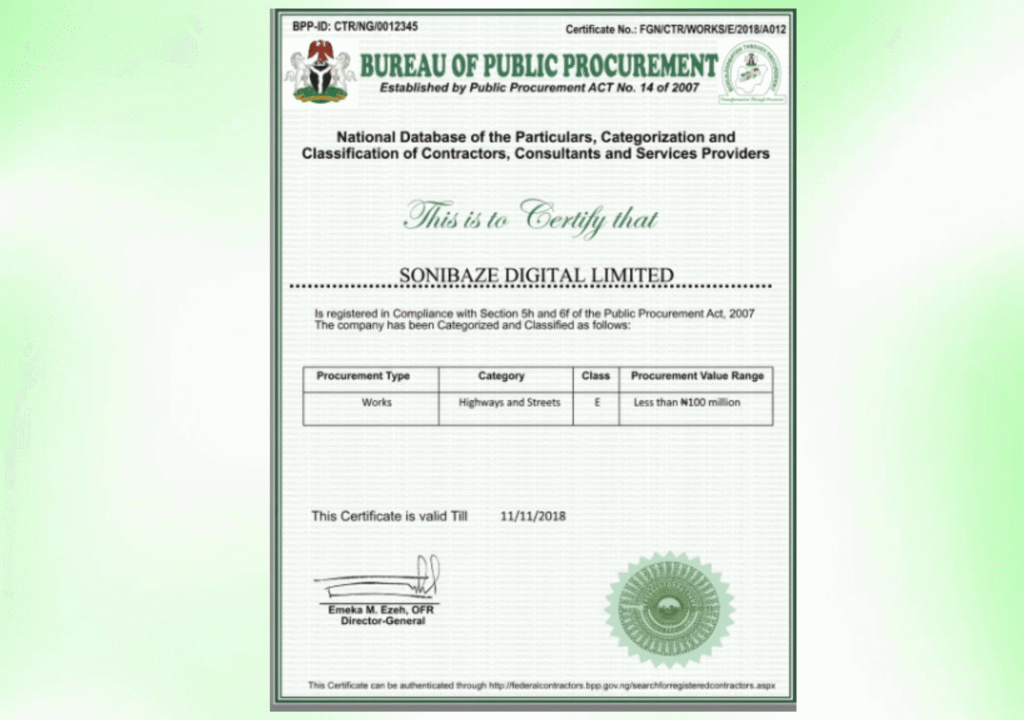
Every contractor, consultant, and service provider doing business or intending to do business with the Federal Government of Nigeria is required to register in this database. Registration results in an Interim Registration Report, which serves as the document procurement officers check when evaluating bids. This report is what most people refer to as the BPP certificate.
The certificate is not permanent. It is renewed annually, and a valid, current report is what is required during any bid process.
Who Needs to Register?
Any company seeking federal government contracts, whether supplying goods, providing services, or executing construction works, needs to be registered in the BPP database. This includes Nigerian companies, foreign companies operating in Nigeria, and businesses across all sectors from IT services to civil engineering to professional consulting.
The database covers contractors, consultants, and service providers. It does not cover manufacturers who are not involved in the direct supply of their own products.
Sole proprietorships and business names registered with the Corporate Affairs Commission cannot register. Only companies with a valid Certificate of Incorporation are eligible for BPP registration.

Documents Required Before You Begin
Before logging on to the BPP portal, have the following ready.
CAC Certificate of Incorporation. This is the most basic requirement and confirms your company’s legal status. Your CAC registration number will be the first thing the portal asks for.
Company address and contact details. You will need your company’s physical address, email address, and phone number. The email address entered must be unique and active since your login credentials will be sent to it.
Contact person details. The name, position, and contact information of the designated representative for the registration.
Tax Clearance Certificate. A valid TCC from the Federal Inland Revenue Service is required. Your tax obligations must be up to date before BPP registration can be completed.
NSITF Compliance Certificate. Evidence of registration and compliance with the Nigeria Social Insurance Trust Fund is required as part of the document set.
PENCOM Compliance Certificate. Companies with 15 or more employees are required to provide a valid PENCOM certificate. Companies with fewer than 15 employees are generally exempt from this requirement at the BPP registration stage.
ITF Compliance Certificate. Companies with 5 or more employees and an annual turnover of at least 50 million naira must provide an ITF certificate. Those below this threshold are not required to submit one.
Audited accounts. Financial statements for the relevant period may be required depending on the category and classification you are applying under.
List of past projects. You will be asked to provide details of jobs executed and completed in the 5 years before registration, in either the public or private sector. This is used for classification purposes.
Step-by-Step Process to Generate Your BPP Certificate
Step 1: Visit the BPP Contractor Database Portal
Go to federalcontractors.bpp.gov.ng or access the portal through the BPP main website at bpp.gov.ng and select the Contractor Registration option. This is the official portal for the National Database of Federal Contractors, Consultants, and Service Providers.
Step 2: Create a New Account
On the portal, select the option to create a new account. You will be prompted to enter your CAC registration number, your company type, your FIRS Tax Identification Number, your company address details, and your contact information.
Ensure the email address you enter is correct and accessible. Your Temporary Contractor ID and password will be sent to that address. If you registered before May 2018, you do not need to create a new account. Simply log in with your existing credentials and your information will be migrated to the current system.
Step 3: Log In and Complete Your Profile
Once you receive your login credentials, return to the portal and log in. Complete your company profile by filling in all required sections, including your company’s sector category, classification information, and details of past projects.
The classification system rates companies from Class A to Class E based on professional capacity, technical capability, financial strength, past experience, and equipment. A company can hold different classifications across different procurement categories depending on its actual track record in each area.
Step 4: Upload Your Compliance Documents
Upload all the required compliance documents listed in the section above. Each document must be current and valid. An expired Tax Clearance Certificate or a lapsed NSITF certificate will cause your application to be flagged.
Pay attention to the PENCOM and ITF thresholds. If your company does not meet the headcount or turnover threshold for these certificates, you do not need to upload them, but you should confirm this against your current staff numbers and annual turnover before proceeding.
Step 5: Submit and Await Verification
Once all sections are completed and documents uploaded, submit your application. BPP will verify the information provided against the records of the relevant agencies, including FIRS, PENCOM, NSITF, and ITF.
Registration with BPP typically takes an average of 5 working days when all documents are complete and accurate. Applications with discrepancies or missing documents take longer.
Step 6: Generate Your Interim Registration Report
After successful registration, log back into the portal and click the button labelled “Generate Interim Registration Report.” Follow the procedure to generate and print the current, valid IRR. This is the document you will present during bid processes. It is your BPP certificate for practical purposes.
To renew the IRR after it expires, log back in with your Temporary Contractor ID and password, click Generate Interim Registration Report, and follow the same procedure. The report is renewed annually.
Obtain Your BPP Certificate
Let us help you obtain your Bureau of Public Procurement (BPP) Registration Certificate quickly and hassle-free. Our experts provide reliable support throughout the registration process, ensuring your business is ready to participate in public procurement opportunities.
Cost of BPP Registration
Registration with BPP is free of charge. There is no government fee for obtaining or renewing the Interim Registration Report. If you engage a consultant to handle the process on your behalf, you will pay a professional fee to the consultant, but nothing is paid to BPP itself.
Common Errors During BPP Registration
Wrong email address. Once submitted, you cannot change the email address on record without contacting BPP directly. Always double-check the email field before submitting.
Mismatched company name. The company name entered on the BPP portal must match the name on your CAC documents exactly. Abbreviations, punctuation differences, or spelling variations will cause a mismatch.
Expired compliance documents. Uploading an expired NSITF or ITF certificate is a common reason for rejection. Check the validity dates on every document before uploading.
Wrong PENCOM or ITF threshold assessment. Some companies exempt from PENCOM or ITF requirements try to submit these certificates anyway with outdated information, while others who do need them skip them. Know your staff headcount and turnover before deciding which compliance documents apply.
Using the wrong portal. The correct portal is federalcontractors.bpp.gov.ng. Third-party sites and unofficial links have caused confusion in the past. Always start from the official BPP website.
BPP Registration Process at a Glance
| Step | Action | Key Detail |
|---|---|---|
| 1 | Visit the BPP contractor database portal | federalcontractors.bpp.gov.ng |
| 2 | Create a new account | CAC number, TIN, company email required |
| 3 | Log in and complete company profile | Include sector categories and past project details |
| 4 | Upload compliance documents | TCC, NSITF, PENCOM, ITF where applicable |
| 5 | Submit and await verification | Typically 5 working days when documents are complete |
| 6 | Generate Interim Registration Report | This is your BPP certificate for bid purposes |
Frequently Asked Questions
Is BPP registration the same for all types of companies?
The portal and general process are the same, but classification varies based on the company’s sector, capacity, and experience. A construction company will be classified differently from an IT consultancy or a goods supplier. Your classification determines the contract sizes and categories you can bid for.
How long is the BPP Interim Registration Report valid?
The IRR is valid for one year. After it expires, you need to log back into the portal and generate a new one. Keeping your underlying compliance documents current throughout the year means renewal is quick, since BPP verification of those documents is part of the renewal process.
Can a sole proprietor register with BPP?
No. Only companies incorporated with the Corporate Affairs Commission are eligible to register in the BPP database. Sole proprietorships and business names are not accepted.
What happens if I cannot find my category in the BPP classification structure?
The BPP classification structure is designed to cover all areas of government procurement. If your company genuinely cannot be placed in any available category, this should be reported to the database administrators through the contact information provided on the BPP website rather than selecting a mismatched category.
Is BPP registration required for state government contracts, not just federal?
The BPP database specifically covers federal government procurement. Some state governments have their own procurement registration systems, and the BPP certificate may not automatically satisfy a state-level requirement. Check the specific requirements for any state government bid you intend to participate in.
Do foreign companies need to register with BPP?
Yes. Foreign companies doing business or intending to do business with the Federal Government of Nigeria are required to register in the BPP database. The same portal and general process applies.
Conclusion: The Process Is Simple When Your Documents Are Ready
BPP registration is one of the more straightforward compliance processes for Nigerian companies bidding on government contracts. The portal is online, the certificate is free, and the turnaround is fast when all documents are in order.
What trips most businesses up is arriving at the portal without a current Tax Clearance Certificate, with lapsed compliance documents, or with company details that do not match their CAC records. Sort those before you start and the rest of the process follows without friction. The Interim Registration Report you generate at the end is what puts your company in front of federal procurement officers when the next contract opportunity comes up.
Obtain Your BPP Certificate
Let us help you obtain your Bureau of Public Procurement (BPP) Registration Certificate quickly and hassle-free. Our experts provide reliable support throughout the registration process, ensuring your business is ready to participate in public procurement opportunities.