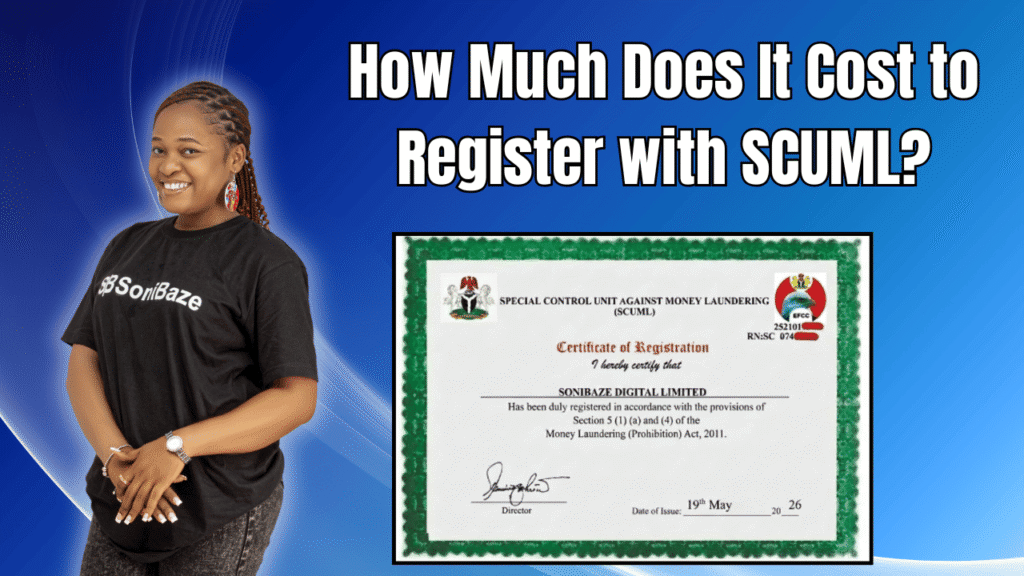
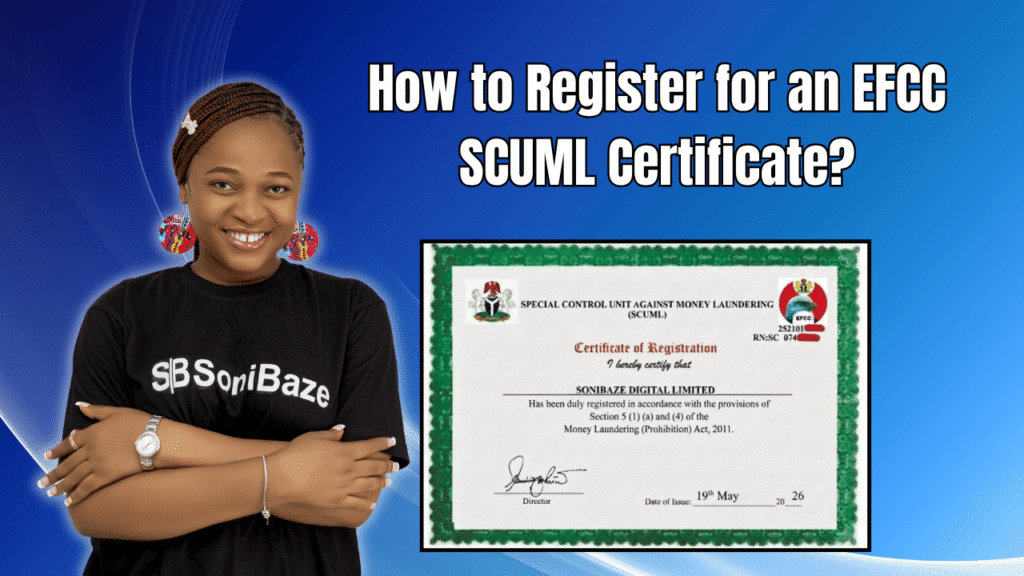
The SCUML certificate is one of those compliance requirements Nigerian businesses often stumble into rather than plan for. A bank asks for it before opening a corporate account. A tender checklist lists it under required documents. Suddenly, something that was never on the radar becomes urgent.
Registration is entirely free and done online. The process is not complicated. What slows most people down is incomplete documentation, unfamiliarity with the portal, or using third-party websites that are not affiliated with SCUML at all.
This article walks through the full registration process, the documents you need to have ready, and what to expect at each stage.
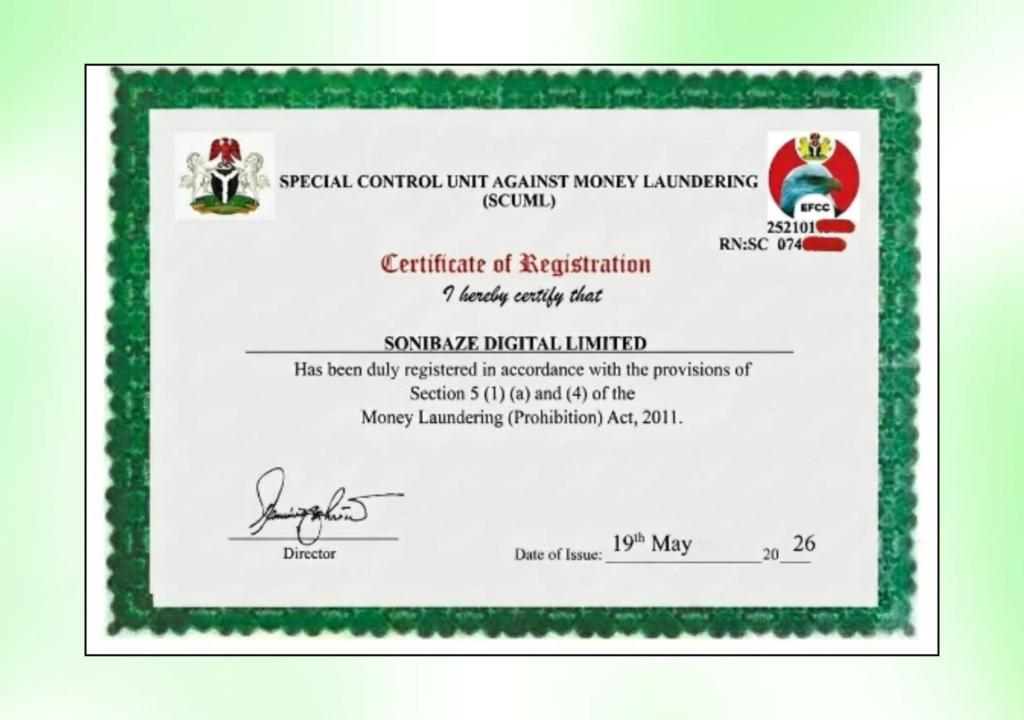
Obtain Your EFCC SCUML Certificate
Let us help you get your EFCC SCUML Certificate quickly and hassle-free. Our team provides fast, reliable support to ensure your SCUML registration is completed accurately and in compliance with regulatory requirements.
What Is SCUML and Why Does Your Business Need It?
SCUML stands for the Special Control Unit Against Money Laundering. It is a unit under the Economic and Financial Crimes Commission, created in September 2005 to regulate and monitor businesses classified as Designated Non-Financial Institutions, or DNFIs, in line with Nigeria’s anti-money laundering laws.
The certificate it issues serves as proof that your organisation is registered with SCUML and that your bank account is not being used for money laundering or terrorist financing. Any DNFI that fails to register with SCUML may be ineligible to maintain bank accounts in Nigeria. Banks are increasingly checking for this certificate during account opening, and in many cases during periodic account reviews as well.
The businesses required to register include real estate firms, car dealerships, hotels, law firms, accounting and audit firms, consultants, fintech companies, NGOs, construction companies, jewellery dealers, and betting and gaming operators.
Before You Start: Key Things to Know
Three facts are worth knowing before you open the SCUML portal.
First, SCUML registration and certification are completely free of charge and can only be completed through the official website at www.scuml.efcc.gov.ng. Any individual or service advertising to facilitate SCUML registration for a fee is not affiliated with SCUML, and using them comes at your own risk.
Second, SCUML registration is done entirely online. EFCC no longer issues hard copies of SCUML certificates. Everything from application to certificate download happens through the portal.
Third, document requirements are not identical across business sectors. A car dealership submits different supporting documents from an NGO or an accounting firm. Before gathering anything, confirm which category your business falls under and check the specific checklist for that sector on the portal.

Documents Required for SCUML Registration
The core documents required apply broadly across most business types. Sector-specific additions are layered on top.
For a limited liability company, the standard document set includes a CAC Certificate of Incorporation, a current CAC Status Report, a Tax Identification Number printout from FIRS, a valid means of identification for at least one director, the Bank Verification Number of each director or proprietor, and bank account details for at least one director.
For a business name registration rather than a limited company, you substitute the Status Report with the BN-01 Form from CAC, and the MEMART is not required since business names do not have one.
For NGOs, a Tax Clearance Certificate is not required, but an agreement signed between the NGO and the National Planning Commission is needed for international NGOs specifically.
Professional firms such as accounting firms, audit firms, and law firms typically also need evidence of membership with the relevant professional body, such as ICAN for accountants or the NBA for law firms.
Step-by-Step: How to Register on the SCUML Portal
Step 1: Visit the Official SCUML Website
Go directly to the official portal at scuml.efcc.gov.ng. Do not use links from third-party services or social media accounts advertising SCUML assistance, as these are not authorised by SCUML.
On the homepage, you will find the option to register. Before proceeding, download and read the registration guideline document, which lists the exact documents required for your specific business category. This step alone saves most applicants at least one failed submission.
Step 2: Select Your Business Sector
The portal asks you to select your business sector before proceeding with the registration form. This determines which document checklist applies to your application. Choose the category that most accurately describes what your business does, since submitting under the wrong category can result in rejection even if your documents are otherwise complete.
Step 3: Complete the Registration Form
The form asks for your company’s name exactly as it appears on your CAC documents, your registration number, your registered address, and details of your beneficial owners including their BVN and valid identification.
Enter every detail exactly as it appears on your source documents. Mismatches between what the form says and what your CAC Status Report or identification documents say are a common cause of applications being queried or rejected.
Step 4: Upload Supporting Documents
Scan and upload the required documents in the format specified by the portal. Documents are typically expected in PDF or clear image format. Make sure each document is legible and complete, meaning no cut-off edges, no blurry images, and no missing pages from multi-page documents like MEMART.
The portal does not allow for partial submissions where you send some documents now and the rest later. Everything needs to be complete and ready before you submit.
Step 5: Submit the Application
Once the form is complete and all documents are uploaded, submit the application for SCUML review. After submission, you will receive a notification acknowledging receipt.
SCUML will notify you if EFCC requests a clarification or additional documents. Respond to any such requests promptly, since delays in responding extend your overall processing time.
Step 6: Attend the Sensitisation Session and Collect Your Certificate
After successful approval of the certificate, DNFIs are expected to undergo a sensitisation session, and the original copy of the CAC Certificate is sighted before the SCUML certificate is released. Any director of the company can pick up the certificate on behalf of the organisation.
The sensitisation session covers your compliance obligations going forward, including reporting requirements. This is also the point at which you receive your portal login credentials for submitting Currency Transaction Reports and Cash-Based Transaction Reports.
Obtain Your EFCC SCUML Certificate
Let us help you get your EFCC SCUML Certificate quickly and hassle-free. Our team provides fast, reliable support to ensure your SCUML registration is completed accurately and in compliance with regulatory requirements.
How Long Does It Take?
The process typically takes 3 to 4 weeks, depending on the completeness of the application and document verification. Applications with all documents in order and no mismatches move faster. Applications with missing sector-specific documents or name discrepancies take considerably longer.
If you engage a registered compliance consultant to manage the process, the timeline can be shorter because experienced hands catch documentation problems before submission rather than after rejection.
Registration Process at a Glance
| Step | Action | Watch Out For |
|---|---|---|
| 1 | Visit the official SCUML portal | Using unofficial third-party links |
| 2 | Select your correct business sector | Choosing the wrong category for your business type |
| 3 | Complete the registration form | Mismatches between form entries and source documents |
| 4 | Upload supporting documents | Incomplete, blurry, or missing documents |
| 5 | Submit and monitor for clarification requests | Slow responses to SCUML queries |
| 6 | Attend sensitisation and collect certificate | Sending an unauthorised representative |
What Happens After You Register
Registration is not the end of your compliance obligations. Once registered, your business is expected to submit reports to SCUML on a regular basis. These include Currency Transaction Reports for transactions above five million naira for individuals or ten million naira for corporate entities, and Suspicious Transaction Reports whenever a transaction raises concerns regardless of the amount.
From 1st January 2026, all reports must be submitted exclusively through the SCUML portal. SCUML will no longer accept CTRs or CBTRs submitted via email after 31st December 2025. If your business registered some time ago and has been emailing reports, you need to obtain your portal login credentials before this deadline if you have not already done so.
Your SCUML certificate is also not permanent. Businesses need to ensure their registration remains current, and any significant change in business structure, ownership, or operations may require updated documentation to be submitted.
Frequently Asked Questions
Is SCUML registration really free?
Yes. SCUML registration is free, and EFCC has repeatedly confirmed this publicly. The certificate is issued at no charge through the official portal. Any agent or service charging a fee for registration is doing so for their own consultancy time, not for any government fee.
How do I know if my business is a DNFI that needs to register?
If your business operates in real estate, car dealing, hospitality, legal or accounting services, consulting, fintech, jewellery, construction, betting, or NGO activities, it is likely classified as a DNFI. Check the full list on the SCUML portal under the sector selection menu to confirm.
Can I submit documents one at a time and complete the application later?
No. The SCUML portal requires a complete submission. You cannot save a partial application and return later to add missing documents. Gather everything before you start the online form.
What if my application is rejected?
If your application is rejected, SCUML will typically communicate the reason. You will need to address the specific issue, whether that is a document mismatch, a missing sector-specific item, or an incorrect entry on the form, and submit a fresh application rather than amending the rejected one.
Does a business name registration qualify, or does it need to be a limited company?
Both qualify. Businesses registered as a business name with CAC can register with SCUML using the BN-01 form and other applicable documents in place of the MEMART and full status report required for limited companies.
Do I need to renew my SCUML certificate?
Currently, SCUML certificates do not carry a fixed annual expiry like some other compliance certificates in Nigeria. However, registered businesses are expected to keep their information current, and changes in ownership, structure, or business activity may require updated registration documents to be submitted.
Conclusion: Get Your Documents Right Before Touching the Portal
The SCUML registration portal itself takes less than an hour to navigate once you know what you are doing. The real preparation happens before you open the browser. Every name needs to match across every document. Every director needs their BVN and valid ID ready. Every sector-specific requirement needs to be confirmed and included.
Businesses that go in prepared come out with a certificate in three to four weeks. Those that submit incomplete applications spend more time responding to queries and restarting submissions than the initial preparation would ever have taken.
Obtain Your EFCC SCUML Certificate
Let us help you get your EFCC SCUML Certificate quickly and hassle-free. Our team provides fast, reliable support to ensure your SCUML registration is completed accurately and in compliance with regulatory requirements.