Front end developers in Nigeria are paid across a wide range, and the gap between the lowest and highest earners in this field is significant. A junior developer at a small firm and a senior developer at a fintech startup can both carry the same job title but earn salaries that are worlds apart.
This article covers what front end developers in Nigeria actually earn per month in 2025, what drives the differences, and what factors will move your salary up or down depending on where you are in your career.
Ready to start a career in web development? Learn and start your tech career today.
Why Front End Developer Salaries Vary So Much in Nigeria
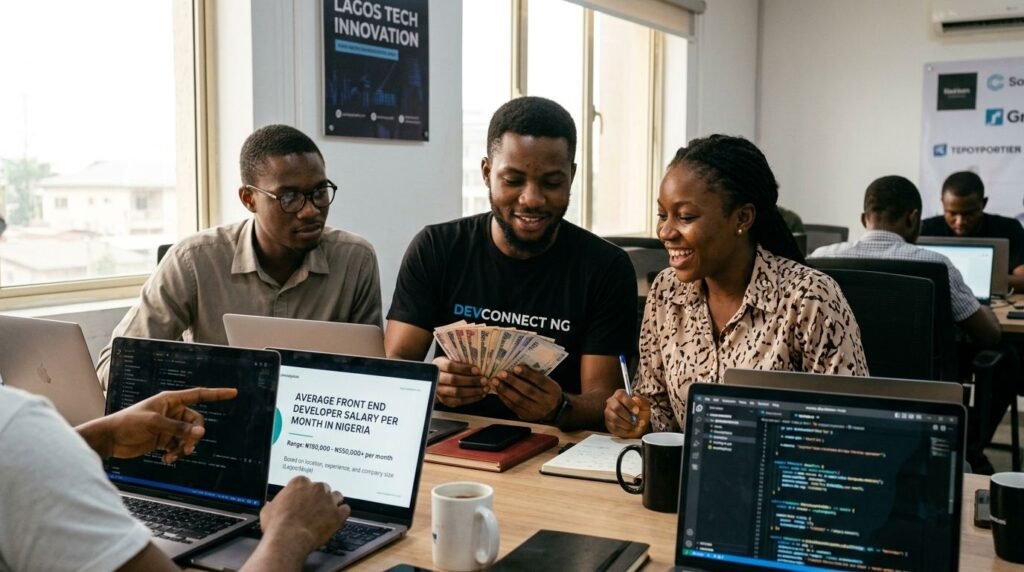
The same role at two different companies can pay ₦80,000 at one and ₦500,000 at another. That is not a mistake. Several factors create this range, and understanding them is more useful than looking at a single average figure.
Company size and funding matter enormously. A Lagos-based fintech with venture capital backing pays differently from a small web agency in Abuja. Startups at growth stage often pay above-market salaries to attract strong engineers. Agencies and SMEs typically pay less but may offer more varied work.
Specialisation plays a role too. A front end developer who also knows React, TypeScript, and has experience building responsive apps for mobile-heavy Nigerian audiences commands more than someone who knows basic HTML and CSS. The market rewards specificity.
Location is a factor in seniority expectations, but remote work has shifted this significantly. Many Nigerian front end developers now earn in dollars through remote contracts with international companies, which puts them in a completely different salary bracket from peers working locally.
Front End Developer Salary by Experience Level in Nigeria
This is the most useful way to look at the data. Experience level, more than any other variable, determines your starting point.
| Experience Level | Years of Experience | Monthly Salary Range (Naira) | Typical Employer |
|---|---|---|---|
| Junior Front End Developer | 0 – 2 years | ₦80,000 – ₦200,000 | Small agencies, startups, SMEs |
| Mid-Level Front End Developer | 2 – 5 years | ₦250,000 – ₦500,000 | Mid-size tech companies, agencies, fintechs |
| Senior Front End Developer | 5+ years | ₦550,000 – ₦1,200,000 | Large fintechs, enterprise companies, tech startups |
| Lead / Principal Developer | 7+ years | ₦1,200,000 – ₦2,500,000+ | Tech companies, multinationals, senior remote roles |
These figures reflect on-site and local employment in Nigeria. Remote international roles, priced in USD, are covered separately below.
Front End Developer Salary by Industry in Nigeria
Some industries pay significantly more than others. If salary is a priority, your choice of industry matters as much as your skill level.
| Industry | Average Monthly Salary | Why It Pays This Way |
|---|---|---|
| Fintech (e.g., Paystack, Flutterwave, Moniepoint) | ₦500,000 – ₦1,500,000 | High technical demand, venture-backed funding, competition for talent |
| E-commerce | ₦300,000 – ₦800,000 | Transaction-critical UI, constant product iteration |
| Healthtech / Edtech | ₦250,000 – ₦700,000 | Growing sector, varies heavily by company size |
| Media and Publishing | ₦150,000 – ₦350,000 | Lower technical complexity, smaller teams |
| Digital Agencies | ₦120,000 – ₦400,000 | Multiple client projects, good learning environment |
| Government / Public Sector | ₦100,000 – ₦250,000 | Structured pay scales, rarely performance-linked |
| NGOs / INGOs | ₦150,000 – ₦400,000 | Varies by organisation size and international funding |
Fintech is, by a clear margin, the highest-paying sector for front end developers in Nigeria. Companies like Paystack, Flutterwave, Moniepoint, and Kuda are known to pay salaries that compete with or exceed some international benchmarks for local hires.
Front End Developer Salary by City in Nigeria
Lagos pays the most, full stop. It has the densest concentration of tech companies, the largest number of funded startups, and the highest cost of living, which salaries reflect.
| City | Junior Monthly Range | Mid-Level Monthly Range | Senior Monthly Range |
|---|---|---|---|
| Lagos | ₦120,000 – ₦250,000 | ₦300,000 – ₦600,000 | ₦650,000 – ₦1,500,000+ |
| Abuja | ₦80,000 – ₦180,000 | ₦200,000 – ₦450,000 | ₦500,000 – ₦1,000,000 |
| Port Harcourt | ₦80,000 – ₦160,000 | ₦180,000 – ₦380,000 | ₦400,000 – ₦800,000 |
| Other cities | ₦60,000 – ₦130,000 | ₦150,000 – ₦300,000 | ₦350,000 – ₦600,000 |
Abuja developers working for federal government agencies, digital marketing firms, or tech-enabled businesses in the FCT sit in a narrower range, though remote work has given many Abuja-based developers access to Lagos-level salaries without relocating.
Remote Front End Developer Salaries in Nigeria (Dollar-Priced Roles)
This is where the earnings picture changes completely. Nigerian front end developers working remotely for international companies, typically in the US, UK, Canada, or Europe, earn in USD and convert at the prevailing exchange rate.
| Role Level | USD Monthly Range | Naira Equivalent (at ₦1,600/$) |
|---|---|---|
| Junior (remote, international) | $500 – $1,500 | ₦800,000 – ₦2,400,000 |
| Mid-Level (remote, international) | $1,500 – $4,000 | ₦2,400,000 – ₦6,400,000 |
| Senior (remote, international) | $4,000 – $10,000+ | ₦6,400,000 – ₦16,000,000+ |
These figures explain why remote work has become such a priority for Nigerian developers. A mid-level developer earning ₦400,000 locally could potentially earn ₦3,000,000 to ₦5,000,000 per month doing equivalent work for an international client. Platforms like Toptal, Andela, Turing, and remote-friendly job boards are where Nigerian developers access these opportunities.
Ready to start a career in web development? Learn and start your tech career today.
What Skills Increase a Front End Developer’s Salary in Nigeria
Technical depth is the clearest lever you have. A developer who only knows HTML, CSS, and basic JavaScript sits at the bottom of the salary range. Adding the following skills moves the needle in a measurable way.
| Skill / Technology | Salary Impact | Why It Matters |
|---|---|---|
| React.js | High | Most in-demand front end framework in Nigerian tech companies |
| TypeScript | High | Required at most senior and fintech roles |
| Next.js | Medium – High | Growing adoption, especially in startups |
| Vue.js | Medium | Less common than React but valued in some stacks |
| Testing (Jest, Cypress) | Medium | Demonstrates production readiness |
| Performance optimisation | High | Critical for mobile-heavy Nigerian user base |
| Figma / design collaboration | Low – Medium | Valued in agencies and product teams |
| API integration (REST, GraphQL) | High | Most product roles require this at mid level |
| Git and version control | Baseline | Expected at all levels; absence is disqualifying |
React is the most consistently requested skill across Nigerian job postings for front end roles. TypeScript is increasingly required rather than preferred at senior levels. If you are building toward a higher salary bracket, these two skills are the most direct path.
Freelance vs Full-Time: Which Pays More?
Freelancing pays more per hour, but it is less predictable. Full-time employment offers stability and often comes with health benefits, pension contributions under PENCOM, and paid leave.
| Comparison Point | Full-Time Employment | Freelancing |
|---|---|---|
| Income predictability | High | Low to medium |
| Monthly earning potential | ₦80,000 – ₦1,500,000 | ₦150,000 – ₦3,000,000+ |
| Tax and pension | Employer handles PAYE and PENCOM | Developer manages independently |
| Career growth | Structured, with promotion paths | Self-directed, tied to client acquisition |
| Access to international rates | Limited (unless remote role) | High, via platforms and direct clients |
| Benefits | Health, leave, equipment often included | None unless negotiated |
The highest-earning front end developers in Nigeria typically combine both, a steady full-time or long-term contract role while taking on select freelance projects on the side. That combination, done well, can push monthly earnings well above what either path produces alone.
Signs Your Front End Developer Salary Is Below Market
If any of these apply to you, there is a reasonable case for renegotiating or moving on.
You have been in the same role for more than 18 months with no salary review. A ₦200,000 salary from 2022 has lost significant real value against inflation. You have added skills, shipped features, and taken on more responsibility, but your pay has not moved to reflect it.
You are doing senior-level work at a junior-level title and pay. This is common in Nigerian tech companies, especially smaller ones. If you are leading projects, mentoring others, or making architecture decisions, your compensation should reflect that reality.
You have a competing offer and your current employer is not willing to match it. That is a data point, not a negotiation tactic. It tells you what the market thinks your skills are worth right now.
Frequently Asked Questions
What is the average front end developer salary in Nigeria per month?
The average monthly salary for a front end developer in Nigeria in 2025 sits between ₦200,000 and ₦450,000 for mid-level roles at Nigerian companies. Junior developers earn between ₦80,000 and ₦200,000. Senior developers at well-funded companies earn ₦600,000 to ₦1,500,000 or more. These figures apply to locally priced employment. Remote roles priced in USD sit significantly higher.
Is front end development a good career in Nigeria?
Yes, and the demand is growing. Nigerian tech adoption has expanded significantly over the past five years, driven by fintech, e-commerce, and mobile platforms. Front end development is one of the most in-demand technical roles because every digital product needs a user-facing interface. The ability to work remotely for international clients adds another layer of earning potential that most non-technical careers in Nigeria cannot match.
How long does it take to become a front end developer in Nigeria?
With focused daily practice, most people can build a working knowledge of HTML, CSS, and JavaScript in three to six months. Adding React and becoming employable at a junior level typically takes another three to six months on top of that. The full timeline from starting to first job is commonly eight to eighteen months, depending on how consistently you practise and whether you build a portfolio of projects along the way.
How much do front end developers at Nigerian fintechs earn?
Fintech companies in Nigeria pay the highest local salaries for front end developers. Junior developers at companies like Paystack, Flutterwave, or Moniepoint typically earn between ₦250,000 and ₦450,000 per month. Mid-level developers earn between ₦500,000 and ₦900,000. Senior and lead roles at these companies can reach ₦1,200,000 to ₦2,500,000 per month, plus stock options or performance bonuses at some firms.
Can a self-taught front end developer get a good salary in Nigeria?
Yes. Nigeria’s tech industry does not require a computer science degree for front end roles. What matters is your portfolio, your skills, and your ability to perform in a technical interview or complete a practical assessment. Many of Nigeria’s highest-paid developers are self-taught. The path from self-taught beginner to well-paid mid-level developer typically runs through a strong portfolio, open source contributions, and a few deliberate years at a company that ships real products.
What is the salary difference between a front end and full stack developer in Nigeria?
Full stack developers earn more, generally in the range of 20 to 40 percent above equivalent front end roles at the same company, because they cover both front end and back end work. A mid-level full stack developer in Nigeria earning ₦400,000 to ₦700,000 per month is common. That said, a highly specialised senior front end developer with deep React and performance expertise can out-earn a generalist full stack developer. Depth in one area often pays better than shallow coverage of two.
Conclusion: Salary Is a Reflection of What You Can Build
Front end development in Nigeria pays well at the mid and senior levels, especially in fintech, remote roles, and product companies. The floor is low for developers who have not moved beyond basic HTML and CSS. The ceiling is very high for developers who can build complex, fast, accessible interfaces and show a track record of doing so.
If you are starting out or trying to move up, the most direct investment is in your skills and your portfolio. A developer who can demonstrate what they have shipped will always have more negotiating power than one who can only describe what they know.
SoniBaze Tech Academy in Karu, Abuja offers certified training in web development alongside digital marketing, UI/UX design, and related fields. Programmes are available for beginners, career switchers, and professionals looking to formalise their skills. Training runs physically, online, and as corporate cohorts.
Ready to start a career in web development? Learn and start your tech career today.