

Most people asking this question want a single number. The honest answer is between three and twelve months, depending on what you want to build, how much time you put in daily, and the quality of your training.
That range is wide, but it is not vague. This article breaks it down by learning path, specialisation, and starting point so you can set a realistic timeline for yourself before you begin.
Ready to start a career in web development? Learn and start your tech career today.
What “Learning Web Development” Actually Means
The timeline question only makes sense when you define what you are learning toward. Web development covers a broad range of skills, and becoming job-ready in one area looks very different from becoming competent in another.
A person who wants to build basic websites for small businesses in Abuja needs a different skillset from one who wants to join a Lagos fintech as a backend engineer. Both are legitimate goals. But they take different amounts of time to reach.
The three main paths are frontend development, which covers what users see and interact with; backend development, which covers servers, databases, and application logic; and full-stack development, which combines both. Each has a different learning curve.
Learning Timeline by Specialisation
| Specialisation | Minimum Months to Job-Ready | What You Need to Learn |
|---|---|---|
| HTML and CSS only (basic sites) | 1 to 2 months | Structure, styling, responsive design |
| WordPress development | 2 to 3 months | Theme setup, page builders, plugins, basic customisation |
| Frontend development (HTML, CSS, JavaScript) | 4 to 6 months | Core languages, DOM manipulation, responsive design |
| React developer (frontend framework) | 6 to 9 months | JavaScript foundation + React, state management, APIs |
| Backend development (Node.js or Python) | 6 to 9 months | Server logic, databases, REST APIs, authentication |
| Full-stack development | 9 to 12 months | Frontend + backend combined, deployment, version control |
| WordPress + basic customisation + SEO | 3 to 4 months | WordPress, HTML/CSS, basic PHP, on-page SEO |
These timelines assume consistent daily practice of three to five hours. Someone studying part-time, two hours per day alongside a job or school, should extend each estimate by 50 to 100 percent.
How Your Starting Point Affects the Timeline
Not everyone starts from the same place. Prior experience with computers, logic, or any form of coding shortens the learning curve meaningfully.
| Starting Point | Expected Impact on Timeline |
|---|---|
| Complete beginner, no tech background | Add two to three months to estimates |
| Comfortable with computers, no coding experience | Standard timeline applies |
| Prior experience with any programming language | Subtract one to two months |
| Degree in computer science or related field | Can focus directly on web-specific skills; subtract two to three months |
| Currently working in a related field (IT support, design) | Some foundational concepts transfer; subtract one month |
The biggest mistake beginners make in Nigeria is underestimating the importance of daily practice. Three months of consistent daily study produces far better results than six months of irregular effort. Consistency matters more than the total number of study days.
Learning Paths Available in Nigeria and Their Timelines
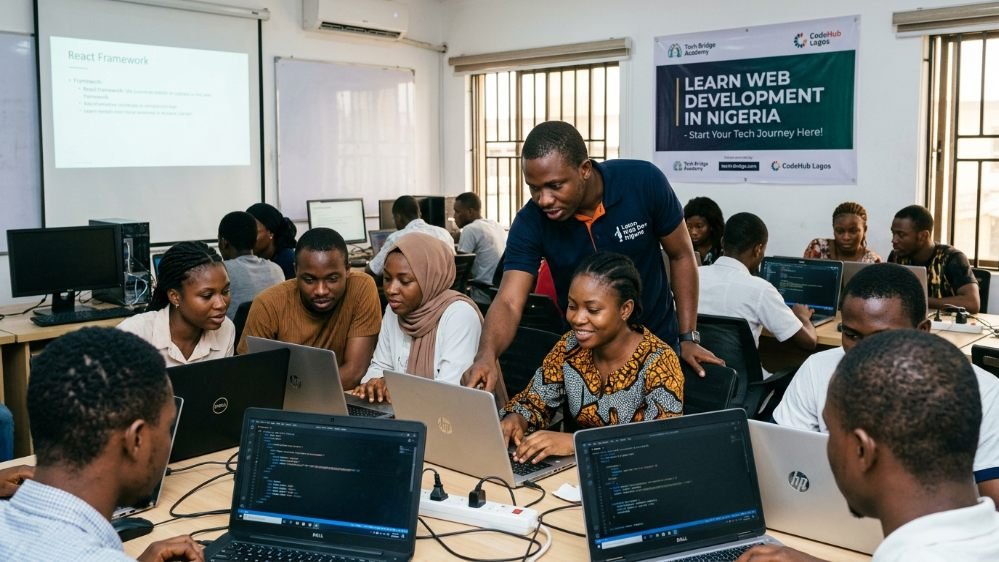
How you learn affects how long it takes. Structured programmes with project-based learning consistently produce job-ready developers faster than self-directed study alone.
| Learning Path | Duration | Cost Range (₦) | Outcome |
|---|---|---|---|
| Self-taught (free online resources) | 9 to 18 months | Free to ₦20,000 | Variable; depends heavily on discipline |
| YouTube and free courses (structured) | 6 to 12 months | Free | Good foundation if consistent |
| Paid online bootcamp (international) | 3 to 6 months | ₦150,000 to ₦500,000 | Strong, but may lack Nigerian market context |
| Local tech academy (Abuja or Lagos) | 3 to 6 months | ₦80,000 to ₦350,000 | Structured, mentored, locally relevant |
| University degree (Computer Science) | 4 to 5 years | ₦200,000 to ₦2,000,000+ | Comprehensive but slow path to employment |
| Internship at a tech agency | 6 to 12 months | Stipend-based | Practical, industry-embedded learning |
SoniBaze Tech Academy in Karu, Abuja runs a Web Development certification programme that takes students from beginner to job-ready in three to six months through physical, online, and corporate training formats. The curriculum includes live project work, which is one of the most important factors in how quickly students become employable.
Ready to start a career in web development? Learn and start your tech career today.
What Slows People Down
Knowing the obstacles that commonly extend timelines helps you avoid them.
Switching Focus Too Often
A common pattern in Nigeria is starting with HTML, switching to Python after two weeks, then seeing a YouTube video about Flutter and switching again. Each switch resets foundational learning and extends the overall timeline significantly. Pick one path and stay on it until you are job-ready.
Learning Without Building
Watching tutorials without building projects is the most widespread mistake in web development learning. You can complete 40 hours of video content and still be unable to build a working website from scratch. Every concept you learn should be applied immediately in a project, however small.
Waiting for Perfect Conditions
Slow internet, erratic electricity, and limited access to hardware are real challenges for learners in parts of Nigeria. They slow progress but do not stop it. Many successful Nigerian developers built their first projects on mobile data and basic laptops. Waiting for better conditions before starting adds months without adding knowledge.
No Accountability Structure
Self-directed learning without deadlines or accountability produces inconsistent results. Learners who join a structured programme, study group, or tech community in Abuja or Lagos consistently complete their training faster than those studying alone with no external structure.
What You Can Build After Each Phase
Progress is more motivating when it is tangible. Here is what a committed learner can realistically build at each stage:
| Stage | Timeline Reached | What You Can Build |
|---|---|---|
| Month 1 | HTML and CSS basics | Static web pages, basic personal portfolio |
| Month 2 to 3 | Responsive design, JavaScript intro | Mobile-friendly websites, simple interactive pages |
| Month 4 to 5 | JavaScript proficient | Web apps with dynamic content, form validation, API calls |
| Month 6 | React or Node.js basics | Single-page applications or basic backend APIs |
| Month 9 to 12 | Full-stack | Complete web applications with database, authentication, and deployment |
Building and deploying a real project at each stage, even a simple one, reinforces what you have learned and gives you something to show potential employers or clients.
How Long Before You Can Start Earning in Nigeria
Most web developers in Nigeria start earning before they finish learning. WordPress developers often take on paid projects by month three. Frontend developers who can build clean, responsive sites start freelancing by month four to five. Full-stack developers are more employable from month nine onward.
| Developer Type | Earliest Paid Work | Early Monthly Earnings (₦) |
|---|---|---|
| WordPress developer | Month 3 | ₦50,000 to ₦150,000 |
| Frontend developer | Month 4 to 5 | ₦80,000 to ₦200,000 |
| React developer | Month 7 to 9 | ₦150,000 to ₦400,000 |
| Full-stack developer | Month 9 to 12 | ₦250,000 to ₦600,000 |
These are conservative estimates for the Nigerian market. Developers who build a strong portfolio and actively seek freelance clients while still learning often exceed these figures earlier than expected.
Frequently Asked Questions
Can I learn web development in three months in Nigeria?
Yes, for specific paths. Three months of full-time, structured learning is enough to become a competent WordPress developer or build clean HTML and CSS websites. It is not enough to become a proficient JavaScript or React developer. If your goal is to start earning from web development within three months, WordPress is the most realistic entry point.
Is web development hard to learn for someone with no tech background?
The first two to four weeks are the most difficult. Learning to think logically and understand how code is structured takes adjustment for people with no prior technical experience. After that initial period, most people find consistent progress. The difficulty is not in the concepts themselves but in the discipline of daily practice without immediate visible results.
Do I need a laptop to learn web development in Nigeria?
A laptop is strongly recommended but not strictly required for early learning. Basic HTML and CSS can be practised on a smartphone using code editor apps. However, JavaScript development, React, and backend work require a laptop or desktop with enough RAM to run a code editor and browser simultaneously. A functional laptop with at least 4GB RAM is a reasonable minimum.
Is it worth learning web development in Nigeria in 2026?
Yes. Demand for web developers in Nigeria continues to grow faster than the supply of trained professionals. E-commerce growth, the expansion of fintech, and the increasing number of Nigerian businesses moving online all create sustained demand. Developers who can work remotely for international clients have access to income levels that are among the highest in the Nigerian tech sector.
What is the best place to learn web development in Abuja?
SoniBaze Tech Academy in Karu, Abuja offers a structured Web Development certification programme with physical and online options. The curriculum covers HTML, CSS, JavaScript, and framework fundamentals alongside live project work, which is the most important factor in becoming job-ready quickly. Enquiries can be made through sonibaze.ng.
Should I learn web development or digital marketing first?
It depends on your goal. Web development produces higher earning potential over time and opens the door to remote work for international clients. Digital marketing produces income faster for most people and requires a shorter training period. Some learners do both in sequence, starting with digital marketing to earn while learning web development over a longer period. SoniBaze Tech Academy offers both programmes for people who want to build skills in either or both areas.
Conclusion: Three to Twelve Months Is Realistic, Not Vague
The timeline to learn web development in Nigeria is three months if you have a narrow, specific goal and full-time commitment. It is closer to twelve months if you are building toward full-stack competency while studying part-time alongside other commitments.
What matters most is not how fast you learn but how consistently you practise and whether you build real projects along the way. A developer who spends six months building ten real websites is more employable than one who spends six months watching tutorials.
If you want a structured path with mentorship, deadlines, and live project experience, SoniBaze Tech Academy in Karu, Abuja offers web development training designed to get you from beginner to job-ready as efficiently as possible.
Ready to start a career in web development? Learn and start your tech career today.