A lot of Nigerian business owners only think about their Tax Clearance Certificate when a bank, a tender document, or a government agency asks for it. Then the questions start. Do I have one? Where do I find the number? Is mine still valid? What does a TCC code even look like?
This article answers all of that clearly, including how to check whether you already have a TCC, what the code looks like, and how to verify that it is genuine.
Obtain Your Tax Clearance Certificate (TCC)
Let us help you obtain your Tax Clearance Certificate (TCC) quickly and hassle-free. Our experts provide reliable support throughout the application process, ensuring your business meets all tax compliance requirements.
What Is a TCC Code?
A Tax Clearance Certificate, commonly called a TCC, is an official document issued by a tax authority in Nigeria confirming that a taxpayer has settled all tax obligations for the three years immediately preceding the current year of assessment. Every TCC issued carries a unique reference number. That reference number is what people mean when they say “TCC code.”
For companies and businesses registered at the federal level, the TCC is issued by the Nigeria Revenue Service, formerly known as the Federal Inland Revenue Service or FIRS. For individuals, sole traders, and business name owners, the TCC is issued by the relevant State Internal Revenue Service.
The modern electronic TCC, known as the e-TCC, also carries a QR code alongside the unique reference number. Both the reference number and the QR code can be used to verify the certificate’s authenticity online.
What a TCC Code Looks Like
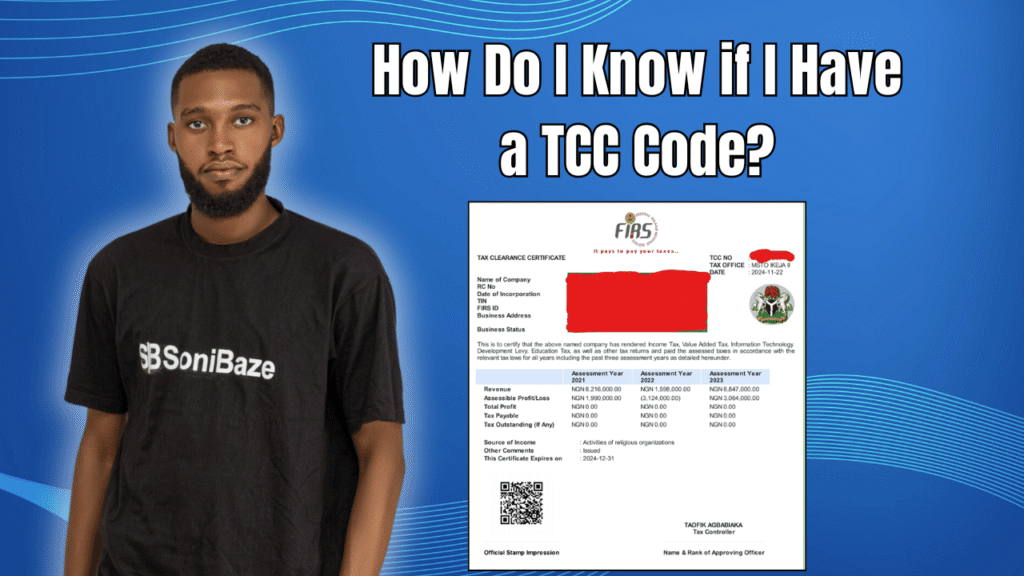
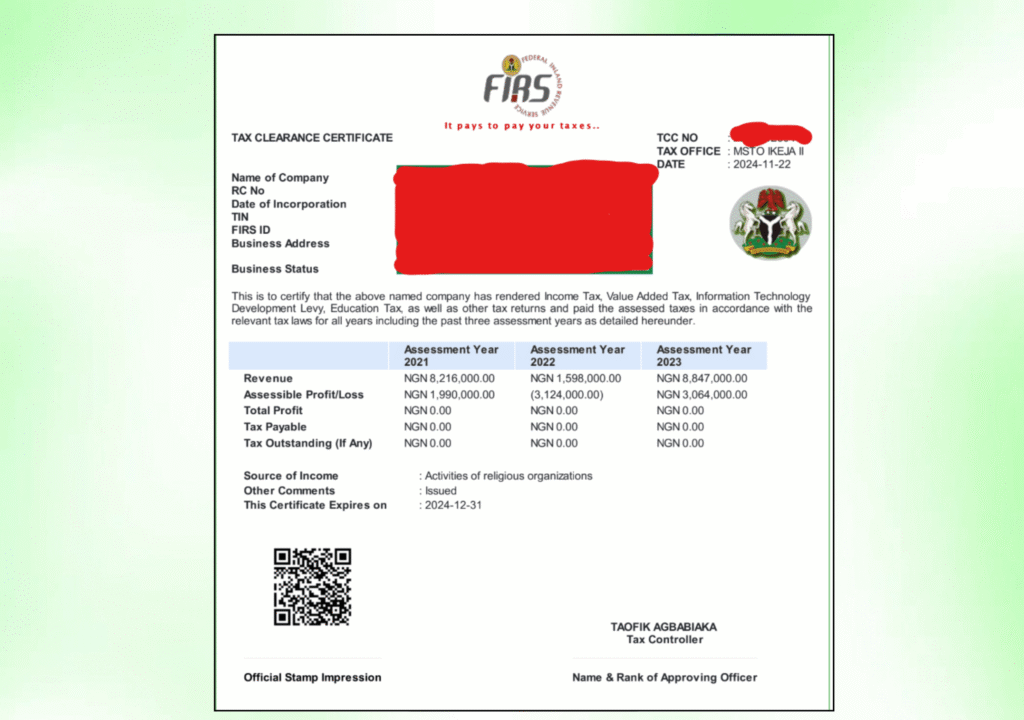
The TCC reference number is a unique alphanumeric code printed on the face of the certificate. It appears alongside other details such as the taxpayer’s name, Tax Identification Number, nature of business or employer name, and the tax figures for the three preceding years of assessment.
On the e-TCC, you will also see a QR code, which is a square barcode that links directly to the NRS verification portal when scanned. The combination of the reference number and the QR code is what makes modern TCCs verifiable without needing to visit a tax office.

How to Know if You Already Have a TCC
If you are unsure whether your company or business already has a valid TCC, here are the ways to check.
Check Your Email
When a TCC is generated online through the NRS e-TCC portal at tcc.firs.gov.ng, a copy is automatically sent to the registered email address on the taxpayer’s file. If your business has ever generated a TCC online, search your email inbox for messages from FIRS or NRS. The certificate is typically sent as a PDF attachment.
Log Into the NRS TCC Portal
For existing companies that have filed corporate tax returns for two or more years, the NRS online portal allows direct TCC generation and retrieval. Go to tcc.firs.gov.ng, log in with your Tax Identification Number and password, and check whether a certificate has been generated. If one exists and your tax affairs are in order, you can download or reprint it directly from the portal.
Check With Your Tax Consultant or Accountant
If your business engages a tax consultant or accounting firm to handle filings and compliance, they will have copies of all TCCs generated on your behalf. A quick call or message to them is often the fastest way to confirm whether you have a current one and retrieve the reference number.
Visit Your Nearest NRS or State IRS Office
If online access is not working or your company falls outside the automated portal’s scope, a visit to the relevant tax office can resolve it quickly. Bring your TIN and company documents. The tax officer can check your filing history and confirm whether a TCC has been issued, and whether it is still valid.
What Information Confirms You Have a TCC
When you locate your TCC, these are the details that confirm it is genuine and active.
| Detail | What to Check |
|---|---|
| Taxpayer name | Must match your registered company or personal name exactly |
| Tax Identification Number (TIN) | Must match the TIN on file with NRS or State IRS |
| Reference number | A unique code printed on the certificate |
| Years covered | Should show the three preceding years of assessment |
| Issuing authority | NRS for companies; State IRS for individuals and business names |
| Date of issuance | TCC is valid for one year from the date it was issued |
| QR code | Present on e-TCCs and links to the online verification portal |
Obtain Your Tax Clearance Certificate (TCC)
Let us help you obtain your Tax Clearance Certificate (TCC) quickly and hassle-free. Our experts provide reliable support throughout the application process, ensuring your business meets all tax compliance requirements.
How to Verify a TCC Code
Having a TCC is one thing. Knowing it is genuine and still valid is another. Here is how to verify.
Online Verification via the NRS Portal
Go to tcc.firs.gov.ng. There is a TCC validation section on the portal where you can enter the certificate’s reference number and confirm whether it is authentic and currently valid. This is the fastest method and does not require visiting any office.
QR Code Scan
For e-TCCs, open a QR code scanner on your phone, point it at the QR code printed on the certificate, and follow the link that appears. This takes you directly to the verification page for that specific certificate. Both the scanned details and the physical certificate should match.
FCT-IRS Verification Process
For TCCs issued by the Federal Capital Territory Internal Revenue Service, the verification process involves scanning the QR code on the certificate, following the displayed link, and filling in your email and organisation name on the form that appears. The system then confirms whether the certificate is verified.
Contact the Issuing Tax Authority
If online tools are not accessible, call or visit the NRS office or the relevant State IRS and provide the TCC reference number. They can confirm on their system whether the certificate is genuine and active.
Signs a TCC May Be Invalid or Fake
Not all TCCs in circulation are genuine. Before accepting one from a contractor or business partner, check for these warning signs.
| Red Flag | What It Suggests |
|---|---|
| No unique reference number | Likely not a genuine certificate |
| Reference number fails online verification | Could be forged or expired |
| Taxpayer name does not match company name | Mismatch suggests the certificate belongs to a different entity |
| Certificate is older than one year | TCC validity is one year from issuance |
| No QR code on an e-TCC | Genuine e-TCCs always include a QR code |
| Issuing authority does not match company type | Companies should have NRS-issued certificates, not State IRS |
Common Reasons You May Not Have a TCC
If you cannot find a TCC for your business, one of these is usually the reason.
You have not filed tax returns for the relevant years. A TCC cannot be issued if returns have not been filed. The NRS requires complete filings for the three preceding years before issuing the certificate.
Your tax payments are outstanding. Even if returns were filed, outstanding tax liabilities will block TCC issuance. All dues must be settled before the certificate is generated.
Your company is new. New companies that have filed returns for fewer than two years cannot use the automated online portal. The process for them requires a manual application at the NRS office, and the certificate may show nil figures for the years before the company was incorporated.
There is a pending tax reconciliation on your account. This can happen if there are discrepancies between what was filed and what the NRS has on record. In this case, the online portal will not generate a TCC, and a visit to the designated tax office is needed to resolve it before the certificate can be issued.
How Long Does It Take to Get a TCC?
For existing companies with a complete filing history and no outstanding liabilities, the online TCC is generated immediately upon login to the NRS portal. For companies applying manually or resolving compliance gaps first, processing typically takes a few days to a few weeks depending on the accuracy of the application and the workload at the relevant tax office.
Frequently Asked Questions
Can I get a TCC if I have not filed returns for three years?
No. The TCC covers the three years immediately preceding the current year of assessment. If returns have not been filed for those years, you must file and pay any outstanding taxes before the certificate can be issued. There is no shortcut around this requirement.
Is the TCC code the same as my TIN?
No. Your Tax Identification Number is a permanent identifier assigned to you or your company at registration with the tax authority. The TCC code is a unique reference number specific to each individual certificate issued. A single taxpayer will have a different TCC code each time a new certificate is issued.
How long is a TCC valid?
A TCC is valid for one year from the date of issuance. After that, a new certificate must be generated. This is why annual renewal is important, particularly for businesses that regularly tender for contracts or need to show tax compliance to banks and regulatory bodies.
Can an individual get a TCC, or is it only for companies?
Both individuals and companies can get a TCC. Companies and businesses registered at the federal level apply through the NRS. Individuals, sole traders, and business name owners apply through the relevant State Internal Revenue Service in the state where they are based.
What if my online portal login is not working?
If you cannot access the NRS TCC portal, first confirm that you are using the correct TIN and password registered on the system. If the login still fails, visit the nearest NRS office with your TIN and company documents. They can assist with portal access recovery and also confirm the status of your TCC directly.
Does having a TIN mean I automatically have a TCC?
No. A TIN is a registration number that identifies you as a registered taxpayer. A TCC is a separate document that is only issued after returns have been filed and taxes have been paid. Having a TIN is the first step, but it does not mean a TCC has been issued.
Conclusion: Check the Portal First, Then Sort Your Filing
If you are not sure whether you have a TCC, the quickest place to start is the NRS portal at tcc.firs.gov.ng. Log in with your TIN and check. If a certificate exists and your filings are current, you can download it in minutes.
If nothing comes up, the gap is almost always unfiled returns or unpaid liabilities. Sorting those out with a tax consultant before an urgent deadline is much less stressful than trying to process a TCC under pressure when a tender or bank application is waiting.
Obtain Your Tax Clearance Certificate (TCC)
Let us help you obtain your Tax Clearance Certificate (TCC) quickly and hassle-free. Our experts provide reliable support throughout the application process, ensuring your business meets all tax compliance requirements.