Most businesses in Nigeria only think about NSITF renewal when a contract bid is two weeks away and someone notices the certificate expired three months ago. By then, it is a scramble. The renewal process is not difficult, but it does require contributions to be current before you even begin, and that part catches a lot of companies off guard.
This article covers what NSITF is, what the compliance certificate actually proves, and exactly how the annual renewal process works.

Obtain Your NSITF Certificate
Let us help you obtain your Nigeria Social Insurance Trust Fund (NSITF) Compliance Certificate quickly and hassle-free. Our experts provide reliable support throughout the application process, ensuring your business meets all statutory compliance requirements.
What Is NSITF and Why Does the Certificate Exist?
The Nigeria Social Insurance Trust Fund is a Federal Government agency that administers the Employee Compensation Scheme, a mandatory social insurance programme that protects employees who suffer work-related harm. This includes injuries on the job, occupational diseases, temporary or permanent disability, and death arising from employment. The scheme covers medical bills, income replacement during recovery, long-term disability compensation, and support for dependants in cases of work-related death.
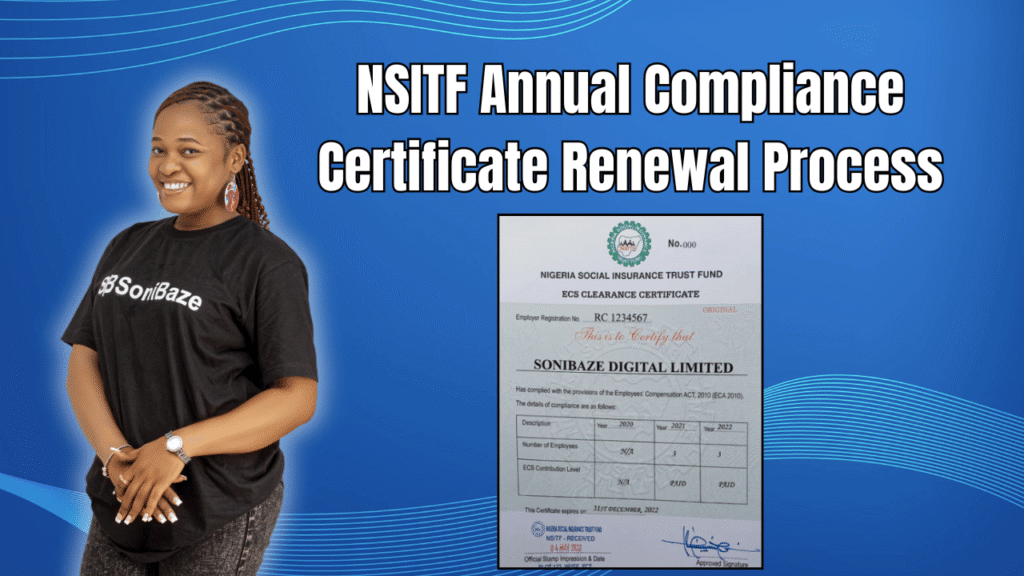
The NSITF compliance certificate is the document that confirms your company has registered with the fund, assessed its payroll, and remitted the required contributions. It is valid for one year and must be renewed annually. Without a current certificate, your company cannot participate in Federal Government procurement, and many private sector clients are increasingly requiring it as well.
Who Must Register and Contribute
All employers in Nigeria with at least five employees are required to register with NSITF and make contributions on behalf of their workers under the Employee Compensation Act. This applies to both public and private sector organisations.
The contribution rate is 1% of total monthly payroll. Payroll here means total remuneration as defined under the Act, excluding pension contributions, bonuses, overtime, and one-off payments like a 13th-month salary. The contribution is the employer’s obligation, not the employee’s.
For companies with fewer than five employees, NSITF registration is not compulsory. However, voluntary registration is possible.

What the Annual Renewal Process Involves
Renewing the NSITF compliance certificate is essentially the same process as the original application, with one critical difference: all monthly contributions from the previous year must already have been paid before the renewal application is submitted.
Here is how the process works step by step.
Step 1: Confirm Your Contributions Are Up to Date
Before anything else, confirm that all your monthly remittances to NSITF are current. This means every month’s 1% payroll contribution for the year must have been paid by the last working day of each respective month. Arrears or gaps in payment will delay or block your renewal.
If contributions are outstanding, they must be paid first, along with any applicable penalties for late remittance.
Step 2: Prepare Your Documents
The renewal application requires a set of documents submitted alongside a formal request on the company’s letterhead. Gather the following before approaching NSITF.
| Document | Details |
|---|---|
| Company letterhead request | A formal letter signifying intention to renew the compliance certificate |
| CAC Certificate of Incorporation | Certified copy of the company’s incorporation document from the Corporate Affairs Commission |
| NSITF 10-digit Registration Number | Issued to the employer at the time of original registration with the fund |
| Completed ECS RE 01 Form | The registration form used when the company first registered with NSITF |
| Completed Payroll Form RE 03 | The Employer Schedule of Payment form showing staff payroll details |
| Evidence of payment via Remita | Receipts showing that all contributions were made through the Remita platform |
| Employee records | A record of all staff covered under the scheme for the relevant period |
| Tax Clearance Certificate or TIN | Current TCC from FIRS, or the company’s Tax Identification Number as an alternative |
Step 3: Submit to Your Nearest NSITF Branch
NSITF does not operate through a single central office for submissions. The organisation runs 13 regional offices and 62 branch offices across Nigeria, which means you submit renewal documents at the branch closest to where your company operates.
Bring duplicate copies of all documents. The NSITF officer at the branch will review the submission, assess the payroll records, and confirm that contributions match the remittance history on file.
Step 4: Assessment and Levy Confirmation
After submission, NSITF carries out a physical assessment of the employer’s wage records to confirm the amount that should have been remitted over the covered period. This assessment determines whether the contributions already paid are accurate and complete.
If there are discrepancies or underpayments, the difference must be settled before the certificate is issued.
Step 5: Payment Through Remita
Any outstanding balance or renewal fee identified during assessment is paid through the Remita platform. NSITF does not accept direct cash payments. All remittances go through Remita, and the payment receipts serve as the evidence of compliance in the renewal file.
Step 6: Certificate Issuance
Once the assessment is complete, documents are verified, and all payments are confirmed, NSITF issues the renewed compliance certificate. The certificate covers the employer for one year from the date of issuance.
Obtain Your NSITF Certificate
Let us help you obtain your Nigeria Social Insurance Trust Fund (NSITF) Compliance Certificate quickly and hassle-free. Our experts provide reliable support throughout the application process, ensuring your business meets all statutory compliance requirements.
Renewal Timeline
The renewal process typically takes between 5 and 10 working days from the date of submission, provided all documents are in order and contributions are fully up to date. Incomplete submissions or outstanding contributions extend this timeline significantly.
| Stage | Typical Duration |
|---|---|
| Document preparation | 1 to 3 days (depends on company records) |
| Branch submission and acknowledgement | Same day |
| Assessment of payroll and contributions | 2 to 5 working days |
| Certificate issuance after clearance | 1 to 2 working days |
| Total from submission to certificate | 5 to 10 working days |
How Much Does NSITF Renewal Cost?
The renewal cost depends on the size of your payroll and the number of months being assessed. The contribution liability is calculated as 1% of total gross payroll for the covered period. There is no flat renewal fee beyond the payroll-based assessment.
If you use a consultant or compliance firm to process the renewal on your behalf, you will pay a professional fee on top of the contribution liability. Professional fees for NSITF processing through consultants generally range from N20,000 to N80,000 depending on the firm and the complexity of the company’s payroll records.
What Happens If You Do Not Renew
Operating with an expired NSITF certificate carries real consequences. Companies that miss renewal are disqualified from bidding for Federal Government contracts through any Ministry, Department, or Agency. A certificate that expired even one day before a bid submission date will result in disqualification.
Beyond procurement, non-compliance exposes the business to penalties and fines under the Employee Compensation Act, potential legal liability if a worker suffers a work-related injury while the company is unregistered, and reputational risk with clients who require current certificates as part of due diligence.
Keeping Track of Annual Renewal
The safest approach is to treat NSITF renewal as a fixed item on the company’s compliance calendar rather than something triggered by a contract deadline. Set a reminder to begin the renewal process at least 30 days before the current certificate expires.
Contributing monthly rather than attempting to clear a full year’s arrears at renewal time also makes the process significantly smoother. Monthly remittances through Remita keep records clean and remove the assessment risk of discovering a gap in the year’s payment history on the day of submission.
Frequently Asked Questions
Does the NSITF compliance certificate expire?
Yes. The certificate is valid for one year and must be renewed annually. There is no grace period after expiry before it becomes invalid for procurement purposes.
Can I renew online without visiting an NSITF office?
Initial registration can be done online through nsitf.gov.ng, but the renewal process currently requires physical submission of documents at an NSITF branch office. Contributions are made through Remita online, but the certificate application itself is handled in person.
What if my company’s contributions were paid late in some months?
Late contributions attract penalties under the Employee Compensation Act. Any outstanding penalty amounts must be paid alongside the renewal application. NSITF will assess the remittance history during the review and flag any months where payment came in after the deadline.
Is NSITF the same as PENCOM?
No. NSITF and PENCOM are separate compliance obligations. NSITF covers employee compensation for work-related injuries and incidents under the Employee Compensation Act. PENCOM relates to pension contributions under the Pension Reform Act. Both are required for government contracts but are administered by different agencies.
What is the NSITF head office address in Abuja?
NSITF’s headquarters is at Plot 794, Muhammadu Buhari Way, Central Business District, Garki, Abuja. The agency also operates 13 regional offices and 62 branch offices across Nigeria for employers outside Abuja.
Can a company register for NSITF and get a certificate even if it has fewer than five employees?
The Employee Compensation Act mandates registration for employers with five or more employees. Companies below this threshold are not required to register, though voluntary registration is an option. If a company below five employees needs the certificate for contract purposes, they should contact NSITF directly to discuss their situation.
Conclusion: Start Early and Keep Contributions Current
NSITF annual renewal is manageable when contributions are paid monthly as they fall due. The problems come when months are skipped and everything is left to be resolved at renewal time. Arrears, assessments, and penalty payments turn a five-day process into a month-long exercise.
The renewal itself requires a formal letter, your registration number, payroll forms, and Remita payment receipts. Submit to your nearest NSITF branch with all documents complete and the process moves quickly. The certificate follows within a week or so of a clean submission.
Obtain Your NSITF Certificate
Let us help you obtain your Nigeria Social Insurance Trust Fund (NSITF) Compliance Certificate quickly and hassle-free. Our experts provide reliable support throughout the application process, ensuring your business meets all statutory compliance requirements.