People keep asking whether web development is still a smart career path in Nigeria. Fair question. No-code tools are everywhere, AI can generate code, and a teenager in Gwarinpa can build a website on Wix in an afternoon without touching a single line of HTML. So where does that leave the professional web developer?
The short answer is yes, web development is still worth it in Nigeria in 2026. But the longer answer is more useful, because the nature of what makes it worth it has shifted. This article breaks down the demand, the income potential, the threats, and what you actually need to stay relevant.
Ready to start a career in web development? Learn and start your tech career today.
What Is Driving Demand for Web Developers in Nigeria Right Now
Nigeria has over 220 million people. Internet penetration crossed 55 percent in 2025, with more than 122 million active internet users. Businesses that ignored their online presence three years ago are now scrambling to get websites, fix broken ones, or rebuild entirely. That pressure is not slowing down.
E-commerce in particular has changed things. Nigerian consumers spent an estimated $12 billion online in 2025, and the gap between businesses with functional, fast, mobile-optimised websites and those without one is now a revenue gap, not just a perception gap. Brands want sites that load quickly on a 4G connection, integrate with Paystack or Flutterwave, and actually convert visitors into customers. That is a technical job.
Beyond e-commerce, the growth of startups, fintech platforms, health tech companies, and government digitisation programmes in Nigeria has created sustained demand for custom web applications that no Wix template can deliver. Companies like Interswitch, Piggyvest, and Cowrywise did not build on drag-and-drop platforms. They needed, and still need, developers.
The Threat from No-Code and AI Tools Is Real but Limited
Let’s not pretend the threat is nothing. Tools like Webflow, Framer, and Squarespace have made it possible for designers and marketers to build competent websites without writing code. AI tools like GitHub Copilot and even ChatGPT can write functional code blocks on demand. Some clients have started asking, “Why should I pay a developer when I can do this myself?”
That is a real question. For simple brochure websites, the answer is sometimes: you should not need to pay a developer. Those projects have largely moved to non-technical creators, and that part of the market is not coming back.
But most Nigerian businesses with serious digital ambitions run into the ceiling of no-code tools quickly. Custom integrations with Nigerian payment gateways, performance optimisation for low-bandwidth users, dynamic product catalogues, admin dashboards, API connections to logistics providers, mobile responsiveness across dozens of Android devices. These are not Wix problems. They are engineering problems.
The developers who are struggling in 2026 are the ones who only ever built basic WordPress sites and stopped there. The ones doing well are those who moved further up the stack.
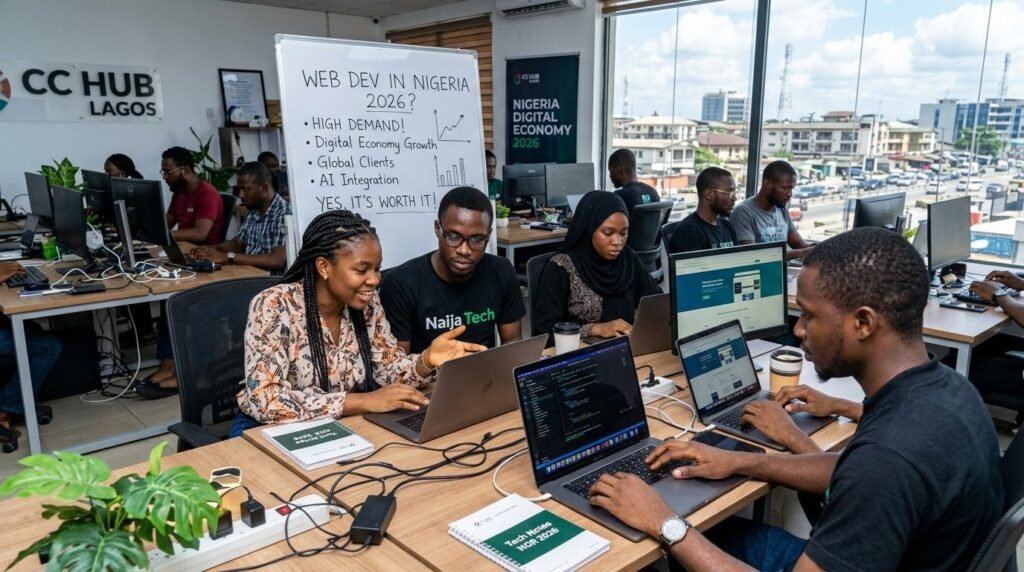
What Nigerian Web Developers Are Actually Earning in 2026
Salaries vary significantly by skill level, specialisation, and whether you work locally or remotely.
| Experience Level | Monthly Income (Local) | Monthly Income (Remote/Freelance) |
|---|---|---|
| Entry-level (0 to 2 years) | ₦120,000 to ₦250,000 | $300 to $700 USD |
| Mid-level (2 to 5 years) | ₦300,000 to ₦600,000 | $700 to $2,500 USD |
| Senior (5+ years) | ₦700,000 to ₦1,500,000+ | $3,000 to $8,000+ USD |
| Specialised (full-stack, fintech, mobile-web) | ₦800,000 to ₦2,000,000+ | $4,000 to $12,000+ USD |
Remote work has changed the calculation dramatically. A mid-level Nigerian developer with solid React and Node.js skills can earn three to five times more working for a UK or US company remotely than at a local firm. Platforms like Toptal, Arc.dev, and direct LinkedIn outreach have made this accessible to Nigerian developers with strong portfolios and communication skills.
Freelancing locally is also viable. A developer in Abuja building three to five corporate websites per year, each priced between ₦500,000 and ₦1,500,000, is generating a solid income without a single full-time employer.
The Skills That Still Command High Pay
Not all web development skills are equal in 2026. Some are saturated. Others are in serious demand with very few people who can do them well.
| Skill | Demand in Nigeria | Average Monthly Income |
|---|---|---|
| React / Next.js (Frontend) | High | ₦400,000 to ₦900,000 |
| Node.js / Express (Backend) | High | ₦450,000 to ₦1,000,000 |
| Full-Stack Development | Very High | ₦600,000 to ₦1,500,000 |
| WordPress (basic) | Saturated | ₦80,000 to ₦200,000 |
| PHP / Laravel | Moderate | ₦300,000 to ₦700,000 |
| Mobile-Web (React Native / Flutter) | Very High | ₦700,000 to ₦1,500,000 |
| Web Performance Optimisation | High, underserved | ₦500,000 to ₦1,200,000 |
| E-commerce Dev (WooCommerce, custom) | High | ₦350,000 to ₦800,000 |
| API Integration (Paystack, Flutterwave) | Very High | ₦500,000 to ₦1,200,000 |
Basic WordPress development is crowded. If that is all you know, 2026 is difficult. The market has not disappeared, but competition has driven prices down and clients expect more for less. Moving into JavaScript frameworks, backend logic, or custom integrations separates you from the crowd.
Web performance is particularly undervalued in Nigeria right now. Fewer than 20 percent of Nigerian websites score above 70 on Google PageSpeed Insights on mobile. Businesses are losing customers to slow load times, and most of them do not even know it. A developer who can audit, diagnose, and fix performance problems is solving a real, costly problem that most agencies ignore.
Web Development as a Business Skill, Not Just a Career
Here is something that gets overlooked: you do not have to be a full-time developer to benefit from knowing web development in Nigeria.
Business owners who understand how websites work make better decisions. They do not get overcharged by agencies. They know when a developer is padding a quote. They can brief their team clearly, review work accurately, and catch technical problems before they become expensive. Knowing the basics of HTML, CSS, and how a CMS functions is becoming a practical business literacy skill in Nigeria, not just a technical one.
Marketers who can build and modify landing pages without waiting for a developer ship campaigns faster. Product managers who understand front-end constraints make more realistic roadmaps. Entrepreneurs who can prototype their own ideas spend less money validating concepts before hiring a full team.
SoniBaze Digital works with Nigerian businesses to build fast, functional websites that are built to rank and convert, not just look good. The gap between a website that sits quietly online and one that generates leads consistently comes down to technical execution.

Is a Web Development Certification Worth It in Nigeria?
Yes, if you choose the right one and pair it with genuine practice.
A certificate alone does not get you hired. Clients and employers want to see what you have built. A portfolio of two or three real projects, even unpaid ones, carries more weight than any certificate in isolation. That said, structured training shortens the learning curve significantly. Someone who follows a proper curriculum covering HTML, CSS, JavaScript, a frontend framework, and basic backend programming will be job-ready faster than someone watching random YouTube videos with no direction.
SoniBaze Tech Academy in Karu, Abuja offers web development training as part of its certified digital technology programmes. The curriculum covers modern technologies, practical project work, and career guidance. Training is available in person, online, and for corporate teams. The next cohort intake is open at sonibaze.ng.
Ready to start a career in web development? Learn and start your tech career today.
Web Development vs Other Tech Careers in Nigeria: A Quick Comparison
If you are deciding between web development and other tech career paths, here is a practical comparison based on 2026 market conditions in Nigeria.
| Career Path | Entry Barrier | Time to Job-Ready | Income Potential | Remote Work Potential |
|---|---|---|---|---|
| Web Development | Moderate | 6 to 12 months | High | Very High |
| Data Analysis | Moderate | 4 to 8 months | High | High |
| UI/UX Design | Moderate | 4 to 8 months | Moderate to High | High |
| Cybersecurity | High | 9 to 18 months | Very High | Moderate |
| Digital Marketing | Low to Moderate | 3 to 6 months | Moderate | High |
| Project Management | Low | 2 to 4 months | Moderate | High |
Web development sits comfortably near the top of the income and remote work potential columns. It takes longer than digital marketing to get started and requires genuine technical discipline, but the ceiling is significantly higher.
Frequently Asked Questions
Is web development oversaturated in Nigeria in 2026?
Basic web development, particularly WordPress and simple HTML websites, is saturated. The mid to senior level of the market, including full-stack development, API integration, and custom web applications, is not oversaturated at all. There are more open positions and client projects requiring those skills than there are qualified developers to fill them. If you are asking whether it is worth learning web development in 2026, the answer depends entirely on how far up the skill ladder you are willing to go.
Can I get a web development job in Nigeria without a university degree?
Yes. Web development is one of the clearest examples of a skill-based field in Nigeria where a degree is not a prerequisite for employment or freelance income. Most Nigerian tech companies and startups care about what you can build and what you have already built. A strong portfolio, a relevant certification, and demonstrated problem-solving ability will get you further than a computer science degree with no practical projects to show.
How long does it take to become a web developer in Nigeria?
With consistent study and practice, most people can build functional websites and land their first paid work within six to twelve months. Becoming a mid-level developer with strong employability, the kind that can command ₦400,000 or more per month locally or work remotely for international clients, typically takes two to three years of deliberate practice, real project work, and continuous learning.
Is freelance web development better than getting a full-time job in Nigeria?
It depends on your financial situation and temperament. Freelancing offers higher income potential and flexibility, but income is irregular, especially in the first one to two years. A full-time role offers stability, structured mentorship, and faster skill growth early in your career. Many Nigerian developers start with a full-time role, build their skills, and then transition to freelancing or remote contract work once they have a strong portfolio and network.
What programming language should a Nigerian web developer learn first?
HTML and CSS first, then JavaScript. This sequence applies regardless of what framework or specialisation you eventually pursue. JavaScript is the most widely used programming language in web development globally and is directly applicable to both frontend and backend work through Node.js. Once you have a solid grasp of JavaScript, picking up frameworks like React or Vue becomes significantly easier.
How does web development compare to app development for income in Nigeria?
Mobile app development, particularly cross-platform development using React Native or Flutter, tends to command slightly higher rates than standard web development in Nigeria because fewer people can do it well. However, the line between web and mobile development is increasingly blurred. Many developers work across both, especially with progressive web apps becoming more common. Web development is generally a better starting point because the learning curve is lower and the path to freelance income is shorter.
Conclusion: Web Development Is Worth It If You Stay Ahead
Web development in Nigeria is not dying. It is sorting. The lower end of the market, basic sites, generic templates, and minimal customisation, has been commoditised. The middle and upper end, custom applications, high-performance builds, complex integrations, and full-stack products, is growing and paying well.
The developers who will struggle in 2026 are those who stopped learning. The ones who will thrive are those treating web development as a continuously evolving craft rather than a fixed set of skills learned once.
If you are considering getting into web development in Nigeria, or if you are already in it and wondering whether to keep going, the answer is clear. Go deeper, not wider. Pick a stack, get genuinely good at it, build real things, and the income and opportunities will follow.
Ready to start a career in web development? Learn and start your tech career today.