
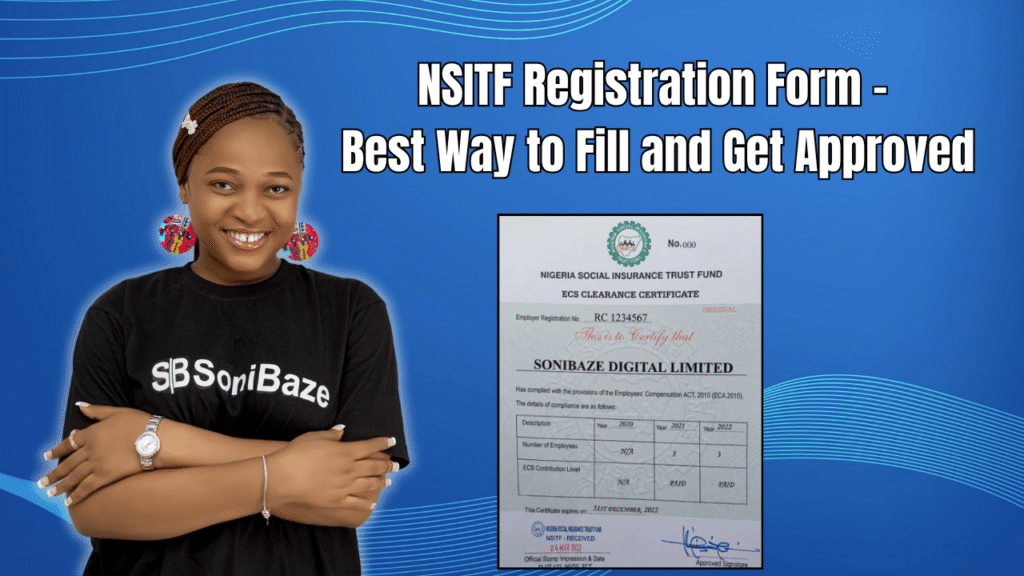
Many Nigerian businesses run into the NSITF requirement the same way. A government tender comes in, the checklist includes an NSITF Compliance Certificate, and the question becomes how to get it done quickly without making avoidable errors that add weeks to the process.
This article covers the NSITF registration form, what goes into it, how to fill it correctly, and what determines whether your application gets approved or sent back.

Obtain Your NSITF Certificate
Let us help you obtain your Nigeria Social Insurance Trust Fund (NSITF) Compliance Certificate quickly and hassle-free. Our experts provide reliable support throughout the application process, ensuring your business meets all statutory compliance requirements.
What Is NSITF and Why Does Registration Matter?
The Nigeria Social Insurance Trust Fund is a Federal Government agency under the Federal Ministry of Labour and Employment. It administers the Employees’ Compensation Scheme under the Employees’ Compensation Act 2010, which provides medical treatment, rehabilitation, and financial compensation to employees who suffer work-related injuries, diseases, or death.
Employers contribute 1% of their total monthly payroll to the scheme. This excludes pension contributions, bonuses, overtime payments, and one-off payments such as 13th-month income. After the first two years of operation, the NSITF Board conducts a risk assessment to classify contributions based on workers’ exposure levels.
Registration is a statutory requirement for every employer in Nigeria with at least one employee, covering both the public and private sectors. The Compliance Certificate that comes out of registration is also a mandatory document for Federal Government contract bidding, making it critical for any business pursuing public procurement.
The Two Core NSITF Registration Forms
Two forms are central to the employer registration process.
| Form | Name | Purpose |
|---|---|---|
| ECS RE01 | Registration of Employer | The primary form for registering the employer with the scheme |
| ECS RE03 | Employer Schedule of Payment | Used to document the employer’s payroll details for contribution assessment |
Both forms are available at the nearest NSITF office or through the official website at nsitf.gov.ng. The ECS RE01 is the starting point. ECS RE03 comes into play once the employer’s remuneration figures have been assessed.

What Information Goes Into the ECS RE01 Form?
The ECS RE01 (Registration of Employer) collects three main categories of information depending on the type of business entity.
For Public and Private Companies
| Field | What to Provide |
|---|---|
| Company name | Full registered name as on the CAC certificate |
| RC number | Corporate Affairs Commission registration number |
| Business address | Physical office address, not a P.O. Box |
| Nature of business | The primary activity the company engages in |
| Date of incorporation | As registered with CAC |
| Number of employees | Total headcount including contract and casual staff |
| Contact information | Phone number and email address |
| Business sector category | The industry classification that applies to the company |
For Sole Proprietorships and Partnerships
| Field | What to Provide |
|---|---|
| Owner or partners’ names | Full legal names of all proprietors or partners |
| BN number | Business name registration number from CAC |
| Business address | Physical location of the business |
| Nature of business | Primary business activity |
| Number of employees | Including part-time and casual workers |
| Contact details | Working phone and email |
The business sector category field is worth paying close attention to. NSITF uses this classification to determine risk exposure levels, which feeds into how contributions may be assessed after the initial two-year flat rate period. Selecting the wrong sector category can cause a query.
Documents Required for NSITF Registration
Gathering these before touching the form is the smartest approach. Incomplete submissions are the most common reason applications stall.
| Document | Details |
|---|---|
| CAC Certificate of Incorporation | For limited liability companies |
| CAC Certificate of Registration | For business names and partnerships |
| Tax Identification Number (TIN) | From the Federal Inland Revenue Service |
| Company profile | A document describing the nature of the business and key personnel |
| Employee details | Names, roles, and remuneration figures for all staff |
| Evidence of registered address | Utility bill or tenancy agreement matching the submitted address |
| Official request letter | Required when applying for the Compliance Certificate after payment |
The employee details are particularly important because NSITF uses the remuneration figures to calculate the contribution amount before issuing the payment schedule.
Obtain Your NSITF Certificate
Let us help you obtain your Nigeria Social Insurance Trust Fund (NSITF) Compliance Certificate quickly and hassle-free. Our experts provide reliable support throughout the application process, ensuring your business meets all statutory compliance requirements.
Step-by-Step: How the Registration and Approval Process Works
Step 1: Obtain and Complete Form ECS RE01
Collect the form from the nearest NSITF office or download it from nsitf.gov.ng. Fill in all fields using information that matches your CAC documents exactly. Mismatches between the form and your CAC registration are a common trigger for queries. Use the registered company name, not a trading name or abbreviation.
Step 2: Submit the Completed Form and Documents
Take the completed ECS RE01 and all supporting documents to the NSITF office that covers your company’s location. The office will process your submission and conduct an assessment of your employees’ remuneration details to determine the payable contribution amount.
Step 3: Receive and Complete Form ECS RE03
Once the initial submission is reviewed, NSITF issues Form ECS RE03 (Employer Schedule of Payment). This form documents the breakdown of staff remuneration and the calculated contribution. Complete it accurately based on your actual payroll figures.
Step 4: Make Payment via Remita
Payments are made through the Remita platform, not directly to NSITF offices. The contribution amount is based on 1% of your total monthly payroll as assessed. Keep the payment receipt as it is required for the next step.
Step 5: Submit Request Letter and Payment Evidence for Certificate
After payment, submit an official request letter along with the Certificate of Incorporation, completed ECS forms, and the evidence of payment. This package triggers the issuance of the Compliance Certificate. According to NSITF’s official portal, the Compliance Certificate is typically processed within 5 working days after successful submission and payment verification.
How Much Does NSITF Registration Cost?
The contribution itself is 1% of total monthly payroll. Beyond that, NSITF charges approximately N50,000 for initial registration and certification processing. Late payment carries a penalty of 5% to 10% per month on unpaid or unremitted contributions, which is why registering as soon as a business begins hiring is significantly cheaper than regularising years of arrears later.
Common Reasons Applications Are Rejected or Delayed
Getting the form filled correctly is only half the process. Understanding what causes delays helps avoid them.
| Problem | How to Avoid It |
|---|---|
| Company name mismatch | Use the exact registered name from the CAC certificate on every field |
| Missing employee remuneration details | Prepare a full payroll list with figures before visiting the office |
| Wrong business sector category | Confirm the correct classification with the NSITF officer before submitting |
| Payment not made via Remita | Do not pay through any other channel regardless of what you are told |
| Missing request letter for certificate | Draft and attach the official request letter before submitting for certification |
| Incomplete documents | Compile every required document before the first office visit |
One practical tip: bring original documents and clear photocopies to the NSITF office on the day of submission. Officers will verify originals but retain the copies. Going back for copies wastes time.
Annual Compliance Requirement
Registration is a one-time process but compliance is ongoing. Employers must remit 1% of monthly payroll every month and report workplace accidents or injuries to NSITF within 7 days of occurrence. The Compliance Certificate confirms that contributions are current and is renewed periodically based on payment records.
Businesses that stop remitting contributions without formally closing or deregistering risk losing their compliant status, which affects their ability to bid for government contracts and may trigger penalty assessments.
Frequently Asked Questions
Do small businesses with fewer than five employees need to register with NSITF?
Yes. The Employees’ Compensation Act 2010 covers every employer in Nigeria with at least one employee. The threshold of five employees that applies to ITF contributions does not apply to NSITF. Even a company with a single employee is required to register and contribute.
Can the NSITF registration form be submitted online?
NSITF has been working toward digitising its services, and the eNSITF platform is available at nsitf.gov.ng for some functions. However, the core employer registration process, particularly for new registrations, typically involves an in-person visit to the NSITF office covering your business location. Confirm the current procedure directly with your nearest NSITF office before assuming a fully online process applies.
How long does it take to get the NSITF Compliance Certificate?
NSITF’s official guidance states that the Compliance Certificate is processed within 5 working days after successful submission of all requirements and verification of payment. In practice, having all documents complete and payment confirmed through Remita puts you in the best position to meet that timeline.
What happens if my company has never registered but has been operating for years?
Late registration is possible and recommended. NSITF can assess arrears based on the period of operation and the number of employees during that time. Regularising voluntarily is preferable to being flagged during a government contract verification process, which often triggers a formal assessment with penalties attached.
Is the NSITF Compliance Certificate the same as the NSITF registration certificate?
They serve different purposes. The Registration Certificate confirms that the employer has been registered with the scheme. The Compliance Certificate confirms that the employer is current with contributions. It is the Compliance Certificate that is required for government procurement and most regulatory filings.
Can a company register with NSITF and immediately apply for a government contract?
Registration alone is not enough for contract purposes. The Compliance Certificate is what procurement authorities require, and that certificate is issued only after registration and payment of the assessed contribution. Budget for both the processing fee and the first contribution when planning timelines for a contract bid.
Conclusion: Prepare the Documents First, Then Fill the Form
The NSITF registration form itself is not complicated. What makes the process slow for most businesses is arriving at the NSITF office without complete employee details, mismatched documents, or without a clear understanding of which business sector category applies to them.
Prepare a full employee list with remuneration figures, gather your CAC documents and TIN, draft the request letter in advance, and go to the NSITF office with everything in order. That approach turns a process that some businesses spend weeks on into one that is done within a few working days.
Obtain Your NSITF Certificate
Let us help you obtain your Nigeria Social Insurance Trust Fund (NSITF) Compliance Certificate quickly and hassle-free. Our experts provide reliable support throughout the application process, ensuring your business meets all statutory compliance requirements.