
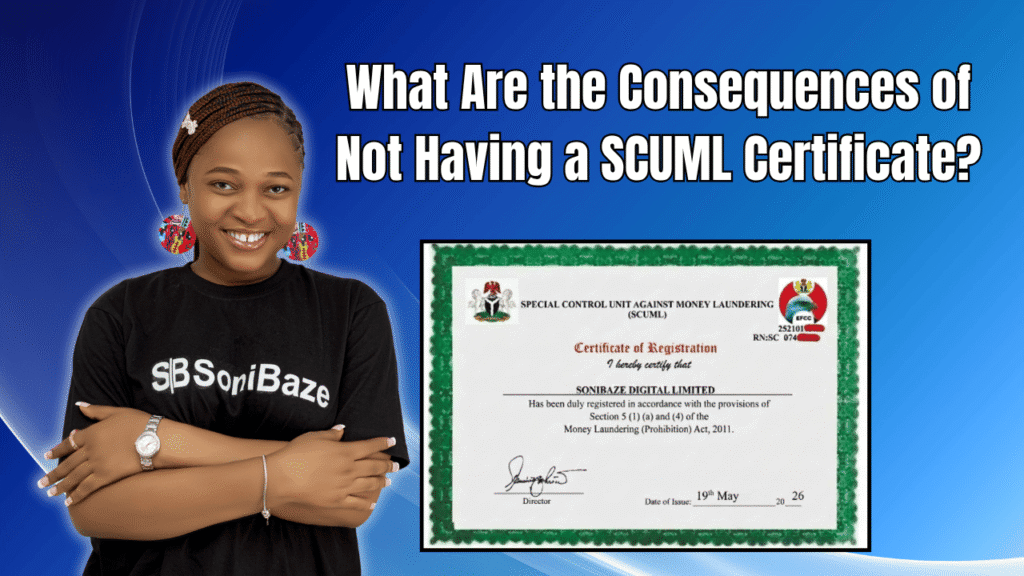
Most business owners in Nigeria only hear about SCUML when a bank tells them they cannot open a corporate account without it. They register, get the certificate, and move on. What many do not realise is that obtaining the certificate is step one of a longer compliance obligation, and that operating without one in the first place exposes a business to consequences that go well beyond a blocked bank account.
If your business falls under the category of a Designated Non-Financial Business or Profession (DNFBP) and you do not have a valid SCUML certificate, you are technically in breach of the Money Laundering (Prevention and Prohibition) Act 2022. The consequences of that breach are real, and they compound the longer the situation continues.
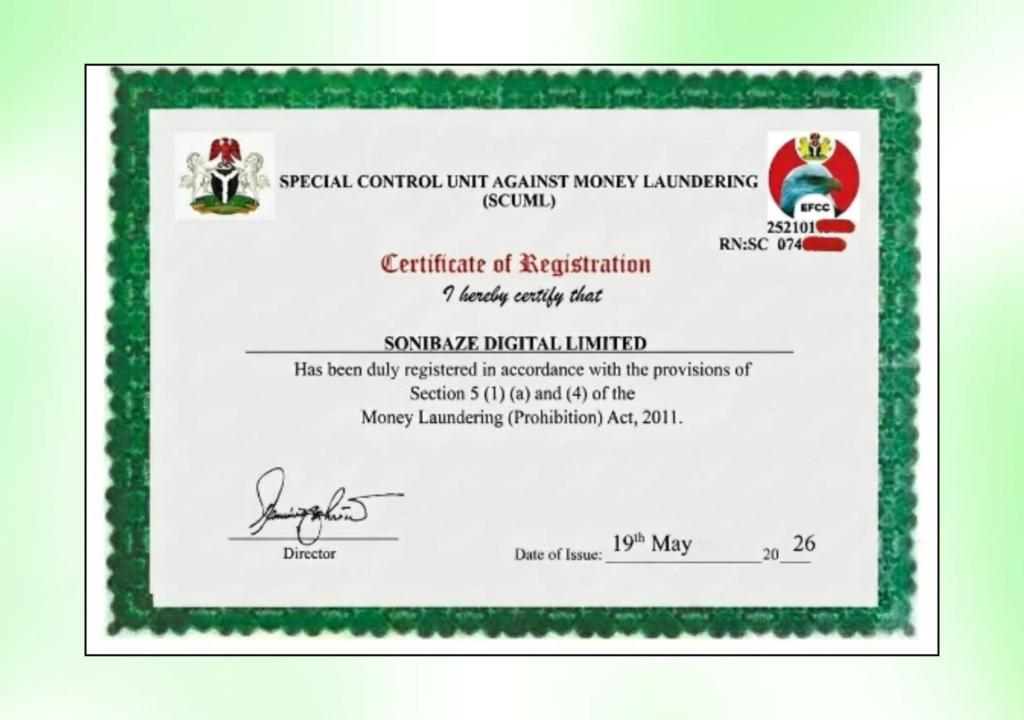
Obtain Your EFCC SCUML Certificate
Let us help you get your EFCC SCUML Certificate quickly and hassle-free. Our team provides fast, reliable support to ensure your SCUML registration is completed accurately and in compliance with regulatory requirements.
Who This Applies To
Before getting into the consequences, it is worth being clear about which businesses are in scope. SCUML registration is required for DNFBPs, a category that includes real estate agents, property developers, estate surveyors, car dealers, accountants, auditors, tax consultants, legal practitioners, hotels, supermarkets, construction companies, jewellery and precious stone dealers, consultants, pool betting operators, NGOs, and trust and company service providers.
If your business is on this list and you are operating without a SCUML certificate, you are not in a grey area. The law is clear.
The Consequences of Not Having a SCUML Certificate
1. No Corporate Bank Account
This is the first wall most businesses hit. Commercial banks in Nigeria are legally required to demand a SCUML certificate from DNFBPs before opening or maintaining a corporate account. Without it, the account application will be declined outright.
For businesses that have already been operating and have an account, non-compliance discovered during a bank review can result in the account being restricted or closed. This is not a technicality banks overlook casually, particularly after increased regulatory scrutiny of DNFBP compliance in recent years.

2. Financial Fines and Penalties
Failure to comply with SCUML regulations can result in fines, and the amounts are significant. Penalties of up to ₦5,000,000 (five million naira) apply for corporate bodies found to be in breach. These fines are imposed by the EFCC or SCUML directly and are separate from any legal proceedings that may follow.
For a small or medium business, a five-million-naira fine is not an abstract risk. It is a cash hit that most businesses are not positioned to absorb while continuing normal operations.
3. Business Closure and Licence Revocation
Non-compliance can lead to the suspension or revocation of business licences. In more serious cases, the EFCC can order operational shutdown pending compliance. This is not a theoretical outcome. Bank accounts could be frozen without warning and assets seized when enforcement action is triggered.
For businesses that have built up clients, contracts, and operational infrastructure, a regulatory shutdown is a far more damaging outcome than the cost and time involved in registering in the first place.
4. Criminal Prosecution of Directors
This is the consequence most business owners do not anticipate. A director of a company that fails to register with SCUML or that fails to file required suspicious transaction reports can face criminal charges in their personal capacity. The liability does not stop at the company level. Individuals running the business are personally exposed.
Directors or key personnel may face prosecution for aiding money laundering or terrorism financing if the non-compliance is found to have enabled illegal financial activity, even if that was never the intent.
5. Frozen Accounts and Seized Assets
EFCC enforcement actions can include freezing business accounts and seizing assets while investigations are carried out. Once enforcement begins, the business does not simply register and have everything resolved. There is a legal process to work through, and operations may be disrupted for the entire duration.
6. Inability to Win Government and Corporate Contracts
Non-compliance can lead to inability to bid for contracts, especially those involving government or large corporations. Tenders and procurement processes increasingly require compliance documentation as a baseline. A business without a SCUML certificate may be disqualified before evaluation even begins.
For businesses whose revenue depends on contract work, this is a direct commercial consequence that reduces competitiveness in the market.
7. Reputational Damage
Non-compliance may damage the reputation of the entity and lead to loss of business opportunities. Once EFCC enforcement actions are taken, they are not private. Regulatory action against a business becomes part of its public record and can affect how clients, partners, and financial institutions view the organisation.
In Nigeria’s business environment, where trust and credibility are major factors in referrals and long-term relationships, reputational damage from an EFCC enforcement action can outlast the original compliance issue by years.
Consequences at a Glance
| Consequence | Who It Affects | Severity |
|---|---|---|
| No corporate bank account | The business | Immediate, operational |
| Financial fines up to ₦5,000,000 | The business | High |
| Suspension or licence revocation | The business | Very high |
| Criminal prosecution | Directors personally | Severe |
| Frozen accounts and seized assets | The business and its assets | Very high |
| Disqualification from contracts | Revenue pipeline | High |
| Reputational damage | Business and principals | Long-term |
Obtain Your EFCC SCUML Certificate
Let us help you get your EFCC SCUML Certificate quickly and hassle-free. Our team provides fast, reliable support to ensure your SCUML registration is completed accurately and in compliance with regulatory requirements.
A Common Mistake: Thinking Registration Ends the Obligation
Many businesses register with SCUML once, receive the certificate, and assume the job is done. SCUML compliance does not end at registration. Filing the required reports as and when due is a legal obligation for all DNFBPs and it is as important as obtaining the SCUML certificate.
Registered businesses are required to submit Currency Transaction Reports (CTRs) and Suspicious Transaction Reports (STRs) to SCUML on an ongoing basis. Businesses that have the certificate but are not meeting these reporting obligations are still non-compliant. The certificate is a starting point, not a complete solution.
Operating on an expired SCUML certificate carries the same risk as operating without registration — the business is technically non-compliant from the date of expiry. Certificate renewal should be tracked and managed well before expiry, not handled reactively after the fact.
What Triggers Enforcement
EFCC and SCUML enforcement is not only reactive. The integration between the Corporate Affairs Commission and SCUML means that businesses that have completed company registration but not SCUML registration are identifiable in the regulatory system. Enforcement risk is not limited to businesses that attract attention through suspicious activity. It applies to any qualifying DNFBP that is simply not registered.
In many cases, enforcement visits result in businesses paying substantial penalties for failing to obtain a SCUML certificate or neglecting to file Currency Transaction Reports. Waiting for a knock on the door is not a strategy.
Frequently Asked Questions
Can my business continue operating without a SCUML certificate while I process the application?
Technically, you are already in breach from the point your business qualified as a DNFBP and did not register. There is no formal grace period beyond the three months from business commencement that SCUML guidelines reference. Getting the application submitted as early as possible reduces the exposure window.
If I register now after a long period without SCUML, will I face penalties for the delay?
Retroactive penalties are possible, particularly if the non-compliance is picked up during an EFCC review or enforcement visit. Voluntary registration before any enforcement action is initiated is the safest position. It does not guarantee immunity from past non-compliance, but it is substantially better than being caught unregistered during an inspection.
Does an expired SCUML certificate create the same risk as never registering?
Yes. From the date of expiry, the business is treated as non-compliant. Renewal should be initiated well before the certificate expires rather than after.
Are there SCUML obligations beyond the certificate itself?
Yes. Registered DNFBPs are required to file Currency Transaction Reports and Suspicious Transaction Reports with SCUML on an ongoing basis. Many business owners are unaware of this once they have the certificate and have opened their bank account.
What should I do if I have already received a query or visit from EFCC or SCUML?
Engage a legal practitioner with experience in compliance and AML matters immediately. Do not attempt to navigate an ongoing EFCC inquiry without legal representation. The penalties at stake, including criminal liability for directors, make this a situation where professional guidance is not optional.
Which sectors are most at risk of SCUML enforcement?
Real estate, hospitality, legal services, accounting, and construction are among the most closely monitored sectors because of their historical exposure to money laundering activity. If your business operates in one of these areas without a SCUML certificate, the enforcement risk is higher than in other categories.
Conclusion: The Certificate Costs Nothing, Non-Compliance Costs Everything
SCUML registration is free. The process takes one to three weeks for most businesses. The consequences of skipping it range from a blocked bank account at the mild end, to criminal prosecution of directors at the severe end, with fines, licence revocation, and reputational damage sitting in between.
The calculation is not complicated. The cost of non-compliance far exceeds the cost of spending a few days getting the paperwork in order.
Obtain Your EFCC SCUML Certificate
Let us help you get your EFCC SCUML Certificate quickly and hassle-free. Our team provides fast, reliable support to ensure your SCUML registration is completed accurately and in compliance with regulatory requirements.