Lead generation companies sit between businesses that need customers and the audiences those businesses are trying to reach. They find, qualify, and deliver potential buyers, and they get paid for doing it. What is less obvious is how exactly that payment is structured and why the model works so well for both sides.
This article explains the different ways lead generation companies earn revenue, which models are most common in Nigeria, and what you should know if you are thinking of hiring one or building one.
Let’s generate qualified leads for your business. We’ve got the strategy that converts.
What a Lead Generation Company Actually Does
A lead generation company collects contact information and buying intent data from people who have shown interest in a product or service. That data is packaged as a “lead” and sold or delivered to a business that wants to convert that person into a paying customer.
The leads can come from many sources. Search engine advertising, social media campaigns, content marketing, email lists, landing pages, and SEO-driven websites are the most common. Some companies also use telemarketing, trade shows, or referral networks to generate leads offline.
The quality of a lead depends on how much intent is attached to it. A person who filled out a quote request form is a stronger lead than someone who just clicked an ad. Lead generation companies charge more for higher-intent leads because they convert at a better rate.
How Lead Generation Companies Make Money
1. Pay Per Lead (PPL)
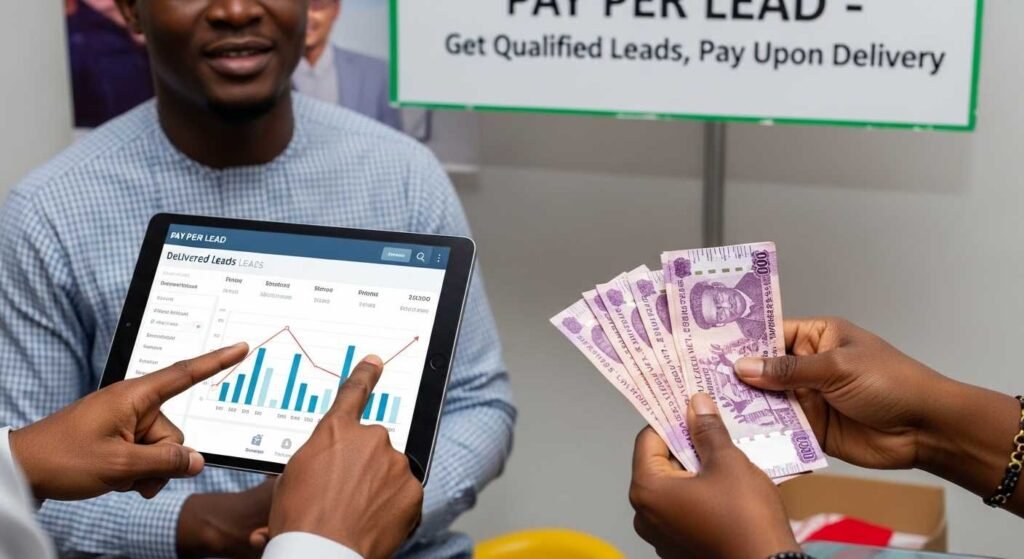
This is the most common model. The client pays a fixed fee for every lead delivered, regardless of whether that lead converts into a sale. The fee per lead varies based on industry, exclusivity, and the qualification criteria set by the client.
In Nigeria, pay-per-lead fees for service businesses such as insurance, real estate, or financial services range from ₦2,000 to ₦25,000 per lead depending on how qualified the contact is. High-value industries like property development or legal services can pay significantly more.
| Industry | Typical Fee Per Lead (Nigeria) |
|---|---|
| Financial services / loans | ₦5,000 – ₦20,000 |
| Real estate | ₦10,000 – ₦50,000 |
| Insurance | ₦3,000 – ₦15,000 |
| Education / training | ₦2,000 – ₦8,000 |
| Health and wellness | ₦3,000 – ₦12,000 |
| B2B services | ₦15,000 – ₦80,000 |
2. Pay Per Appointment (PPA)
Some clients are not just paying for contact details. They want confirmed meetings with potential buyers. In this model, the lead generation company books an actual appointment between the prospect and the client’s sales team before the fee is triggered.
This model commands higher fees than pay per lead because more work is involved. The company must not only attract the prospect but also qualify them and secure their commitment to a meeting. For B2B lead generation in Nigeria, pay-per-appointment fees typically range from ₦20,000 to ₦150,000 per confirmed meeting.
3. Pay Per Sale or Revenue Share
In this model, the lead generation company earns a percentage of each sale that results from a lead they provided. Instead of a flat fee, they take a commission, often between 5% and 30% depending on the product or service.
This arrangement is common in affiliate marketing, e-commerce partnerships, and insurance sales in Nigeria. It aligns the lead generator’s incentive with the client’s revenue, which makes it attractive to clients who are cautious about upfront costs. The risk for the lead generation company is that they absorb the cost of generating leads without guaranteed payment if sales do not close.
4. Monthly Retainer Model
Some lead generation companies charge a fixed monthly fee to manage the entire process on the client’s behalf. This includes running ads, managing landing pages, qualifying leads, and delivering them regularly throughout the month.
The retainer model is common for businesses that need a consistent volume of leads and want to outsource the entire acquisition function. Monthly retainers for lead generation services in Nigeria range from ₦150,000 to ₦800,000 depending on the scale of the campaign and the channels involved.
| Retainer Tier | Monthly Fee Range | What Is Typically Included |
|---|---|---|
| Basic | ₦150,000 – ₦250,000 | One channel, small volume, monthly report |
| Mid-level | ₦300,000 – ₦500,000 | Two to three channels, qualified leads, CRM delivery |
| Full-service | ₦600,000 – ₦800,000+ | Multi-channel, appointment setting, performance tracking |
5. Selling Lead Data in Bulk
Some lead generation companies build large databases of consumer or business data and sell that data in bulk to multiple buyers. A company might collect contact details from a health-related survey and sell that list to several medical insurance providers, pharmacies, or wellness brands.
This model is more controversial because the same leads are sold to competing buyers, which reduces their exclusivity and conversion rate. However, it is a high-margin model when the database is large. In Nigeria, bulk lead lists are sometimes offered by data vendors and digital marketing firms for fixed fees based on volume and category.
6. Lead Generation as Part of a Broader Agency Service
Many digital marketing agencies in Nigeria do not sell leads directly. Instead, they build and manage the infrastructure that generates leads for their clients, such as ad campaigns, SEO content, and landing pages, and charge for that as a service.
In this arrangement, the client owns the leads directly. The agency earns its revenue through service fees rather than per-lead pricing. SoniBaze Digital, for example, runs paid media and SEO campaigns that generate leads for clients across Abuja and Nigeria, with the client retaining full ownership of the data and conversions.
Let’s generate qualified leads for your business. We’ve got the strategy that converts.
Exclusive vs Shared Leads: What the Difference Means for Pricing
One of the biggest factors in lead pricing is exclusivity. An exclusive lead is sold to only one buyer. A shared lead is sold to two or more competing businesses at the same time.
Exclusive leads cost more but convert better. Shared leads are cheaper but arrive in a competitive environment where the prospect may have already spoken to a rival before your sales team calls.
| Lead Type | Typical Price Premium | Best For |
|---|---|---|
| Exclusive lead | 2x to 4x higher | High-value services, long sales cycles |
| Shared lead | Lower cost | High-volume, fast-moving products |
What Makes a Lead Generation Business Profitable
The profitability of a lead generation company depends on the gap between what it costs to generate a lead and what a client pays for it. A company spending ₦3,000 in ad costs to generate a lead it sells for ₦10,000 is running a healthy margin.
That margin is protected by targeting efficiency, landing page conversion rates, and lead quality. Companies that invest in better audience targeting and faster qualification processes keep their cost per lead low while maintaining or increasing their prices.
Volume also matters. A company generating 50 leads a month at ₦10,000 each earns ₦500,000. Scaling that to 500 leads a month with similar margins produces ₦5,000,000. The cost structure does not rise linearly, which is what makes the model scalable.
Frequently Asked Questions
Is lead generation profitable as a business in Nigeria?
Yes, particularly for high-value industries like real estate, financial services, insurance, and B2B services. The model works because businesses will always need new customers, and generating qualified interest consistently is a skill not every company can do internally. Margins can be strong once targeting and conversion infrastructure are in place.
What is the difference between lead generation and digital marketing?
Digital marketing is a broad term covering all online promotion activities, including SEO, social media, content, and advertising. Lead generation is a specific goal within digital marketing, focused on collecting contact information and buying intent from potential customers. Many digital marketing agencies offer lead generation as one of their services.
How do lead generation companies get paid if the leads do not convert?
Under a pay-per-lead model, the company is paid for delivering leads regardless of whether those leads convert to sales. That is the key difference between pay per lead and pay per sale. Clients who want to only pay for results typically use a revenue share or pay-per-sale arrangement, but they often pay a higher rate per conversion in exchange.
Can a small business in Nigeria hire a lead generation company?
Yes. Several agencies in Nigeria offer lead generation services scaled to smaller budgets. Entry-level retainers start around ₦150,000 per month for simple single-channel campaigns. Small businesses should define a clear target customer profile and set a realistic cost-per-lead expectation before engaging any provider.
How do I know if a lead generation company is delivering quality leads?
Track the conversion rate from lead to actual sale. A quality lead should have verifiable contact information, should have demonstrated interest in your specific offer, and should be reachable. If you are receiving leads with wrong numbers, no buying intent, or contacts from irrelevant industries, the quality standards need to be renegotiated with your provider.
Does SoniBaze Digital offer lead generation services?
SoniBaze Digital runs paid media campaigns and SEO strategies that generate qualified leads for businesses across Nigeria. Clients retain ownership of all lead data while the agency manages targeting, ad spend, and landing page performance. Visit sonibaze.ng to discuss your lead generation needs.
Conclusion: The Model Rewards Efficiency
Lead generation companies make money by sitting at the intersection of audience access and buyer demand. The more efficiently they can attract the right people and the more reliably they can qualify and deliver them, the higher their margins and the more clients they retain.
For business owners, understanding these models helps you choose the right arrangement. Pay per lead protects you from overspending on traffic with no results. Revenue share aligns your provider’s incentives with yours. A retainer gives you consistent volume with predictable costs.
If your business needs a steady flow of qualified enquiries, the right lead generation strategy can reduce your dependence on referrals and walk-ins. SoniBaze Digital helps businesses across Nigeria build lead generation systems using SEO, paid ads, and content marketing. Visit sonibaze.ng to get started.
Let’s generate qualified leads for your business. We’ve got the strategy that converts.