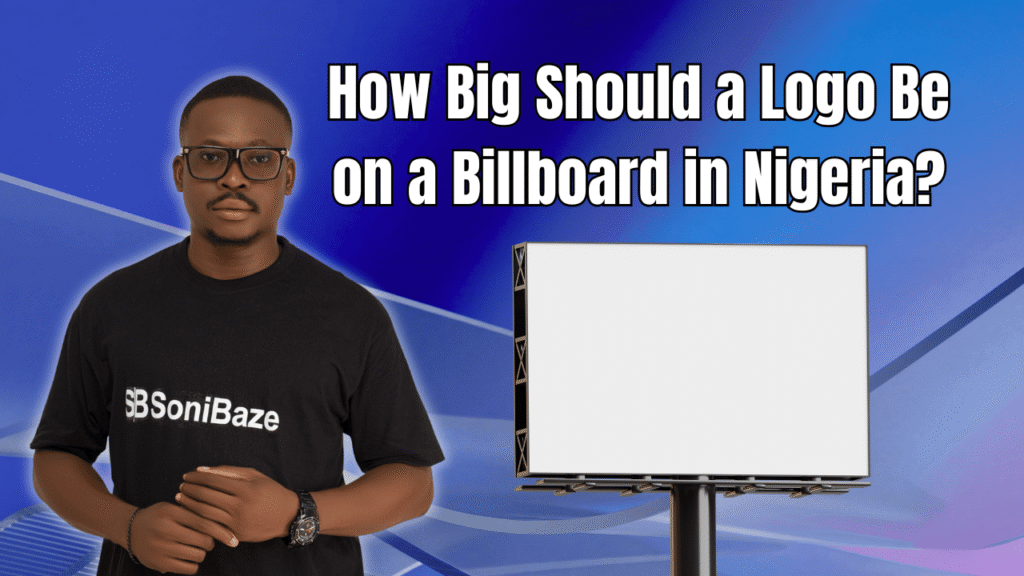
You paid for the space. You have the design. But somewhere between the brief and the final print, someone asks the question nobody prepared for: how big should the logo actually be?
It sounds simple. It is not. Logo sizing on a billboard is one of those decisions that gets rushed, guessed at, or copied from whatever was done last time. This article gives you the actual answer, based on billboard dimensions common across Nigeria, viewing distances in Nigerian traffic conditions, and design principles that determine whether your brand gets seen or skipped.
Let’s get your brand on billboards around Abuja and seen by the right audience.
Why Logo Size on a Billboard Is Not Obvious
Most people approach billboard design the same way they approach a flyer. Make the logo big. Fill the space. That thinking produces cluttered boards that drivers cannot read before they have already passed.
The goal of a billboard is not to display your logo. The goal is to make your brand memorable to someone moving at 40 to 80 km/h, often in traffic, with three seconds or less to absorb what is in front of them. Your logo is one element in that experience, not the entire experience.
Too small and nobody notices who placed the ad. Too large and the logo crowds out the message, the product, or the visual that was supposed to catch the eye first. The right size lives in a specific range, and that range depends on your billboard size and viewing distance.
Standard Billboard Sizes in Nigeria
Before talking percentages, it helps to know the formats you are working with. Billboard sizes vary across Nigeria depending on location, vendor, and approval from state advertising agencies like the Abuja Environmental Protection Board (AEPB) in the FCT.
| Billboard Type | Common Dimensions | Typical Locations |
|---|---|---|
| Standard horizontal | 12ft x 8ft (3.6m x 2.4m) | Residential roads, small commercial areas |
| Medium roadside | 20ft x 10ft (6m x 3m) | State roads, market areas |
| Large roadside | 48ft x 14ft (14.6m x 4.2m) | Expressways, major intersections |
| Gantry / overhead | 24ft x 8ft per panel | Bridges, highway overheads |
| Unipole | 40ft x 20ft (12m x 6m) | Express roads, high-traffic corridors |
The larger the board, the more forgiving the design. But the viewing distance also increases, which means your logo needs to be visible from further away, not just physically larger.
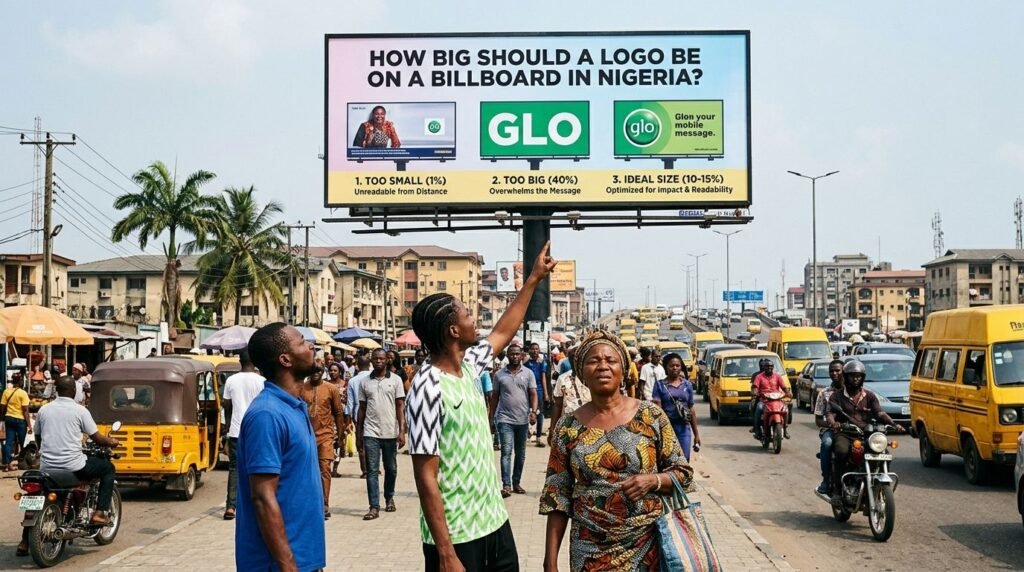
The General Rule: 10 to 20 Percent of the Board
The widely applied standard in outdoor advertising design is that a logo should occupy between 10 and 20 percent of the total billboard face. That range gives the logo clear visibility without dominating the layout.
On a standard 48ft x 14ft expressway board, 15 percent of the face area translates to roughly a 7ft x 2ft logo space. That is large enough to read clearly from 100 metres in moving traffic, while still leaving room for a headline, supporting visual, and any product image.
For smaller boards like a 12ft x 8ft roadside format, the same percentage produces a logo around 2ft x 1.5ft. That works on a clean background. On a busy design, you may need to push to 20 percent to maintain legibility.
How Viewing Distance Changes Everything
Viewing distance is the practical factor that most designers ignore when sizing logos for Nigerian billboards. A board on the Kubwa Expressway is seen from a different distance than one on a narrow Wuse market road.
The rule of thumb used by sign makers: for every 10 feet of viewing distance, text and logo elements should be at least 1 inch tall to remain legible. At 100 feet, your logo needs to be at least 10 inches tall. At 300 feet, that becomes 30 inches, or 2.5 feet.
| Viewing Distance | Minimum Logo Height | Best Suited Board Size |
|---|---|---|
| 30 feet (10m) | 3 inches | Small wall-mounted formats |
| 50 feet (15m) | 5 inches | 12ft x 8ft roadside |
| 100 feet (30m) | 10 inches | 20ft x 10ft medium board |
| 200 feet (60m) | 20 inches | 48ft x 14ft expressway |
| 300 feet (90m) | 30 inches | Unipole, gantry boards |
On Nigerian expressways where traffic can briefly clear and drivers see boards from 200 to 300 feet away, undersized logos simply disappear. This is one of the more common problems SoniBaze Digital’s design team corrects when reviewing billboard artwork from clients who produced it in-house.
Logo Placement: Where on the Board?
Size alone does not determine whether your logo registers. Placement matters just as much.
The most read areas of a billboard, in order, are the upper-left quadrant, the centre, and the lower-right. Logos placed in the lower-left corner, especially on large formats, often go unnoticed because the viewer’s eye has already moved on.
| Placement Position | When It Works | When to Avoid |
|---|---|---|
| Upper left | Strong brand recall, works on most layouts | When headline sits upper-left already |
| Upper right | Works with left-aligned visuals | Can feel disconnected from main message |
| Centre bottom | Good for single-message boards | Easily cropped by obstructions at ground level |
| Lower right | Works as a sign-off after reading the board | Weak on fast roads, viewer exits before reaching it |
| Integrated into headline | High-visibility product ads | Requires strong brand recognition already |
For most Nigerian billboard contexts, upper-left or upper-right placement with the logo occupying 12 to 15 percent of the face gives you both visibility and clean layout.
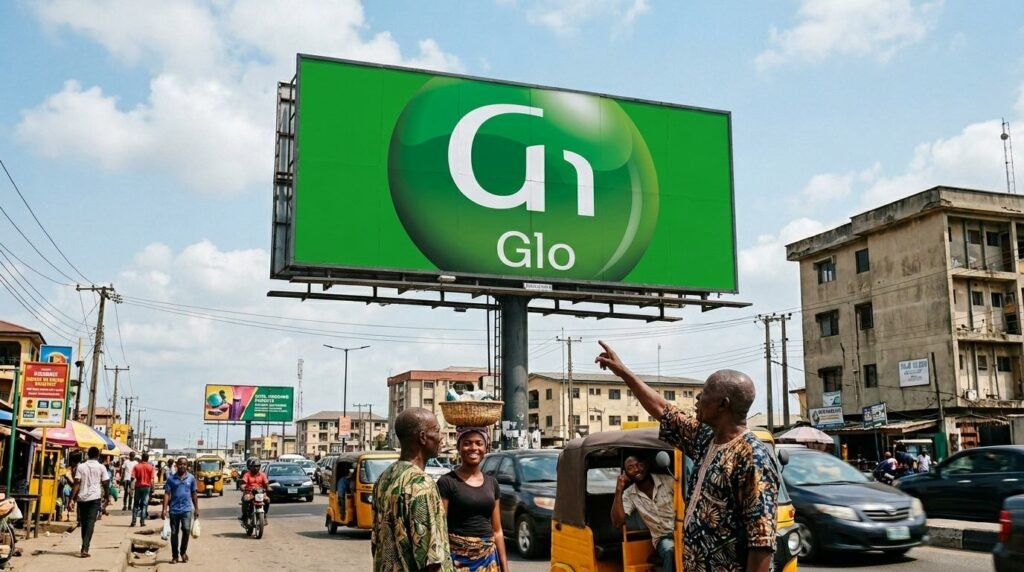
Does Your Logo Type Affect the Right Size?
Yes. A wordmark logo, one made entirely of text, reads differently at distance than an icon-based logo or a combination mark. Each type has slightly different sizing requirements.
| Logo Type | Description | Sizing Consideration |
|---|---|---|
| Wordmark | Text only (e.g. Coca-Cola, GTBank script) | Needs more width; increase by 15 to 20% over icon size |
| Lettermark | Initials only (e.g. UBA, MTN) | Can be sized smaller; high contrast matters more |
| Icon / symbol | Shape or graphic only | Can go smaller if distinctive; minimum 8 inches at 100ft |
| Combination mark | Icon plus text | Size the text for legibility; icon follows proportionally |
| Emblem | Badge or seal style | Needs more space; intricate details disappear at distance |
Emblem-style logos are the most difficult on billboards. The internal detail vanishes from 50 feet away and what remains looks like an unrecognisable blob. If your logo is an emblem, use a simplified version for outdoor formats.
Background Contrast and Its Effect on Perceived Size
Here is something that catches people off guard. A logo can be perfectly sized on paper and still look small on the actual board, simply because the background eats it.
A dark blue logo on a navy background disappears regardless of physical size. The same logo on white appears twice as prominent. Contrast is what creates visible size, not just dimensions.
If your brand colours do not create natural contrast against your chosen background, either adjust the background or add a clear zone around the logo. A white or coloured box behind the logo, even a subtle one, can double its perceived visibility without changing its actual dimensions.
Let’s get your brand on billboards around Abuja and seen by the right audience.
Quick Reference: Logo Size by Billboard Format
| Billboard Format | Recommended Logo Size | Logo as % of Face | Notes |
|---|---|---|---|
| 12ft x 8ft standard | 2ft x 1.5ft | 18 to 20% | Small board; logo needs more prominence |
| 20ft x 10ft medium | 3ft x 2ft | 12 to 15% | Balanced layout possible |
| 48ft x 14ft large | 6ft x 2.5ft | 10 to 13% | Expressway viewing; prioritise contrast |
| 40ft x 20ft unipole | 8ft x 3ft | 10 to 12% | High-speed roads; keep design very simple |
| 24ft x 8ft gantry | 4ft x 2ft | 12 to 15% | Overhead; top-aligned logo works best |
These are working guidelines, not fixed rules. Your specific design, the number of elements on the board, and the complexity of the logo will all shift these numbers slightly.
Common Logo Sizing Mistakes on Nigerian Billboards
Making the logo the entire headline is one of the most frequent problems seen on Nigerian roadside boards. It works if your brand already has 80 percent recognition in that market. For most businesses, it does not. The logo should support the message, not replace it.
Scaling a logo from a business card or social media profile without adjusting for print resolution is another issue. A logo that looks sharp at 500 pixels wide looks pixelated and unprofessional when printed at 48 feet. Always work from a vector source file when producing billboard artwork.
Finally, using the same layout across different board sizes without resizing proportionally produces unbalanced results. A design that fills a 20ft board well will look sparse and disconnected on a unipole. Each format deserves its own sizing pass.
Frequently Asked Questions
What percentage of a billboard should a logo take up?
Between 10 and 20 percent of the billboard face is the practical standard for most formats. Smaller boards lean toward the higher end of that range because the overall space is limited. Larger expressway boards can sit at 10 to 12 percent because the physical dimensions still produce a large, legible logo.
Should the logo be bigger or smaller than the headline text?
In most billboard designs, the headline or key message should be the most dominant element visually. The logo confirms the brand after the message has landed. A logo that competes with or overwhelms the headline reduces overall message clarity. The exception is brand awareness campaigns where name recognition is the only objective.
Can I use my full brand logo on a billboard or should I simplify it?
If your logo has fine detail, multiple internal elements, or an emblem-style design, create a simplified version for billboard use. Fine detail disappears at distance and in varying light conditions. A clean, high-contrast version of your logo will always outperform the full version on a large format outdoor board.
Does the same logo size work for both day and night visibility?
No. At night, illuminated boards change the perceived weight of your logo, particularly if your logo is light-coloured on a dark background. Logos that look appropriately sized during the day can appear washed out or overpowering under artificial lighting. If your board will be lit, review the design under simulated lighting conditions before final print approval.
How do I know if my logo is too small on a billboard design?
Print a scaled version of your design on A4 paper and hold it at arm’s length. If you cannot read or clearly identify the logo at that distance, it will not register on a real board from a moving vehicle. It is a rough test but a useful one. A more precise approach is to ask your print vendor to send a proof at a standard viewing ratio before full production.
Is there a minimum logo size requirement for billboard advertising in Nigeria?
There is no universal regulatory minimum for logo size on Nigerian billboards. Approval from bodies like the AEPB in Abuja or the Lagos State Signage and Advertisement Agency (LASAA) focuses on overall board dimensions, structural compliance, and content standards rather than internal design proportions. Logo sizing is a design decision, not a regulatory one.
Conclusion: Get the Size Right Before It Goes to Print
A billboard is not a second chance. Once it is printed and installed, what you see is what you get for the duration of the campaign.
Logo size is one of those decisions that looks minor in a design file and becomes very obvious on a 48-foot board above a busy expressway. Too small, and the brand investment disappears into the background. Too large, and the message never lands. The 10 to 20 percent guideline, combined with the right placement and strong contrast, gives you a logo that works.
Check the dimensions, check the contrast, and check the viewing distance before the artwork goes to the printer.
Let’s get your brand on billboards around Abuja and seen by the right audience.