A billboard that nobody reads is just expensive wallpaper. Nigeria has thousands of them.
The difference between a board that drives calls, walk-ins, and brand recognition and one that gets ignored comes down to a handful of specific decisions. Most of them happen before the creative ever goes to print.
This article breaks down exactly what those decisions are.
Let’s get your brand on billboards around Abuja and seen by the right audience.
Why Most Nigerian Billboards Underperform
Businesses spend between ₦200,000 and ₦5,000,000 per month on billboard placements in Abuja alone. That is a serious investment. Yet many of those boards carry too much text, wrong colours, poor images, or a call to action that nobody can read at 80 kilometres per hour.
The problem is rarely the location. It is the creative. A bad design in a premium spot still fails. A sharp design in a decent spot can outperform it.
Understanding what actually makes a billboard work in the Nigerian environment saves you money and makes the spend worth it.
What Makes a Billboard Successful in Nigeria
1. One Message. Nothing More.
This is the rule most advertisers break first.
A billboard is not a brochure. A driver passing at speed has roughly three seconds to absorb your message. If your board has a headline, three benefit points, a phone number, a website, a social media handle, and a tagline, none of it lands. The brain moves on before it can process any of it.
The strongest billboards in Nigeria carry one idea. One line of copy. One call to action. One contact point. If you are tempted to add more, take something away instead.
2. High Contrast Colours
Nigeria’s outdoor advertising environment is harsh. Midday sun bleaches lighter colours. Harmattan dust reduces visibility across northern Nigeria for months at a time. Your colour combination needs to work in both conditions.
The most effective combinations are black and yellow, white and dark blue, and red and white. These hold up in direct sunlight, read clearly from a distance, and register quickly. Avoid pastel shades, grey and white, or yellow and white. They disappear in strong light. Avoid red and green together, which is difficult for colour-blind viewers, and blue and black, which offers almost no contrast.
The industry you are in should also shape your choice. Real estate performs well in black and white or navy and white, which reads as premium. Food businesses benefit from red and white or orange and white, which triggers appetite associations. Financial services tend to use navy and gold or black and gold for authority. Healthcare uses green and white or blue and white for calm credibility.
3. Font Size That Is Actually Readable
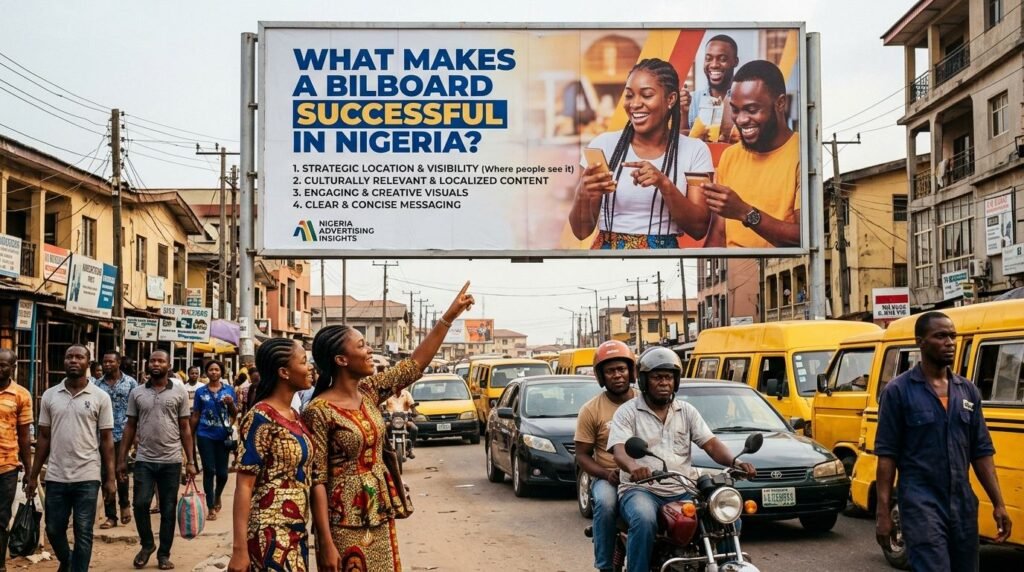
The most common creative mistake in Nigerian billboard advertising is using fonts that are too small and too decorative.
Your headline should be legible from at least 50 metres. That means large, bold, sans-serif fonts. No scripts. No thin weights. No fonts with tight letter spacing. The test is simple: print the design at full scale, stand 20 to 30 metres away, and read it without squinting. If you need to focus, the font is too small.
Body copy on a billboard almost never works. If your message requires a second sentence of explanation, it is not the right message for a billboard.
4. A Single, Clear Call to Action
A call to action tells the viewer what to do next. Without one, even an interested person has no next step.
One call to action is enough. Call this number. Visit this website. Walk into this location. Use this code. Trying to include all four options on one board creates confusion and reduces the chance any of them get acted on.
Your contact point should be formatted for speed. A phone number in large digits works. A short, memorable URL works. A QR code works only if the board is in a location where people are standing still, not driving past.
5. Location Matched to Audience
The best creative on the wrong road reaches the wrong people.
A real estate brand targeting Abuja’s upper-middle-class professionals belongs on Maitama Road, Wuse II, or the Airport Road corridor, not on a residential side street in Karu. A food business targeting working-class traffic belongs near market access roads and commuter routes, not in an embassy zone.
Before booking any placement, define who you are trying to reach and where those people travel daily. Traffic volume alone is not enough. A road with 50,000 daily commuters who are not your audience delivers less value than a road with 10,000 who are.
Key FCT locations and what they deliver: Airport Road handles institutional and corporate traffic. Kubwa Expressway reaches high-density residential commuters. Wuse and Garki attract government workers and business visitors. Maitama reaches embassies, NGOs, and senior professionals.
6. High Resolution Print-Ready Artwork
A blurry billboard damages your brand more than no billboard at all.
Images and graphics for large format printing need to be supplied at the correct resolution for the physical dimensions of the board. A file that looks sharp on a laptop screen will pixelate badly when stretched to three metres by six metres.
If your agency or designer is building creative for a billboard, the artwork should be provided at a minimum of 150 DPI at actual print size for small formats, and your designer should understand large format file preparation. Not all graphic designers do. Always request a print-ready proof before production begins.
7. Refresh Your Creative Regularly
A billboard that has been up for 18 months without changing stops being seen.
The human brain filters out repeated visual stimuli in familiar environments. People stop consciously registering a board they have passed hundreds of times. Refreshing your creative every four to six months reactivates attention from the same audience.
The refresh does not need to be a complete redesign. Changing the colour scheme, updating the headline, or introducing a new product or seasonal offer is enough to re-engage viewers who had mentally stopped seeing the board.
Let’s get your brand on billboards around Abuja and seen by the right audience.
8. Consistency With the Rest of Your Brand
A billboard that looks nothing like your website, social media, or other marketing materials creates a disconnect.
When someone sees your board on Airport Road on Monday and visits your website on Wednesday, the visual language should feel like the same brand. Same colours, same fonts, same tone of messaging. If they look like two different businesses, one of them is not working as hard as it should.
SoniBaze Digital designs billboard creatives that align with clients’ existing digital presence, so every touchpoint reinforces the same brand identity.
9. Measurability Built Into the Campaign
Most businesses cannot tell whether their billboard is generating results because they have no tracking mechanism on it.
The fix is simple. Use a dedicated phone number that is only on that billboard. Use a specific URL or promo code that appears nowhere else. This lets you attribute inbound calls, visits, or codes used directly to the billboard campaign. Without it, you are spending ₦200,000 to ₦5,000,000 per month with no way to evaluate the return.
10. A Design That Works in Black and White
This is a professional check that most clients never apply.
Convert your billboard design to greyscale and look at it. If the hierarchy is clear, the text is readable, and the composition still works, the design is structurally sound. Colour is adding to the message, not carrying it. If the design falls apart in greyscale, it is relying too heavily on colour to do the work of contrast and composition.
Billboard Success Checklist
| Element | What to Check |
|---|---|
| Message | One headline, one CTA, one contact |
| Colour | High contrast, tested in sunlight |
| Font | Bold, sans-serif, legible from 50 metres |
| Call to action | Single, specific, trackable |
| Location | Matched to target audience’s daily route |
| Resolution | Print-ready artwork at correct DPI |
| Brand consistency | Aligns with website and social media |
| Creative refresh | Scheduled every four to six months |
| Tracking | Dedicated number or URL for attribution |
Frequently Asked Questions
How much does a billboard cost in Abuja, Nigeria?
Static billboard placements in high-traffic FCT areas typically start from ₦200,000 per month. Premium locations on major corridors like Airport Road or unipole structures in Maitama and Wuse II can cost between ₦1,500,000 and ₦5,000,000 per month or more. The cost depends on size, format, location, and whether the board is static or digital.
How many words should a Nigerian billboard have?
As few as possible. Three to seven words for the headline is a good target. One line for the call to action. One contact number or URL. Anything beyond that reduces readability at speed. The boards that get remembered in Nigeria are almost always the ones with the least copy on them.
What size should a Nigerian billboard design file be?
Large format print files should be supplied at a minimum of 150 DPI at actual print dimensions. Work at full scale with your designer or provide a 1:10 scale file at 1500 DPI as an alternative. Always confirm file specifications with the printing vendor before production, as requirements vary by board size and printing technology used.
How do I know if my billboard location is the right one?
Research the daily traffic profile of the road, not just the volume. Drive the route yourself at the time your target audience would be travelling. Is the board visible from a distance? Is there any obstruction from trees, other boards, or structures? Does the surrounding environment attract your type of customer? Proximity to your business location is useful but not essential. Proximity to your target audience’s regular routes is what matters.
Should I use a digital or static billboard in Nigeria?
Both work, and the choice depends on your goals and budget. Static boards offer uninterrupted, continuous visibility of a single creative. Digital boards allow multiple advertisers to share a surface in rotation, which reduces your cost but also your share of time. If your message needs to change frequently or you are running a time-limited campaign, digital makes sense. If you want sustained brand presence, a static board generally delivers more concentrated exposure.
How often should I change my billboard creative in Nigeria?
Every four to six months is a practical guide for most businesses. Audiences in high-frequency locations, roads they use daily, stop registering a familiar board. A creative refresh keeps the placement working. For seasonal businesses or promotional campaigns, refresh the creative to match each key moment in your trading calendar. A Christmas campaign board that is still up in February actively undermines credibility.
Conclusion: The Creative Is the Campaign
Spending money on a billboard location is only half the work. The other half is making sure what goes on that board earns the space it occupies.
Every element discussed in this article, from colour contrast to font size to a single measurable CTA, is something you can control before a single naira is spent on production or placement. Getting those decisions right is what separates billboard advertising that builds a brand from billboard advertising that just burns a budget.
SoniBaze Digital manages billboard advertising in Abuja and the FCT, including creative design, location booking, and performance tracking. For businesses that want their outdoor advertising to connect with a broader digital marketing strategy, including SEO and social media, contact SoniBaze Digital at sonibaze.ng.
Let’s get your brand on billboards around Abuja and seen by the right audience.