A Tax Clearance Certificate is one of those documents that sits quietly in the background until the moment you need it urgently. A government contract. A bank loan. A land transaction. An immigration application. All of a sudden, you are scrambling to get one, and discovering that the process involves more preparation than you expected.
This article covers what a Tax Clearance Certificate is, who needs it, and exactly what documents are required to get one in Nigeria, whether you are an individual or a company, filing for the first time or renewing.
Obtain Your Tax Clearance Certificate (TCC)
Let us help you obtain your Tax Clearance Certificate (TCC) quickly and hassle-free. Our experts provide reliable support throughout the application process, ensuring your business meets all tax compliance requirements.
What Is a Tax Clearance Certificate?
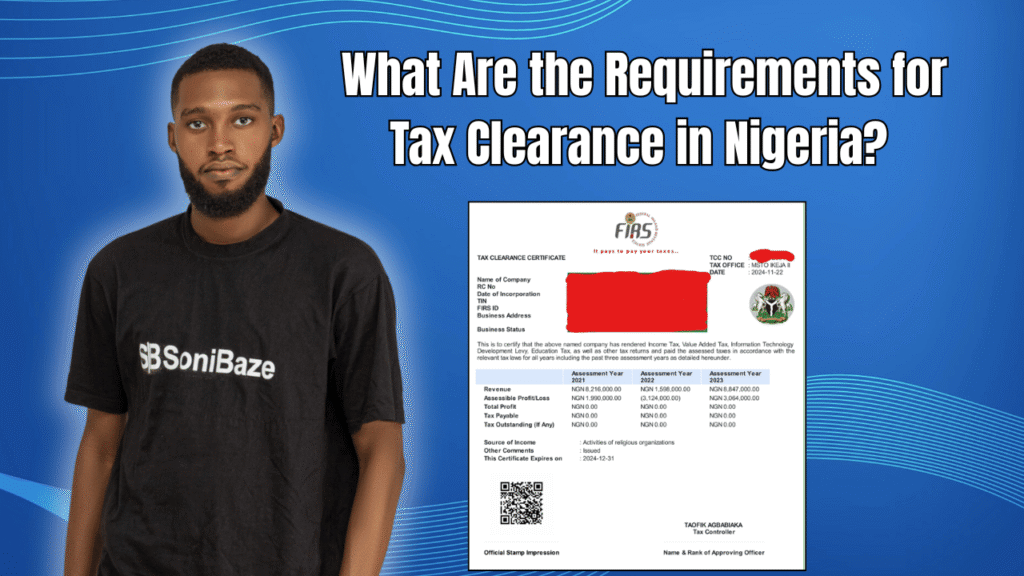
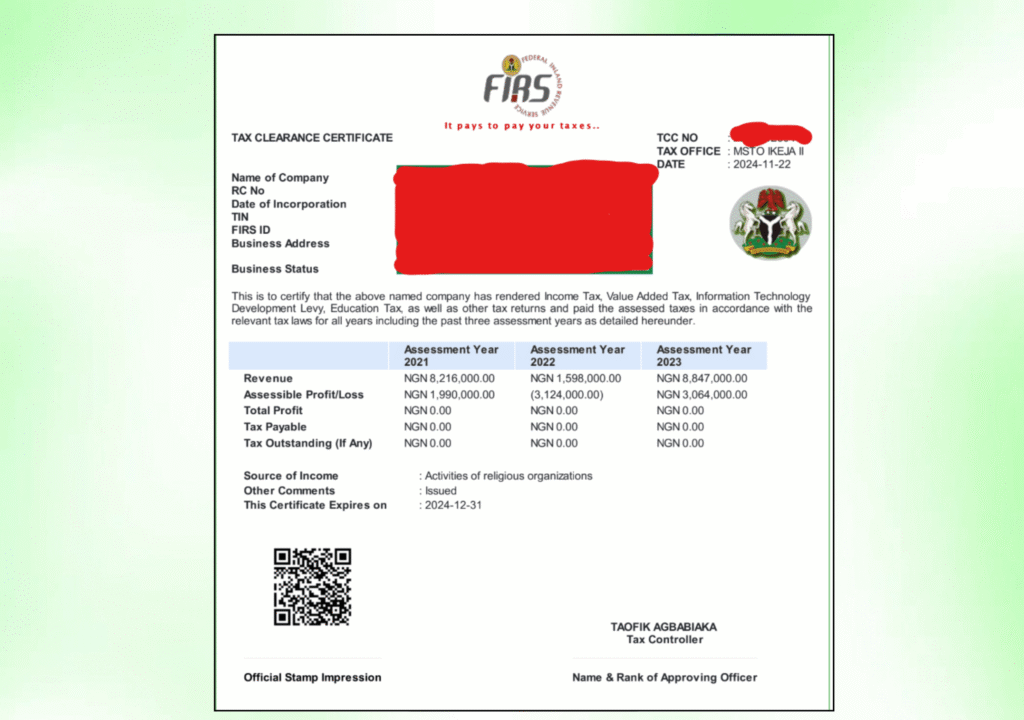
A Tax Clearance Certificate, commonly called a TCC, is an official document issued by the Federal Inland Revenue Service (FIRS) or the relevant State Internal Revenue Service confirming that a taxpayer has paid all taxes due for a specified period. In Nigeria, the certificate typically covers the three years immediately preceding the current year of assessment.
The TCC is not a document you get once and keep forever. FIRS issues it annually, and it contains specific tax information for those three preceding years, including turnover, assessable profit or loss, total profit, tax payable, and any outstanding liabilities.
Two authorities issue TCCs in Nigeria. FIRS handles corporate income tax, value added tax, and taxes for companies operating across multiple states. State Internal Revenue Services handle personal income tax for employees and self-employed individuals residing in their respective states. FCT residents apply through the FCT Internal Revenue Service specifically.
Where Is a TCC Required?
A valid TCC is compulsory for several categories of transactions in Nigeria. Without it, many of the following will hit a wall.
| Transaction Type | Why TCC Is Required |
|---|---|
| Government contract bids | MDAs and agencies require it before awarding contracts |
| Business licence applications | Renewal and new licence issuance often require proof of tax compliance |
| Real estate transactions | Certificate of Occupancy, building plan approvals, and land transfers require it |
| Bank loan applications | Financial institutions use it as part of due diligence |
| Import and export licences | Customs and trade licence applications require a valid TCC |
| Share capital transactions | Stamping of loan capital and share capital increases require it |
| Gaming and pools licences | Operator licences require evidence of tax compliance |
| Immigration applications | Work permits and residency documents for expatriates require it |

Requirements for Companies (Existing Businesses)
Companies that have been registered with FIRS for two or more years and have filed corporate tax returns qualify as existing companies. The online application process for this category is largely automated through the FIRS TCC portal at tcc.firs.gov.ng.
Documents Required
| Document | Details |
|---|---|
| Valid Tax Identification Number (TIN) | Must be active and correctly registered with FIRS |
| Certificate of Incorporation | Issued by the Corporate Affairs Commission with the RC number |
| CAC Form CAC 2 and CAC 7 (certified true copies) | Directors and shareholders forms from CAC |
| Memorandum and Articles of Association | As filed with CAC at the time of incorporation |
| Audited financial statements | Required for determining taxable income and calculating liability |
| Filed tax returns | Proof that Company Income Tax, VAT, and other applicable returns have been filed |
| Evidence of tax payments | Receipts or payment references for all taxes paid in the relevant years |
| Proof of registered business address | Form CAC 3 or Notice of Registered Address as filed with CAC |
For the online route, existing companies can log into the FIRS TCC portal, generate the certificate directly if all filings and payments are up to date. The certificate becomes available for immediate download after a successful application.
Requirements for New Companies (First-Time Applicants)
New companies, meaning those that have been incorporated but have not yet filed two years of corporate tax returns, follow a different process. The application cannot be completed entirely online and requires a visit to the nearest Integrated Tax Office (ITO) covering the company’s registered address.
Documents Required
| Document | Details |
|---|---|
| Certificate of Incorporation from CAC | With RC number |
| Form CAC 3 or Notice of Registered Address | Showing the correct business address as filed with CAC |
| Date of commencement of business | Required for the tax office to set up the file correctly |
| Completed VAT Registration Form (Form 001) | For VAT registration at the same time as TIN registration |
| Memorandum and Articles of Association | Certified true copy |
| Certified true copy of CAC Form 2 and CAC Form 7 | Directors and allotment of shares forms |
| Completed FIRS questionnaire for new taxpayers | On company letterhead, addressed to the Tax Controller at the ITO |
Once these documents are submitted at the Integrated Tax Office, a Tax Identification Number is issued to the company. The company is then registered for Company Income Tax and VAT. The TCC can only be applied for after this registration is complete and returns have been filed.
Fees for New Companies
New companies incorporated within six months of application pay no fee for their first TCC. Companies that have been incorporated for more than six months but have not yet commenced business and have not registered with FIRS pay a pre-operation levy of NGN 25,000 for the first application and NGN 20,000 for each subsequent year until they file a Notice of Commencement of Business.
Obtain Your Tax Clearance Certificate (TCC)
Let us help you obtain your Tax Clearance Certificate (TCC) quickly and hassle-free. Our experts provide reliable support throughout the application process, ensuring your business meets all tax compliance requirements.
Requirements for Individuals (Existing Taxpayers)
Individuals who have filed personal income tax before apply through their State Internal Revenue Service or, for FCT residents, through the FCT-IRS. The required documents are different from the company route.
Documents Required
| Document | Details |
|---|---|
| Valid Tax Identification Number (TIN) | Linked to the relevant state tax office |
| Completed TCC Application Form (Form 802) | Available at the state IRS office |
| Completed Personal Income Tax Annual Returns (Form A) | Including any Benefits in Kind if applicable |
| Valid means of identification | National ID, driver’s licence, or international passport |
| Pay slips for the previous three years | For January, April, September, and December of each year |
| Bank statement | Required if pay slips are not available |
| Evidence of tax payments | Receipts or e-payment confirmation for relevant years |
| Previous TCC | Required in the case of renewal |
For salaried employees, PAYE deductions made by their employer count as their tax payment. The key requirement is confirmation that the employer has been remitting those deductions to the relevant tax authority.
Requirements for Individuals Who Have Never Filed
First-time individual filers face additional requirements because their tax history needs to be established before a TCC can be issued.
| Document | Details |
|---|---|
| Tax Identification Number (TIN) | First step before anything else |
| Bank Verification Number (BVN) or NIN | For identity verification |
| Back tax returns | Returns covering the period of taxable income |
| Proof of identification | Valid government-issued ID |
| Proof of address | Utility bill or official correspondence |
| Payment of outstanding taxes | Any liabilities calculated on the back returns must be settled |
There is no shortcut here. A TCC cannot be issued to an individual with unfiled returns or unpaid liabilities. The returns and payments come first.
Requirements for Direct Assessment Filers (Self-Employed Individuals)
Self-employed individuals, freelancers, and business owners not registered as companies are assessed directly by the state IRS rather than through an employer’s PAYE system.
| Document | Details |
|---|---|
| Self-Assessment Tax Form | Completed and filed |
| Income Tax Working Sheet | Showing computation of income and tax liability |
| Notice of Assessment | Issued by the state IRS after reviewing the returns |
| E-payment receipt or bank teller | Confirming settlement of assessed tax |
| Proof of service or income | Supporting documentation for income declared |
| Application for TCC | Submitted after all returns and payments are in order |
| Employees Annual Assessment File | If the applicant also employs staff |
Common Reasons TCC Applications Are Delayed or Rejected
Most delays are preventable. The common causes are well-documented and mostly come down to records not matching across different government databases.
| Cause of Delay | What It Means |
|---|---|
| Unfiled tax returns | Returns for one or more of the past three years are missing |
| Unpaid tax liabilities | Outstanding balances must be cleared before a TCC is issued |
| Name or address mismatch | Company or individual details differ between CAC and FIRS records |
| Wrong TIN | Using a TIN not tied to the correct tax office or taxpayer record |
| Incomplete documents | Missing audited accounts, pay slips, or payment receipts |
| Unremitted PAYE or WHT | Employers who deducted taxes but did not remit them to the authority |
How Long Does It Take?
For existing companies applying online through the FIRS portal, the certificate is available immediately if all filings and payments are confirmed in the system. For manual applications and new taxpayers, processing typically takes one to two weeks from the date of submission, depending on the tax office’s workload and whether additional documentation is requested.
Frequently Asked Questions
Can a company get a TCC if it made a loss in a given year?
Yes. A company that made a loss can still file returns and apply for a TCC. The certificate confirms that all obligations have been met, not that the company was profitable. The key is that the returns were filed even in loss years.
Is a TCC from FIRS the same as one from the State IRS?
No. FIRS issues TCCs for companies and federal taxpayers, covering corporate income tax and VAT. State Internal Revenue Services issue TCCs for personal income tax. For most business-related transactions like government contracts and BPP registration, the FIRS-issued TCC is what is required. Individuals may need both in some circumstances.
What happens if a TCC is used fraudulently?
Providing incorrect information or obtaining a TCC through misrepresentation, forgery, or falsification is a criminal offence under Nigerian tax law, carrying fines, imprisonment, or both. FIRS can also verify the authenticity of any TCC electronically through the FIRS portal using the TCC number and taxpayer details.
Do expatriates need a Nigerian TCC?
Yes. Expatriates and non-resident persons doing business in Nigeria require a TCC to demonstrate payment of Nigerian taxes. This is also relevant for countries that have bilateral tax treaties with Nigeria, where the TCC is used to claim credit for taxes paid locally.
How often must a TCC be renewed?
A TCC covers a specific tax year and is issued annually. Businesses and individuals who need a current TCC for ongoing transactions must apply each year after filing their returns and settling any outstanding liabilities.
Can I apply for a TCC on behalf of a company?
Yes. An authorised representative, such as an accountant or tax consultant, can apply on behalf of a company. The representative must provide authorisation documentation and present accurate company details during the application process.
Conclusion: Compliance First, Certificate Second
The TCC is not a document you apply for and then worry about compliance later. It is the end product of a tax compliance process that begins with registration, continues with annual filings, and ends with settled liabilities. Get those three things right consistently, and the certificate itself becomes a formality.
The businesses that struggle with TCC applications are usually the ones that skipped a filing year, let an outstanding balance sit too long, or never reconciled their CAC records with their FIRS records. Fixing those gaps before you need the certificate urgently is the most practical approach.
Obtain Your Tax Clearance Certificate (TCC)
Let us help you obtain your Tax Clearance Certificate (TCC) quickly and hassle-free. Our experts provide reliable support throughout the application process, ensuring your business meets all tax compliance requirements.