Ask ten Nigerian business owners whether they need a website, and at least three will tell you they already have one on Instagram. Ask the other seven, and most will say they are planning to build one soon. Web design, it turns out, is still very much needed. The question is what kind, who is doing it, and how much it pays.
This article looks at whether web design is still a viable skill and career in Nigeria in 2026, what the market actually looks like, and where the real demand is coming from.
Ready to start a career in web development? Learn and start your tech career today.
What Is Driving Web Demand in Nigeria Right Now
Nigeria has over 103 million internet users as of 2026, and that number keeps climbing. More importantly, businesses that once relied entirely on physical foot traffic or word of mouth are now expected to have some kind of verifiable online presence. A website is still the most credible form of that presence.
Social media pages get hacked, suspended, or simply do not rank on Google. A business with a proper website, especially one that loads fast on mobile and shows up in search results, has a significant advantage over one that only has an Instagram page. This reality has not changed. If anything, the bar has risen.
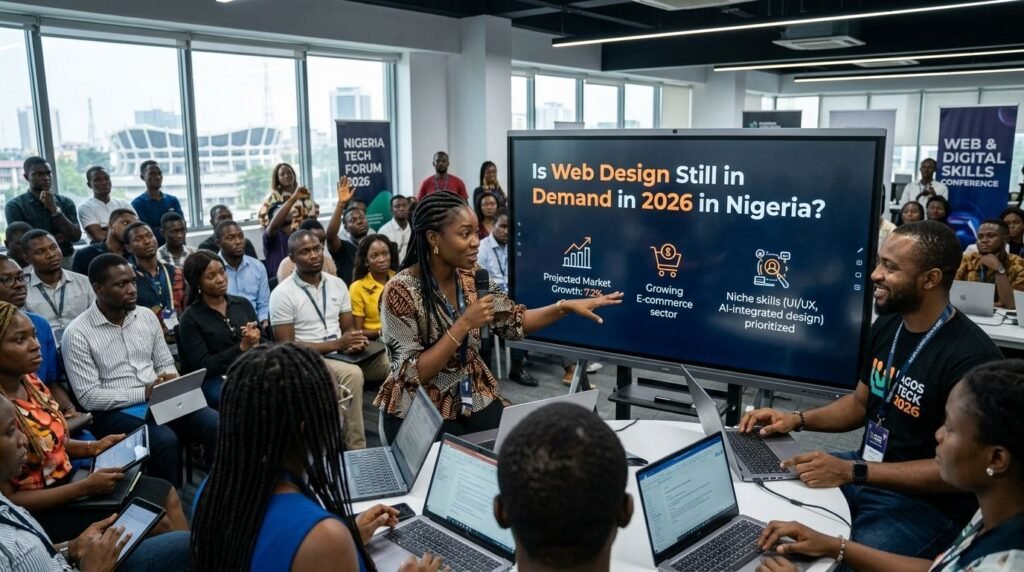
Nigerian banks, fintechs, hospitals, schools, churches, real estate companies, and e-commerce stores are all building or rebuilding their web presence. The demand is there. What has changed is what clients expect and what skills are needed to meet those expectations.
Is Web Design Still a Viable Career in Nigeria in 2026?
Yes. But the nature of the work has shifted.
Five years ago, knowing how to build a WordPress site and make it look presentable was enough to attract clients. That is no longer the case. Clients are more informed now. They have seen good websites. They know what mobile responsiveness looks like, even if they cannot name it. They want speed, they want functionality, and they want something that actually brings in customers, not just something that exists.
The web designers doing well in Nigeria in 2026 are not just building pages. They are combining design skills with SEO knowledge, performance optimisation, and sometimes e-commerce integration. The ones who treat web design as a standalone visual exercise are losing clients to those who can show that a website will rank and convert.
Where the Real Demand Is Coming From
Small and Medium Businesses Going Online for the First Time
A large portion of Nigerian SMEs still do not have functional websites. Many have attempted it and ended up with slow, outdated sites they cannot update themselves. This is a significant market. Businesses in sectors like fashion, food, logistics, professional services, and retail are actively looking for web designers who can build something clean, fast, and manageable.
The budget for this segment typically ranges from ₦150,000 to ₦500,000 for a basic corporate or portfolio site. The work is not glamorous, but it is consistent and available across the country.
E-Commerce
Nigerian e-commerce grew by approximately 15 percent year-on-year between 2023 and 2026. More business owners want to sell directly online rather than relying on Jumia or Konga taking a cut of every transaction. WooCommerce and Shopify-based stores are being requested regularly, particularly by fashion brands, food businesses, and anyone selling physical products.
E-commerce web design commands higher fees. A functional online store with payment integration, product pages, and a checkout flow typically costs between ₦400,000 and ₦1,200,000 depending on complexity and the agency or freelancer involved.
Churches and Religious Organisations
This is an underrated market in Nigeria. Large and mid-sized churches want websites for sermon archives, event booking, donation portals, and member portals. This segment pays consistently and tends to want ongoing maintenance contracts, which means recurring income for the web designer.
Government and Institutional Clients
Federal and state government agencies, parastatals, and tertiary institutions regularly commission website builds and redesigns. These projects tend to be larger in scope and budget, often exceeding ₦2,000,000 for a full institutional site. Competition is stiff, but the contracts are real.
Startups and Tech Companies
Nigeria’s startup ecosystem remains active despite funding slowdowns in 2023 and 2024. Startups need landing pages, investor-facing sites, product pages, and web applications. This segment values speed, clean design, and the ability to work with developers. It pays well and tends to attract the more technically skilled web designers.
What Skills Actually Get You Hired in 2026
The days of landing clients with HTML and CSS alone are largely over at the mid-to-senior level. What Nigerian businesses and employers are looking for in 2026 combines design competence with practical technical and strategic knowledge.
| Skill | Why It Matters in Nigeria | Demand Level |
|---|---|---|
| WordPress / Elementor | Powers the majority of Nigerian SME websites | Very High |
| Shopify / WooCommerce | Growing e-commerce market requires these | High |
| Mobile-first design | Over 80% of Nigerian web traffic comes from mobile | Essential |
| SEO basics | Clients want sites that rank, not just exist | High |
| Page speed optimisation | Poor hosting infrastructure makes this critical | High |
| UI/UX fundamentals | Clients increasingly judge sites by usability | Medium-High |
| Figma | Standard prototyping and design tool | Medium-High |
| JavaScript / React | Required for web app and frontend development roles | Medium |
| Webflow | Growing among premium clients and agencies | Medium |
| Conversion rate basics | Separates designers from strategic web professionals | Growing |
You do not need all of these. But if you can only do one thing, clients in 2026 want that one thing done well and fast, on mobile, and with some understanding of how the site will perform in search.
Web Design vs Web Development: Which Pays More in Nigeria?
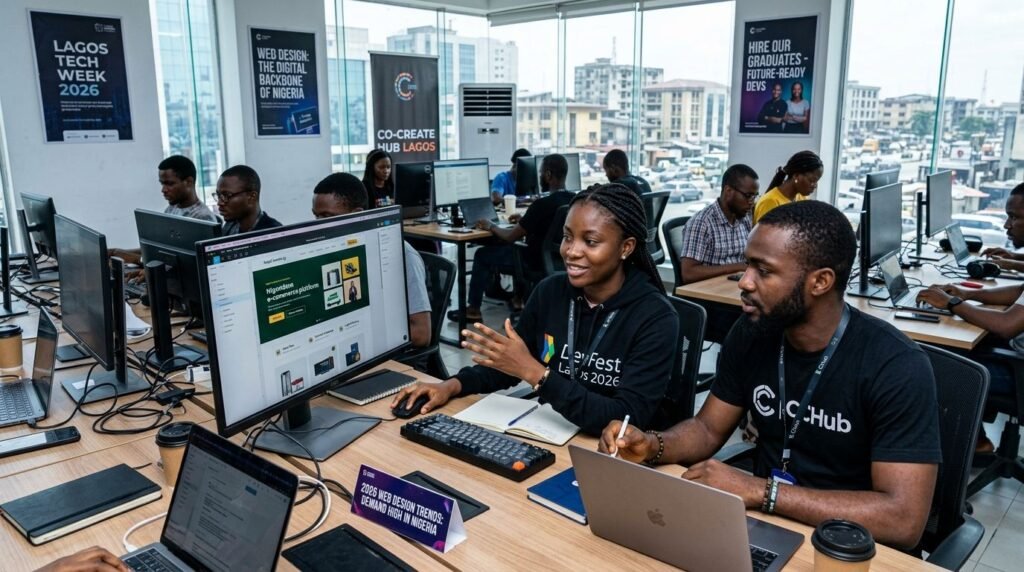
These two roles are often confused and sometimes overlap. Web designers focus on how a site looks and how users move through it. Web developers focus on how it is built and how it functions. In Nigeria, the line blurs frequently because many clients want one person to do both.
| Role | Average Monthly Rate (Freelance) | Average Salary (Agency/Company) |
|---|---|---|
| Web Designer (basic) | ₦80,000 to ₦180,000 | ₦100,000 to ₦200,000 |
| Web Designer (mid-level, UI/UX) | ₦200,000 to ₦400,000 | ₦200,000 to ₦350,000 |
| Web Developer (frontend) | ₦250,000 to ₦500,000 | ₦250,000 to ₦500,000 |
| Web Developer (full-stack) | ₦400,000 to ₦1,000,000+ | ₦400,000 to ₦800,000 |
| Web Designer + Basic SEO | ₦250,000 to ₦500,000 | ₦220,000 to ₦400,000 |
These figures reflect the Nigerian market as of 2026 and vary by location, client type, and portfolio strength. Abuja-based clients in government and corporate sectors tend to pay at the higher end. Lagos has more volume but also more competition.
Ready to start a career in web development? Learn and start your tech career today.
The Impact of Website Builders and AI Tools
This comes up in every conversation about web design careers. Wix, Squarespace, and similar tools have been available for over a decade. They did not kill web design. Neither will AI page builders, at least not at the level most Nigerian businesses operate.
The real issue is not that these tools exist. It is that most Nigerian business owners do not have the time, skill, or consistency to use them properly. They start a Wix site, abandon it after two pages, and end up hiring someone anyway. What they are paying for is not just technical execution; it is the expertise to make the right decisions, the knowledge to configure things correctly, and the accountability of working with a professional.
AI tools like Framer AI and Wix AI Site Generator can produce a reasonable starting point. A skilled web designer in Nigeria uses these tools to work faster, not as a replacement for skill. Clients who tried AI tools and got poor results are actively looking for human professionals to fix or rebuild what those tools produced.
Is Now a Good Time to Learn Web Design in Nigeria?
If you are considering entering the field, 2026 is not a bad time. The market is not saturated at the level of genuine competence. There are many people claiming to build websites, but far fewer who can build sites that load in under three seconds on a Nigerian mobile network, rank on Google, and are easy for the client to update themselves.
The gap between what most people offer and what the market actually needs is wide enough to build a career in. The key is not to learn surface-level skills and assume that will be enough. Go deeper on at least two or three areas: performance, SEO integration, or e-commerce functionality. That combination is where the consistent work and better-paying clients are.
SoniBaze Tech Academy in Karu, Abuja offers certified web development training designed for the Nigerian market. The curriculum covers practical, client-ready skills rather than theoretical frameworks, which is what gets you hired or paid faster.
Frequently Asked Questions
Is web design still relevant in Nigeria with so many businesses using social media only?
Yes, and the relevance is growing rather than shrinking. Social media platforms are rented space. Accounts get restricted, suspended, or lose reach without warning. A website is owned infrastructure. As Nigerian businesses mature and start thinking about long-term brand equity and Google search visibility, the website becomes non-negotiable. Social media and a website are not competing choices; they serve different functions.
How much can a web designer earn in Nigeria in 2026?
It depends heavily on skill level and the type of clients you work with. Entry-level designers working with small businesses typically earn between ₦80,000 and ₦180,000 per month on retainer or project fees. Mid-level designers with e-commerce experience or UI/UX skills can earn ₦250,000 to ₦500,000. Full-stack developers or designers working with corporate and government clients can exceed ₦800,000 per month. Freelancers with international clients via platforms like Upwork earn in dollars, which changes the equation significantly.
Do I need to know how to code to be a web designer in Nigeria?
Not necessarily, but it helps. Many working web designers in Nigeria use WordPress with page builders like Elementor and never write a line of code. However, knowing basic HTML, CSS, and how to troubleshoot a site is a significant advantage when things go wrong, which they regularly do. Clients do not care about your workflow; they care about whether their site works. A designer who can handle minor technical problems without calling a developer is more valuable than one who cannot.
Which is better to learn in Nigeria, web design or web development?
Both are in demand, but they attract different types of work and clients. Web design with UI/UX skills is more accessible as an entry point and allows you to serve a wider range of Nigerian SMEs. Web development, particularly full-stack or frontend JavaScript, opens doors to higher-paying roles in Nigerian tech companies, banks, and remote international work. If you enjoy visual problem-solving and client interaction, start with web design. If you prefer building logic and functionality, go toward development. The skills increasingly overlap, and adding one to the other over time is the strongest long-term position.
Is web design in Nigeria better as a freelance career or a full-time job?
Both paths work. Full-time positions at digital agencies, banks, tech companies, or media firms offer stability, consistent income, and exposure to larger projects. Freelancing offers flexibility and higher earning potential once you build a client base, but income is inconsistent at the start. Many Nigerian web designers begin with a job to build skills and a portfolio, then transition to freelancing. The hybrid approach, where you work full-time and take freelance projects on the side, is common and practical in the Nigerian market.
What type of websites are most in demand in Nigeria right now?
E-commerce sites, corporate and company profile sites, church websites, school and institution websites, and landing pages for service businesses are consistently in demand. Real estate websites with property listing functionality are growing. Portfolio sites for professionals and creatives, particularly lawyers, doctors, architects, and consultants, are a steady niche. Sites that need to rank locally on Google and load fast on mobile data are the most commercially valuable to build because clients see direct results from them.
Conclusion: Web Design Is Not Going Anywhere
The demand for web design in Nigeria in 2026 is real, consistent, and available across sectors and price points. What has changed is the standard. Clients expect more. They want speed, mobile functionality, search visibility, and a site that actually serves a business purpose.
The designers and developers who thrive are the ones who have moved past the basics and can deliver results, not just pages. That shift in expectation is not a threat to the profession. It is a filter that rewards the people who took the skill seriously.
If you are already in the field, keep building deeper competence in the areas that matter most to Nigerian clients: performance, SEO, e-commerce, and mobile design. If you are considering getting in, the timing is as good as any, provided you go in with the right skills and a clear sense of who you want to serve.
Ready to start a career in web development? Learn and start your tech career today.