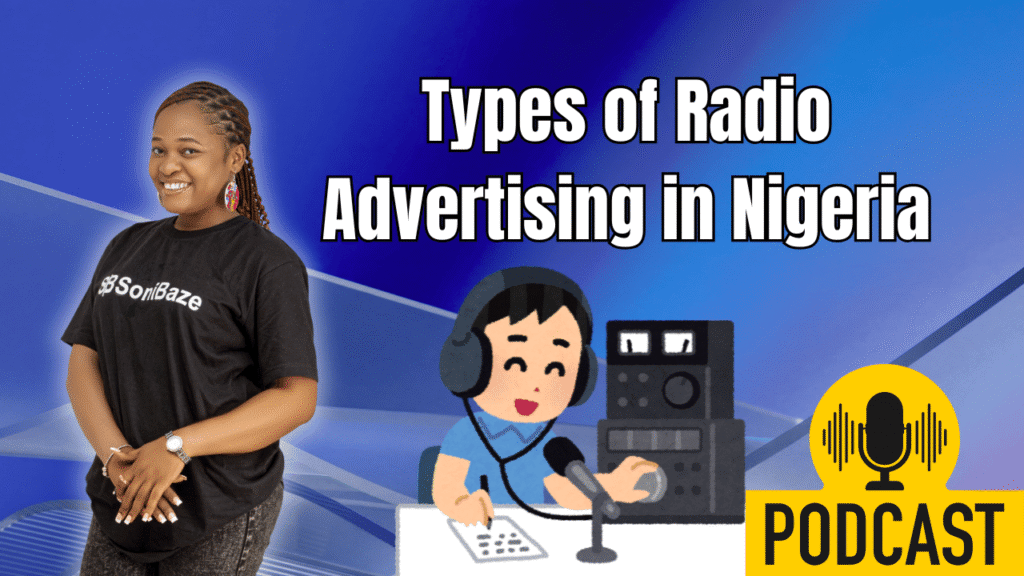
Radio is older than television, older than the internet, and older than most marketing theories. It is also still working. Nigeria has over 400 licensed radio stations broadcasting across FM, AM, and online frequencies, and millions of Nigerians tune in daily during commutes, at work, and at home.
The question is not whether radio advertising works. It does, for the right business with the right format. The real question is which type of radio advertising fits your goals, your budget, and your audience. This article breaks down every major format used in Nigeria, what each one costs, and when to use it.
Get your brand on air across Abuja radio stations and beyond with powerful radio ads.
Why Radio Still Matters for Nigerian Businesses
Nigeria has a mobile population. A significant portion of daily life happens away from screens, in vehicles, market stalls, salons, and shops where a radio plays in the background. Arbitron and Nielsen studies across Africa have repeatedly shown radio reach exceeds television in certain demographics, particularly in semi-urban and rural areas.
In states like Kano, Kaduna, Ogun, and Anambra, radio is not a secondary channel. It is often the primary one. Even in Abuja and Lagos, drive-time radio slots on stations like Wazobia FM, Cool FM, and Rhythm FM attract loyal audiences that are hard to reach through social media or outdoor advertising alone.
Radio also has a cost advantage. A well-produced 30-second spot on a mid-tier Nigerian station costs a fraction of what a billboard or television campaign would, with comparable reach in the right market.
Types of Radio Advertising in Nigeria
1. Spot Advertising (Radio Commercials)
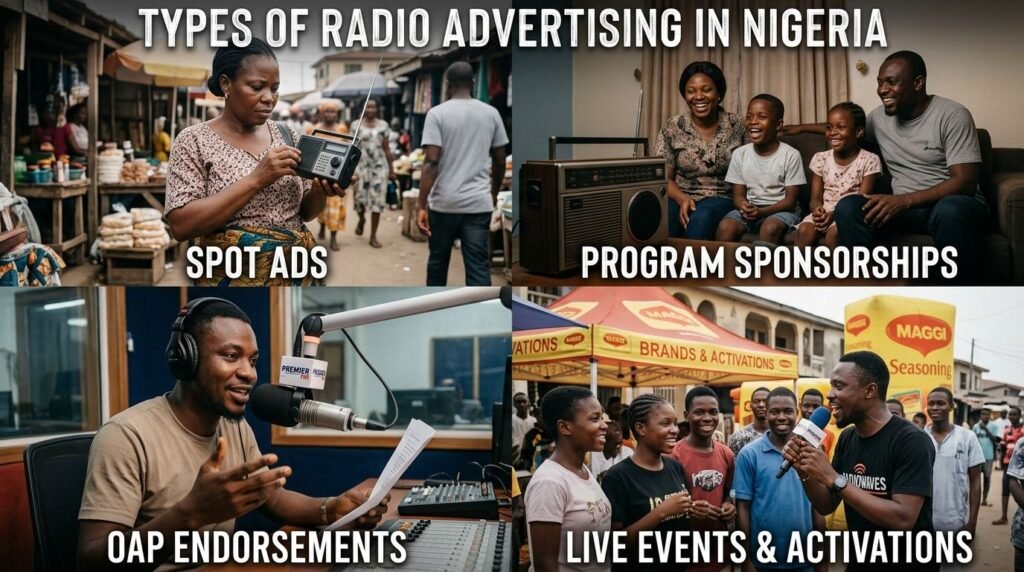
This is the most common form of radio advertising in Nigeria. A spot is a pre-recorded audio advertisement, typically 15, 30, or 60 seconds long, aired during commercial breaks between programmes or segments.
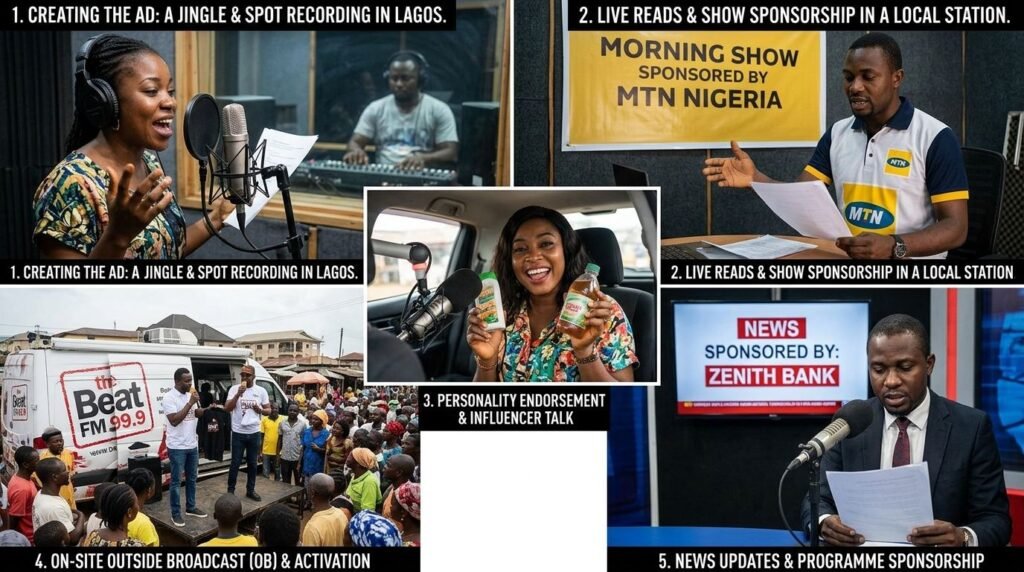
Spots are produced in advance and played at scheduled times. The advertiser pays for a fixed number of airings, called “spots,” across a defined period. A 30-second spot on a station like Cool FM Abuja during drive time (6am to 9am or 4pm to 7pm) reaches tens of thousands of commuters in a single airing.
The effectiveness of a spot depends heavily on the script, the voice, the sound design, and the frequency. A poorly written ad aired 100 times is still a poorly written ad. Most radio stations in Nigeria have in-house production teams that can produce your spot, though independent production houses generally deliver better results.
| Format | Duration | Best Use Case |
|---|---|---|
| Short spot | 15 seconds | Brand reminders, promotional announcements |
| Standard spot | 30 seconds | Product introductions, offers, and events |
| Long spot | 60 seconds | Detailed storytelling, service explanations |
2. Sponsored Segments
A sponsored segment is when a brand pays to be associated with a specific part of a radio programme. Common examples include traffic reports, weather updates, news headlines, or sports scores that open with “brought to you by [Brand Name].”
This format works because the listener is already paying attention. Traffic updates are high-attention moments, especially on stations like Brila FM (sports), Wazobia FM, or any station with a dedicated morning show. Your brand name gets mentioned in a context where people are actively listening, not zoning out during a commercial break.
Sponsored segments cost more per airing than standard spots, but they carry built-in audience attention. For businesses targeting daily commuters or specific interest groups, this is one of the most efficient radio formats available in Nigeria.
3. Live Reads (Host-Endorsed Advertisements)
A live read is when the radio presenter reads your advertisement in their own voice, during the show, as if recommending it personally. No pre-recorded production. Just the host, your talking points, and their audience.
This matters because Nigerian radio audiences trust their presenters. A popular Abuja morning show host with a loyal following saying “I personally use this product” carries more credibility than a scripted jingle from a voice actor. The perceived endorsement is part of the value.
Live reads are common on breakfast and drive-time shows. They require a clear, concise brief, usually no more than 150 words, that the presenter can adapt into their natural style. The advertiser does not control the exact wording, which is both the risk and the point. It sounds organic because it largely is.
4. Programme Sponsorship
Programme sponsorship means a brand pays to sponsor an entire radio show, often for a week, a month, or a full season. The brand is mentioned at the opening and closing of every episode, and sometimes integrated into the content itself.
A business sponsoring a popular afternoon talk show on a station like Nigeria Info 99.3 FM or Inspiration FM gets consistent brand exposure throughout every episode of that programme. The audience associates the brand with the content they enjoy. That association builds over time.
This format is most effective for brands with a longer advertising horizon, banks, insurance companies, real estate developers, and educational institutions, where repeated exposure and trust-building matter more than immediate conversions.
5. Radio Roadblocking
Roadblocking means running the same advertisement simultaneously across multiple radio stations at the same time. The goal is saturation. A listener switching between stations cannot avoid your ad.
This is expensive and typically reserved for product launches, major promotions, or political campaigns. During peak election periods in Nigeria, roadblocking across regional and national stations is widely used. During a major product launch, a fast-moving consumer goods brand might roadblock across ten to fifteen stations for a single day.
The logistics require buying airtime from multiple stations in a coordinated window, usually managed through a media buying agency. It is not a budget option, but when reach and immediate awareness are the goal, nothing in radio delivers it faster.
6. Jingles
A jingle is a short, branded musical composition, usually 15 to 30 seconds, that plays as part of a spot or sponsored segment. The purpose is memorability. A good jingle gets stuck in the listener’s head long after the radio is off.
Some of the most recognised brands in Nigeria built their name partly on radio jingles. MTN, Dangote, and Indomie all have audio identities that Nigerians can hum without being prompted. That level of recall is not accidental. It is the result of consistent jingle use over years.
Jingles cost more to produce than standard voiceover spots. A professionally composed and recorded jingle in Nigeria can cost between ₦150,000 and ₦800,000 depending on the studio, the musicians, and the complexity. But unlike a spot that sounds dated in a year, a strong jingle can remain in use for five to ten years.
7. Advertorial Programmes (Infomercials)
An advertorial programme, sometimes called a radio infomercial, is a longer-form advertisement, typically five to thirty minutes, that is structured like a regular programme but is entirely paid content. It might be a product demonstration, a health education segment, or a business owner interview.
This format is common in Nigeria for pharmaceuticals, herbal products, agricultural inputs, and financial services. Stations that air these programmes usually label them as sponsored content, though the distinction is not always obvious to listeners.
Advertorials work because they give the advertiser time to educate the audience. You cannot explain a pension product in 30 seconds. You can in fifteen minutes. For complex products or services that require audience understanding before purchase, the advertorial format outperforms a standard spot significantly.
8. Digital and Streaming Radio Advertising
Online radio is growing in Nigeria. Stations like Cool FM, Beat FM, and Wazobia FM all stream live on their websites and apps. Several internet-only radio stations have also emerged, targeting younger, urban Nigerian listeners.
Digital radio advertising allows for targeting that traditional FM cannot offer. Advertisers can reach listeners by location, time of day, and device. A business in Abuja can run ads only to listeners streaming from the FCT, rather than paying for nationwide airtime they do not need.
The cost of digital radio advertising in Nigeria is still lower than FM in most cases, and the measurement is better. Streams, impressions, and click-throughs on companion banner ads are all trackable, making it easier to calculate return on investment.
Radio Advertising Cost Overview in Nigeria
Prices vary by station tier, time slot, and format. The figures below reflect general market rates as of 2025 and should be confirmed directly with stations or a media buying agency.
| Ad Format | Estimated Cost Range | Notes |
|---|---|---|
| 30-second spot (community FM) | ₦5,000 to ₦20,000 per airing | Lower reach, local coverage |
| 30-second spot (mid-tier FM) | ₦20,000 to ₦80,000 per airing | City-wide reach, e.g. Abuja, Port Harcourt |
| 30-second spot (national FM) | ₦80,000 to ₦250,000 per airing | Stations like Cool FM, Wazobia FM nationwide |
| Sponsored segment | ₦50,000 to ₦300,000 per episode | Depends on programme and station |
| Live read | ₦30,000 to ₦150,000 per read | Varies by presenter profile and station |
| Programme sponsorship | ₦500,000 to ₦3,000,000+ per month | Full programme association |
| Jingle production | ₦150,000 to ₦800,000 once-off | Studio, composition, and recording |
| Advertorial (30 minutes) | ₦100,000 to ₦500,000 per airing | Depends on station and slot |
| Digital radio ad | ₦15,000 to ₦100,000 per campaign | Targeting options available |
Choosing the Right Format for Your Business
Not every format suits every business. A local restaurant in Karu, Abuja has different needs from a Lagos-based e-commerce brand or an Abuja real estate developer.
Spot advertising is the most accessible starting point for most Nigerian businesses. It is affordable, repeatable, and measurable enough to test what works. Once you know your spot is performing, you can explore sponsored segments or programme sponsorship to build deeper association with your audience.
Jingles are worth investing in early if you plan to advertise consistently over multiple years. The production cost is front-loaded but the asset keeps working across every campaign you run.
For businesses with complex services, including insurance, loans, health products, or investment schemes, advertorial programmes give you the time to educate listeners before asking for action. A 30-second spot cannot do that job.
Get your brand on air across Abuja radio stations and beyond with powerful radio ads.
Frequently Asked Questions
How do I book radio advertising in Nigeria?
You can contact a radio station directly through their marketing or advertising department. Most major Nigerian stations have rate cards they share upon request. Alternatively, a media buying agency can handle the booking across multiple stations, negotiate better rates, and manage scheduling on your behalf. For large campaigns covering multiple cities, using an agency is generally more efficient than negotiating directly with each station.
Which radio stations have the highest reach in Nigeria?
Wazobia FM and Cool FM are among the highest-reach stations nationally, with Wazobia operating across Lagos, Abuja, and Port Harcourt. Brila FM dominates sports content. For Abuja specifically, stations like Wazobia FM 99.5 Abuja, Cool FM 98.9 Abuja, and Raypower FM 100.5 have strong listenership. Community stations like Kogi State FM or Plateau Radio Television have strong local reach in their regions.
How many times should my ad air per week?
Frequency is critical in radio advertising. A single airing is almost never enough. Most media planners recommend a minimum of five to seven airings per week per station to achieve meaningful recall. For a product launch or time-sensitive promotion, twelve to twenty airings per week during the campaign period is common practice among Nigerian advertisers.
Can I target a specific city with radio advertising in Nigeria?
Yes. Each radio station broadcasts within a specific signal coverage area. Booking airtime on a station based in Abuja will primarily reach Abuja and its surrounding FCT communities. If you want to target Lagos only, you book Lagos stations. For nationwide campaigns, you either buy from a network or book individually across multiple city stations.
Is radio advertising still effective for reaching young Nigerians?
It depends on format and station. Traditional FM radio has lower penetration among Nigerians under 25 compared to older demographics. However, digital and streaming radio is growing with younger audiences, particularly those commuting or working in environments where screens are impractical. Stations with strong social media integration and younger-skewing programmes also hold more relevance for this age group than purely traditional broadcasters.
What makes a radio ad effective in Nigeria?
Three things drive radio ad performance in Nigeria: a clear message, a compelling voice, and sufficient frequency. The ad needs to say one thing well, not five things poorly. The voice actor or presenter needs to sound credible and engaging, not robotic or generic. And the ad needs to air often enough that the audience hears it multiple times before the campaign ends. A single airing on the best station in Nigeria will not move the needle.
Conclusion: Match the Format to the Goal
Radio advertising in Nigeria is not a single thing. It is a collection of formats, each with a different cost, a different reach, and a different effect on the listener. Spots build awareness. Live reads build trust. Jingles build memory. Sponsored segments capture attention at the right moment. Advertorials educate.
The businesses that get the most from radio are the ones that think beyond “I want to run ads” and ask instead: what do I want the listener to do, and which format gives me the best chance of making that happen?
If you are planning a radio campaign and want it integrated with your broader marketing strategy, including digital advertising, content, and outdoor, SoniBaze Digital works with businesses across Nigeria to plan and execute campaigns that connect across channels.
Get your brand on air across Abuja radio stations and beyond with powerful radio ads.