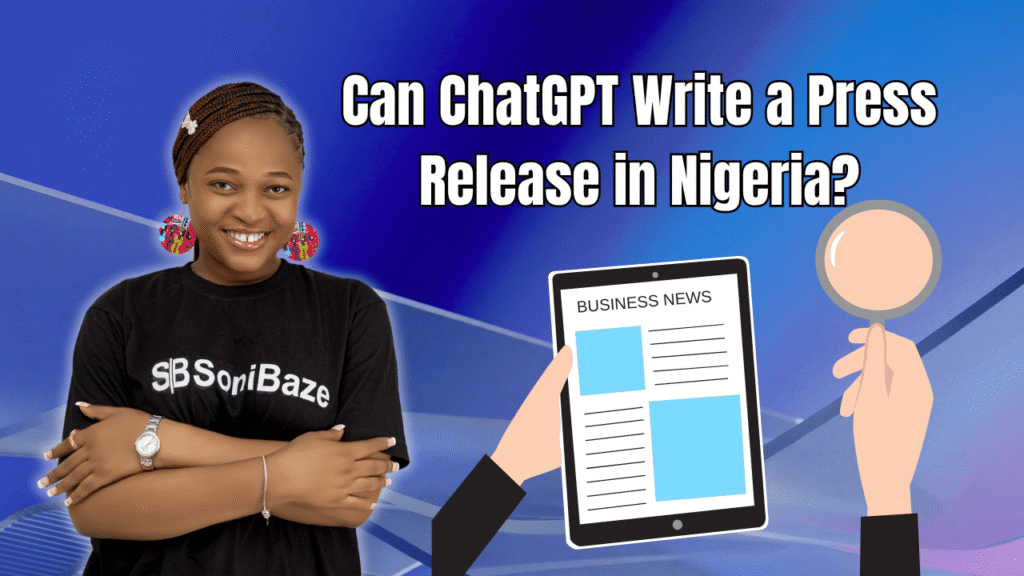
ChatGPT can write a press release. That part is not in question. What matters is whether what it produces is actually usable in the Nigerian media context, where editors at Vanguard, Punch, ThisDay, and Channels Television have specific expectations, and where a poorly structured release gets ignored regardless of how polished it looks.
This article breaks down what ChatGPT gets right, where it falls short, and what you need to do to make AI-generated press releases work for Nigerian distribution.
Want your brand featured in top media outlets? Let’s make it happen with our press release.
What ChatGPT Actually Does Well
Speed is real. A well-prompted ChatGPT session can produce a structured 500-word press release in under two minutes. For businesses that have never written one before, that is a significant head start. The tool handles the basics reliably: headline, dateline, lead paragraph, body copy, and boilerplate.
It also writes in correct journalistic style without prompting. Most of the time. Short sentences, active voice, third-person attribution. These are things ChatGPT has been trained on extensively, and it shows.
For simple announcements, like a product launch, a new hire, or a partnership, the output is often 70 to 80 percent ready. That remaining 20 to 30 percent is where the Nigerian context comes in.
Where ChatGPT Gets It Wrong for Nigerian Audiences
It Does Not Know the Nigerian Media Landscape
ChatGPT has no real-time knowledge of which Nigerian publications cover which sectors, what angle Businessday prefers versus The Nation, or which editor at Arise TV handles corporate stories. It will write a press release addressed to “media outlets” with no specificity.
That matters because Nigerian journalists, particularly at tier-one publications, respond better to releases that feel relevant to their beat. A fintech announcement sent to a lifestyle journalist gets deleted. Context-aware distribution requires human knowledge of the local media map.
Local Context Is Generic at Best, Wrong at Worst
Ask ChatGPT to write a press release for a real estate company in Abuja and it will produce something that reads like it was written for a generic global audience. It will not reference the FCT, Wuse, Maitama, or Jabi Lake Mall. It will not mention FCDA approvals or the specific land title challenges that make property news in Abuja distinct.
Nigerian readers and journalists notice this. A release that could have been written for any country in the world carries less credibility than one that shows clear local knowledge.
It Fabricates Quotes
This is the most dangerous failure mode. ChatGPT often generates attributed quotes for executives that sound plausible but were never said. In Nigeria, where regulatory scrutiny of corporate communications is increasing and reputational risk is significant, publishing a fabricated quote from your CEO or Managing Director is a serious problem.
Every quote in a press release must come from a real person who approved it. ChatGPT cannot know what your leadership team actually said or wants to say. You have to supply that, and you have to verify it before the release goes out.
Distribution Is a Completely Separate Problem
Writing the release is only half the job. Getting it published in Nairametrics, Premium Times, Nigerian Tribune, or any of the 200+ regional publications across the country requires a distribution strategy. ChatGPT has no contacts. It cannot submit to newsrooms. It cannot follow up with editors.
In Nigeria, press release distribution to 20,000+ media platforms, including print, online, broadcast, and newswire channels, requires either in-house PR relationships built over years or a professional agency. SoniBaze Digital handles press release distribution to over 20,000 media platforms across Nigeria and beyond, which is a service that no AI tool replicates.
A Practical Comparison
| Task | ChatGPT | Human PR Professional |
|---|---|---|
| Drafting a structured release | Strong | Strong |
| Applying correct press release format | Reliable | Reliable |
| Nigerian-specific context and references | Weak | Strong |
| Generating accurate executive quotes | Cannot do it reliably | Requires sourcing, not generation |
| Understanding Nigerian media beats | No real-time knowledge | Strong with experience |
| Distribution to Nigerian newsrooms | Cannot distribute | Core service |
| Follow-up with editors | Not applicable | Essential for placement |
| Compliance with Nigerian regulatory language | Generic, not current | Up to date |
How to Use ChatGPT Properly for a Nigerian Press Release
ChatGPT works best as a drafting assistant, not a finished product provider. Here is how to use it without running into problems.
Give It Specific Nigerian Context in the Prompt
Do not just say “write a press release about our product launch.” Say: “Write a press release for a Lagos-based fintech company announcing the launch of a USSD savings product targeting market traders in Onitsha and Aba. The tone should suit BusinessDay and Nairametrics. Include a quote from the CEO, which I will provide.”
The more specific the prompt, the more usable the output.
Always Supply the Quotes Yourself
Never let ChatGPT generate executive quotes. Write them yourself or ask the relevant person directly. Then paste them into the prompt as a fact to include. This applies to MD statements, board commentary, and any attributed third-party endorsement.
Add Local Facts and Figures
Before using the output, add at least two or three Nigerian-specific data points. If you are announcing a fintech product, reference the number of unbanked Nigerians, or cite CBN statistics on mobile money adoption. If you are announcing a property development, include the specific location in Abuja or Lagos and relevant planning approvals. Specific facts make a release more credible and far harder for an AI detector to flag.
Edit the Boilerplate Section Manually
The boilerplate, the final paragraph describing your company, is almost always generic when ChatGPT writes it. Rewrite it to include your actual registration details, year of founding, core markets, and a specific claim that reflects your position in the Nigerian market. A boilerplate that says “a leading provider of innovative solutions” tells journalists nothing. One that says “a CBN-licensed microfinance bank serving 45,000 customers across the North-Central zone since 2018” tells them everything they need to know.
Want your brand featured in top media outlets? Let’s make it happen with our press release.
What a Well-Structured Nigerian Press Release Looks Like
| Section | What It Should Contain |
|---|---|
| Headline | One sentence, active voice, specific to the news |
| Dateline | City, State, Nigeria, and the release date |
| Lead paragraph | Who, what, when, where, why, in two to three sentences |
| Body paragraph 1 | Expansion of the lead with key details |
| Executive quote | Real, approved, attributed to a named individual with title |
| Body paragraph 2 | Supporting context or background |
| Data or third-party validation | Nigerian statistics, regulatory reference, or market data |
| Boilerplate | Company description with registration details and contact |
| End notation | ### or -END- to signal close of release |
| Media contact | Named contact, direct phone number, professional email |
Frequently Asked Questions
Can I submit a ChatGPT-written press release to Nigerian newspapers directly?
You can, but the acceptance rate will depend entirely on how well it has been edited for local context. A generic AI-generated release with no Nigerian references, fabricated quotes, or vague boilerplate is likely to be ignored or rejected. A well-edited release that reads as credibly local, has real quotes, and is sent to the right editor on the right beat has a much better chance of placement.
Will Nigerian editors know if a press release was written by AI?
Some will, some will not. The bigger issue is not whether it was written by AI but whether it reads as credible and newsworthy. Nigerian journalists are not primarily running AI detection tools. They are asking whether the story is relevant, whether the quote sounds real, and whether the company behind the release is legitimate. A poorly localised release raises those questions regardless of how it was written.
Does using ChatGPT for press releases save money?
It saves time on the drafting stage, which typically takes one to three hours for a skilled writer. Whether it saves money overall depends on whether the resulting release is good enough to place. A free draft that never gets published delivers no value. A well-distributed release placed in five major Nigerian publications generates media exposure that can cost ₦200,000 to ₦800,000 or more to replicate through paid advertising. The drafting cost is not the expensive part. Distribution and placement are.
What is the ideal length for a press release in Nigeria?
Between 400 and 600 words is the accepted range for most Nigerian publications. Some editors prefer shorter, around 300 words, for straightforward announcements. Longer than 600 words and you risk the editor cutting the bottom half. Write with the expectation that only the top 60 percent may be published, and structure accordingly.
Can ChatGPT write press releases in Nigerian Pidgin or local languages?
ChatGPT can produce text in Nigerian Pidgin and has some exposure to it in training data, but the output is inconsistent and sometimes reads as tourist-grade rather than natural. For Yoruba, Igbo, or Hausa press releases targeting regional publications, a human translator or writer with native fluency is necessary. AI is not reliable for this.
Should I use ChatGPT for every press release my business sends out?
Use it selectively. For routine announcements where the structure is standard and the facts are clear, ChatGPT speeds up drafting meaningfully. For high-stakes releases, such as crisis communications, regulatory announcements, IPO-related news, or CEO statements, the risk of an error or a poorly phrased quote is too high to rely on a first draft from AI. Those need professional writing and professional review before distribution.
Conclusion: A Tool, Not a Strategy
ChatGPT is a capable drafting tool. It is not a press release strategy. It cannot replace knowledge of the Nigerian media landscape, real human quotes, or a distribution network that gets your release in front of the right editors.
The smarter approach is to use it for speed on the first draft, then apply your own knowledge of the Nigerian context, replace every AI-generated quote with a real one, add local facts, and hand the finished release to a distribution partner who can actually place it.
That combination, AI efficiency plus human expertise plus professional distribution, is what produces press releases that get published in Nigeria.
Want your brand featured in top media outlets? Let’s make it happen with our press release.