The short answer is no. But the longer answer is more useful.
Digital marketing is not hard to learn in the way that medicine or engineering is hard to learn. There is no licensing exam, no seven-year programme, no single body of knowledge you have to master before you can start. What makes it feel hard for most Nigerians is the volume of information available online, most of it written for Western markets, and the absence of clear guidance on where to start and what actually matters in this country.
This article tells you what digital marketing actually involves, which parts take the most time to learn, and what a realistic learning path looks like for someone starting from scratch in Nigeria today.
Ready to start a career in digital marketing? Learn the skills that pay.
What “Learning Digital Marketing” Actually Means
Digital marketing is not one skill. It is a collection of related disciplines that all serve the same goal: helping businesses get found online, attract the right audience, and convert that audience into customers.
The main areas are search engine optimisation, paid advertising on platforms like Google and Meta, social media management, content marketing, email marketing, and web analytics. A working professional in the field does not need to master all of these at once. Most specialists focus on one or two areas and build from there.
This matters because a lot of beginners approach digital marketing as though it is a single subject to finish. It is not. It is more like a toolkit. You start with the tools most relevant to your goals, learn them well, and expand over time.
The Parts That Are Genuinely Easy to Pick Up
Some areas of digital marketing have a short learning curve. Social media management is the most obvious example. If you already use Instagram, Facebook, or TikTok regularly, you are not starting from zero. The jump from personal user to professional manager is mostly about strategy, consistency, and analytics rather than learning new platforms from scratch.
Canva-based graphic design for social media is similarly accessible. Within a few days of practice, most beginners can produce clean, branded visuals that meet a professional standard. Basic email marketing using tools like Mailchimp is also something most people can operate confidently within a week or two.
These are real, billable skills. Nigerian freelancers and small agency staff earn between ₦80,000 and ₦200,000 per month managing social media accounts at an entry level. Starting here while learning more technical skills in parallel is a practical approach.
The Parts That Take More Time
SEO takes longer to learn and even longer to see results from. Understanding keyword research, on-page optimisation, link building, and technical SEO basics like site speed and crawlability requires consistent study over several months. Seeing results from SEO work typically takes three to six months after implementation, which means the feedback loop is slow compared to paid advertising.
Google Ads and Meta Ads have a shorter results cycle but a steeper learning curve on the strategy side. Setting up a basic campaign takes a few hours to learn. Running a campaign that actually generates a positive return on ad spend, without burning through a client’s budget, takes practice, data, and pattern recognition that only comes with real campaign experience.
Data analytics is the area most beginners underestimate. Reading Google Analytics 4, interpreting campaign data, and presenting meaningful reports to a client or employer is a skill that separates competent digital marketers from genuinely useful ones. It is not complicated, but it requires dedicated time to learn.
Does Your Location in Nigeria Affect How Hard It Is?
Honestly, yes. But not in the way most people assume.
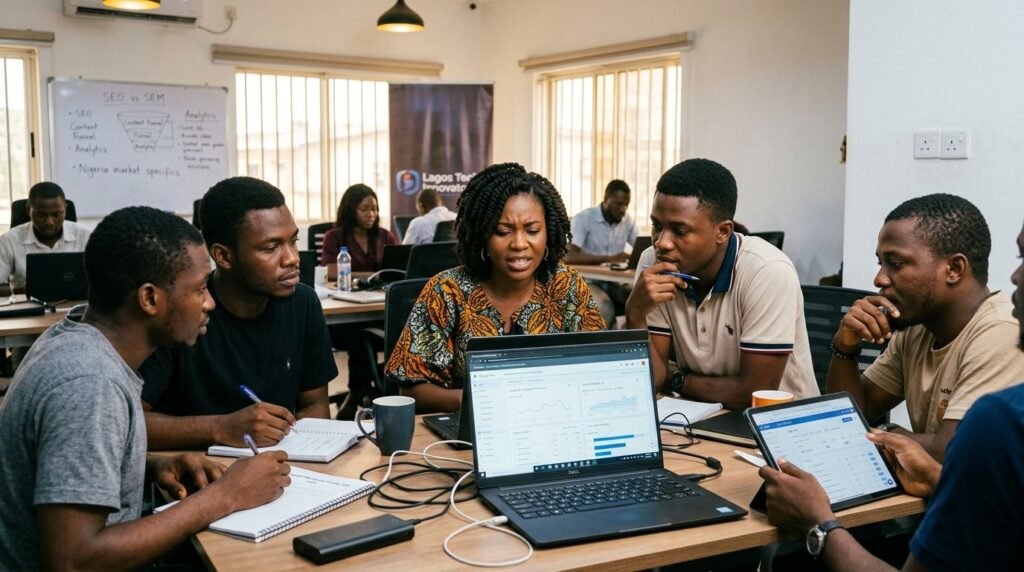
Internet access, not education level or location, is the main variable. Someone in Abuja or Lagos with a reliable data connection and a decent laptop has access to virtually the same learning resources as someone in London. Google Skillshop, Meta Blueprint, HubSpot Academy, Coursera, and YouTube are all free or low-cost and fully available in Nigeria.
The practical challenge is applying what you learn. Getting your first client in Kano or Owerri requires a different outreach approach than getting one in Lagos. The market size differs. The competition differs. But the skills themselves translate everywhere.
One thing that does not translate directly from international courses is the Nigerian market context. Courses built for American or European audiences will teach you how Google Ads works, but they will not teach you how Nigerian consumers behave on Instagram, what a realistic ad budget looks like for an Abuja restaurant, or how to pitch a social media retainer to a Wuse business owner. That local knowledge comes from practice, not courses.
How Long Does It Take to Learn Digital Marketing in Nigeria?
This depends on two things: which skills you focus on, and how consistently you practise.
| Skill Area | Time to Basic Competency | Time to Job-Ready Level |
|---|---|---|
| Social Media Management | 2 to 4 weeks | 2 to 3 months |
| Canva / Visual Content | 1 to 2 weeks | 4 to 6 weeks |
| Email Marketing | 1 to 2 weeks | 1 to 2 months |
| Content Writing and Copywriting | 4 to 6 weeks | 3 to 4 months |
| Google Analytics | 3 to 4 weeks | 2 to 3 months |
| Meta Ads (Facebook/Instagram) | 4 to 6 weeks | 3 to 6 months |
| Google Ads | 4 to 8 weeks | 4 to 6 months |
| SEO | 2 to 3 months | 6 to 12 months |
These are estimates based on someone studying two to three hours per day and practising on real or mock accounts. Cramming courses without applying what you learn doubles the timeline, because retention without practice is low.
Most people who are intentional about learning become employable in three to six months. Becoming genuinely good, the kind of good that gets referrals and raises, typically takes one to two years of active work.
Ready to start a career in digital marketing? Learn the skills that pay.
Free vs Paid Learning: What Works in Nigeria
You do not need to spend money to start learning digital marketing in Nigeria. The free resources are substantial.
Google Skillshop provides free certifications in Google Ads, Google Analytics, and related tools. Meta Blueprint covers Facebook and Instagram advertising at no cost. HubSpot Academy offers certifications in content marketing, email marketing, and inbound marketing. YouTube has full-length courses from credible instructors for every major digital marketing skill.
The limitation of free resources is structure. Most free courses are scattered. You have to build your own curriculum and hold yourself accountable. A lot of people start, lose direction after two weeks, and stop.
Paid training programmes, like the digital marketing courses at SoniBaze Tech Academy in Karu, Abuja, solve this problem. You get a structured path, a trainer to ask questions, assignments that force application, and a certificate at the end. For people who know they need accountability and practical guidance, structured training shortens the learning curve significantly.
The honest comparison is this: free resources give you the knowledge. Structured training gives you the knowledge plus the discipline to apply it.
Common Reasons People Struggle to Learn Digital Marketing in Nigeria
Most people do not struggle because digital marketing is complicated. They struggle for three specific reasons.
The first is trying to learn everything at once. Someone who spends their first month reading about SEO, social media, paid ads, email marketing, and web design simultaneously ends up knowing a little about a lot and not enough about anything to act on it. Pick one area. Learn it to a functional level. Then expand.
The second is learning without practising. Watching a full YouTube playlist on Meta Ads and never running a single campaign, even a ₦5,000 test campaign on your own page, produces very little real skill. Application is how digital marketing knowledge converts into ability. Every week of learning without application is a week of slow progress.
The third is waiting until they feel “ready” to start working with clients. Most people are more ready than they think after two to three months of focused study. Waiting for certainty before taking on a first client, even for free, is one of the main reasons Nigerian digital marketing beginners take years to get started when months would have been enough.
Frequently Asked Questions
Can I learn digital marketing on my phone in Nigeria?
Yes, largely. Most major learning platforms including Google Skillshop, Meta Blueprint, and HubSpot Academy are mobile-accessible. YouTube works on any smartphone. For applying skills, social media management can be done entirely from a phone. However, for Google Ads, analytics, and SEO tools, a laptop provides a significantly better experience. If you are serious about building a career in digital marketing, investing in a basic laptop is worth prioritising early.
Do I need a marketing background to learn digital marketing in Nigeria?
No. People enter digital marketing in Nigeria from education, accounting, medicine, engineering, and almost every other field. A marketing background helps you understand consumer behaviour and campaign thinking faster, but it is not a prerequisite. What matters more is curiosity, willingness to practise, and the discipline to keep learning even when results are slow.
Is digital marketing a good career in Nigeria in 2025?
Yes. The demand for skilled digital marketers in Nigeria is growing faster than the supply of competent practitioners. Businesses across Abuja, Lagos, and other cities are actively looking for people who can manage their social media, run paid ads, and improve their search rankings. Entry-level salaries range from ₦80,000 to ₦200,000 per month. Mid-level and senior practitioners with strong track records earn considerably more, and freelancers with a solid client base can earn significantly above the employment equivalent.
How much does digital marketing training cost in Nigeria?
Costs vary widely. Free resources from Google, Meta, and HubSpot cost nothing. Structured training programmes at Nigerian digital marketing academies typically range from ₦50,000 to ₦250,000 depending on the depth of the course, the certification offered, and whether it is online or physical. Corporate training programmes are priced separately. The most important factor is not cost but quality: look for programmes that include practical assignments and real campaign experience, not just lectures and slides.
What is the best digital marketing skill to learn first in Nigeria?
Social media management is the most practical starting point for most Nigerians. It has the shortest learning curve, the widest demand among Nigerian businesses, and the lowest barrier to getting your first client or job. Once you have social media management to a functional level, adding content writing, then basic analytics, then paid advertising builds a stack of skills that makes you genuinely competitive in the Nigerian market.
Can I get a job in digital marketing without a degree in Nigeria?
Yes. Digital marketing is one of the most genuinely skills-based fields in Nigeria. Employers and clients care about what you can do and what results you have produced, not which university you attended. A strong portfolio, relevant certifications, and demonstrated campaign experience will open more doors than a degree with no practical work behind it.
Conclusion: Hard Is the Wrong Word
Digital marketing is not hard. It is broad, and it requires patience. The people who succeed at it in Nigeria are not the ones with the highest IQs or the fanciest degrees. They are the ones who pick a starting point, practise consistently, and do not stop when the first few weeks feel slow.
The learning curve flattens quickly once you start working on real accounts. The first month feels uncertain. By the third month, most people are surprised by how much they know. By six months of consistent application, most are ready to earn from it.
SoniBaze Digital runs a tech academy in Karu, Abuja with certified training in digital marketing, SEO, social media management, and related disciplines. Training is available physically, online, and as corporate programmes, designed around what the Nigerian market actually requires.
Ready to start a career in digital marketing? Learn the skills that pay.