Most Nigerian businesses that invest in SEO do not see results. Not because SEO does not work here, but because the same mistakes get repeated over and over. Some are made by business owners managing their own websites. Many are made by the agencies they hire.
This article covers 12 of the most common SEO mistakes Nigerian businesses make, why each one hurts rankings, and what to do instead.
Ready to rank higher on Google and get more customers with expert SEO. Your customers are searching.
Why These Mistakes Are So Costly
SEO mistakes compound. A slow website does not just affect one page. A keyword strategy built around the wrong terms wastes every article you publish. A Google penalty does not disappear when you stop the bad practice. It sits on your domain until you actively fix it.
According to a 2024 BrightEdge report, over 53 percent of all website traffic globally comes from organic search. In Nigeria, where digital advertising costs have risen sharply, ranking organically reduces your dependence on paid ads considerably. Getting SEO wrong does not just cost you rankings. It costs you the long-term traffic that should be replacing your ad spend.
The mistakes below are not theoretical. They are patterns seen consistently across Nigerian business websites, from e-commerce stores in Lagos to professional services firms in Abuja.
12 Common SEO Mistakes Nigerian Businesses Make
1. Targeting Keywords Nobody Is Actually Searching
This is the most widespread mistake. A business creates pages and articles around terms that feel relevant but have little to no actual search volume in Nigeria. A real estate company writes about “property investment opportunities” when Nigerians are searching for “houses for sale in Lekki” or “buy land in Abuja.”
Keywords need to reflect how your actual customers phrase their searches, not how your industry describes itself internally. Generic, broad terms are also typically too competitive for a new or mid-sized website to rank for. Long-tail keywords, three to five word phrases with specific intent, are where most Nigerian businesses should be building their early SEO foundation.
The fix: Use Google Keyword Planner, Ahrefs, or Semrush to research actual search volumes for Nigerian queries before creating any content. Filter by Nigeria or specific cities where relevant.
2. Ignoring Mobile Performance
Over 80 percent of internet users in Nigeria access the web on mobile devices. A website that loads slowly on a smartphone or displays content incorrectly on a small screen is losing rankings and losing customers at the same time.
Google uses mobile-first indexing. This means the mobile version of your website is what Google evaluates when deciding where to rank you. A site that looks fine on a desktop but breaks on mobile is being assessed based on the broken version.
The fix: Run your website through Google’s PageSpeed Insights and the Mobile-Friendly Test. Fix any issues flagged before doing anything else with SEO.
3. Writing Thin Content That Adds No Real Value
A 300-word blog post covering a topic that deserves 1,500 words is thin content. Google’s Helpful Content updates, rolled out heavily between 2022 and 2024, specifically target pages that exist to rank rather than to genuinely help a reader.
Many Nigerian websites, particularly those that have hired cheap content writing services, have dozens of underdeveloped articles that answer questions superficially without giving readers what they actually need. These pages do not just fail to rank. They can drag down the overall authority of the entire website.
The fix: Audit your existing content. Any article under 800 words that covers a topic requiring more depth should either be expanded significantly or redirected to a stronger page.
4. Skipping Meta Titles and Descriptions
Open many Nigerian business websites and you will find pages where the browser tab just shows the company name, or where the meta description is blank. These are missed opportunities that directly affect click-through rates from search results.
The meta title is one of the strongest on-page signals Google uses to understand what a page is about. The meta description does not directly affect rankings but it determines whether someone chooses to click your result over a competitor’s. A compelling, specific meta description for a well-ranked page can double the traffic that page receives.
The fix: Every page on your website needs a unique meta title of 50 to 60 characters and a meta description of 150 to 160 characters. Both should include the primary keyword and describe what the page offers clearly.
5. Using Duplicate Content Across Pages
Copying the same text across multiple service pages, location pages, or product descriptions is a fast way to confuse Google and dilute your rankings. If you have a web design agency with separate pages for “web design in Abuja,” “web design in Lagos,” and “web design in Port Harcourt,” and those pages share 90 percent of the same text, Google will not rank all three. It will pick one and ignore the rest.
This also happens when businesses copy supplier descriptions onto product pages without rewriting them. Multiple websites may have identical descriptions, making it impossible for any single one to stand out.
The fix: Each page needs original content written specifically for that page’s purpose and audience. Location pages especially need locally relevant content, not just a city name swapped in.
6. Building Links From Irrelevant or Low-Quality Sources
Backlinks remain a major ranking factor. But the source matters enormously. Paying for links from Nigerian link farms, submitting to hundreds of low-quality directories, or participating in link exchange schemes generates links that Google either ignores or actively penalises.
A single link from a reputable Nigerian news site, a respected industry blog, or a high-traffic local business directory is worth more than 200 links from irrelevant, low-authority websites. Many agencies in Nigeria still sell link packages that consist entirely of the latter.
The fix: Focus link building on quality over quantity. Target digital PR, guest posts on credible industry publications, and citations from established Nigerian business directories. Use Google’s Disavow Tool to clean up any genuinely toxic links already pointing at your site.
7. Never Updating Old Content
A page ranking on page two of Google for a competitive term will rarely climb to page one on its own. Content that was accurate in 2021 may now be outdated, missing newer data, or failing to address questions that have become more relevant. Google favours content that is current and comprehensive.
Many Nigerian websites publish articles and then leave them untouched for years. This is a significant missed opportunity, particularly for evergreen topics in industries that change regularly, such as finance, technology, real estate, and law.
The fix: Review your top 20 organic landing pages every six months. Update statistics, add new sections, improve internal links, and refresh the publication date after making substantial changes. Even a 20 to 30 percent content update can move a stagnant ranking.
8. No Internal Linking Strategy
Internal links, links from one page on your website to another, help Google understand the structure of your site and distribute ranking authority across your pages. Websites with no deliberate internal linking often have important pages that Google cannot find easily or does not know to prioritise.
A blog article that ranks well and attracts traffic but never links to your main service page is leaving traffic on the table. That article could be funnelling readers to your highest-converting page. Without the link, they read and leave.
The fix: Every article you publish should link to at least two or three relevant pages on your site, including at least one core service or product page. Review older articles and add internal links to newer content where relevant.
9. Ignoring Google Business Profile
For any Nigerian business with a physical location or a service area, Google Business Profile is one of the most powerful and underused SEO tools available. A fully optimised profile with accurate details, regular posts, photos, and consistent customer reviews can put you in the map results at the top of Google searches, above the organic listings.
Most Nigerian businesses either have incomplete profiles, outdated information, or have never claimed their listing at all. Some have duplicate listings created accidentally that split their review count and confuse Google.
The fix: Claim your Google Business Profile if you have not already. Fill in every field. Add current photos. Post at least twice a month. Respond to every review. Consistent activity on the profile signals to Google that the business is active.
10. Using SEO Tactics That Worked in 2015
Keyword stuffing, hiding white text on white backgrounds, creating doorway pages, and spinning articles to produce bulk content are all tactics that were used widely in Nigeria up until relatively recently. Google has become significantly better at detecting each of them, and the penalties for getting caught are severe.
Some agencies in Nigeria still use these tactics, either because they have not updated their knowledge or because they are trying to inflate short-term results at the client’s long-term expense. A sudden unexplained traffic drop is often the first sign a site has been penalised for outdated black-hat practices.
The fix: If you inherited an SEO strategy from a previous agency, run a full technical audit using Semrush or Ahrefs. Look specifically for manual actions in Google Search Console. If penalties exist, address them before doing anything else.
11. No Clear Page Structure or Heading Hierarchy
A page with no H1 tag, or one where the H1 and H2 headings are used randomly without structure, is harder for Google to interpret. Google reads heading tags as signals about what a page covers and how the content is organised. Poorly structured pages rank lower than well-structured ones, even when the content quality is similar.
This is a common issue on Nigerian websites built with drag-and-drop page builders where headings are assigned based on visual size rather than semantic purpose.
The fix: Every page needs exactly one H1 containing the primary keyword. Subheadings should follow a logical H2 and H3 hierarchy. Audit your key pages with a free tool like Screaming Frog to identify heading structure problems.
12. Treating SEO as a One-Time Project
This is the mistake that ties everything else together. SEO is not something you do once and then leave. It requires ongoing content creation, link building, technical maintenance, and competitive monitoring. A website that stops investing in SEO starts losing ground to competitors who have not.
Many Nigerian businesses spend money on an initial SEO setup, see some early movement, and then cancel the retainer. Six months later they wonder why rankings have dropped. The early work built momentum. Stopping the work let that momentum fade.
The fix: Budget for SEO as a monthly business cost, not a one-time project. Even a modest ongoing investment of ₦80,000 to ₦150,000 per month, focused on the right activities, produces compounding returns over time.
Quick Reference Summary
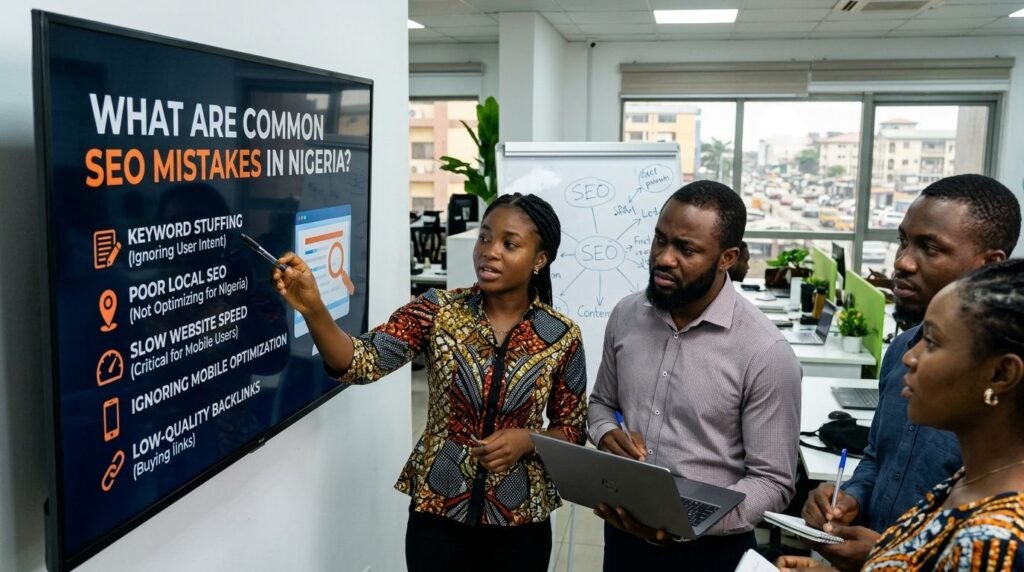
| Mistake | Why It Hurts | The Fix |
|---|---|---|
| Wrong keyword targeting | Content never gets found | Research actual Nigerian search volumes first |
| Poor mobile performance | Google ranks the mobile version | Fix PageSpeed and mobile usability issues |
| Thin content | Dragged down by Google’s Helpful Content updates | Expand or redirect underdeveloped articles |
| Missing meta titles and descriptions | Lower click-through rates from search results | Write unique, keyword-rich meta for every page |
| Duplicate content | Google ignores most of the copies | Write original content for each page |
| Low-quality backlinks | Penalties instead of rankings | Build links from reputable Nigerian sources |
| Stale content | Competitors overtake you over time | Review and update top pages every six months |
| No internal linking | Authority and traffic are not distributed | Link every article to two to three key pages |
| Incomplete Google Business Profile | Missing from local and map results | Claim and fully optimise the profile |
| Outdated black-hat tactics | Manual or algorithmic Google penalties | Audit for penalties and clean up toxic links |
| Poor heading structure | Google cannot interpret page topics | Set one H1 per page with logical H2 and H3 use |
| Treating SEO as a one-off | Rankings fade without continued investment | Budget for ongoing monthly SEO activity |
Ready to rank higher on Google and get more customers with expert SEO. Your customers are searching.
Frequently Asked Questions
How do I know if my website has been penalised by Google?
Check Google Search Console for any manual actions under the Security and Manual Actions section. An algorithmic penalty is harder to spot directly but typically shows up as a sudden drop in organic traffic around the dates of a known Google algorithm update. Tools like Semrush and Ahrefs can also track historical visibility loss over time.
Can I fix these SEO mistakes myself or do I need an agency?
Some fixes are manageable without an agency. Adding meta descriptions, improving internal linking, updating old content, and optimising your Google Business Profile are all things a business owner or in-house team member can do with some research. Technical issues like crawl errors, site speed problems, and penalty recovery are better handled by an experienced SEO professional.
How long does it take to recover from an SEO mistake?
It depends on the severity. Missing meta descriptions and poor internal linking can be fixed quickly and results can improve within four to eight weeks. Recovering from a Google penalty typically takes three to six months after the problematic links or content have been removed. Rebuilding domain authority after sustained black-hat practices can take longer.
Does SEO work differently for local Nigerian businesses compared to national ones?
Yes. Local businesses benefit most from Google Business Profile optimisation, local keyword targeting such as “electrician in Ikeja” or “caterer in Wuse 2,” and citations in Nigerian business directories. National businesses need broader keyword strategies, stronger content programmes, and more aggressive link building to compete across multiple cities and search intents.
Is it possible to rank on Google in Nigeria without paying for ads?
Yes. Organic rankings from SEO are entirely separate from paid advertising. A well-optimised website with strong content and quality backlinks can rank on the first page of Google without any ad spend. The investment is in the SEO work itself rather than in buying ad placements. Businesses that rank organically often find their cost per lead significantly lower than through paid channels over time.
How many of these mistakes should I fix first?
Start with the ones that affect the widest range of pages. Mobile performance and page speed affect every page on your site. Missing meta titles affect every page that lacks them. Thin content affects every article you have published. Prioritise fixes that have the broadest impact before addressing more specific issues.
Conclusion: The Businesses That Avoid These Mistakes Win
SEO in Nigeria is still an underinvested channel relative to the opportunity. Many industries have first-page rankings available to businesses willing to do the work consistently and correctly. The businesses already there are not necessarily the best. They are often just the ones that avoided the most damaging mistakes.
Fix your technical foundation. Write content around what your customers are actually searching for. Build links from credible sources. Stay consistent. That combination, done without shortcuts, is what produces durable rankings.
SoniBaze Digital provides SEO audits and full-service SEO management for businesses across Nigeria, with particular strength in Abuja, the FCT, and competitive national markets. Rated 4.9/5 on Sortlist, we work with businesses that want results grounded in current best practice, not tactics borrowed from 2015.
Ready to rank higher on Google and get more customers with expert SEO. Your customers are searching.