Nigeria has one of the largest broadcasting landscapes in Africa. Dozens of television stations operate across the country, and a significant number of them are owned or funded by government at the federal or state level.
This article covers the major government owned TV stations in Nigeria, who runs them, where they broadcast, and what role they play in the country’s media environment. Whether you are a media buyer, a business looking to advertise, or simply curious about how Nigerian broadcasting works, this breakdown covers what you need to know.
Get your business seen on top TV stations in Abuja and across Nigeria.
How Government Broadcasting Works in Nigeria
The Nigerian Broadcasting Commission, known as the NBC, regulates all broadcasting activity in the country. It sets standards for content, licensing, and ownership. Government stations are typically licensed as public broadcasters and are funded through a mix of federal or state allocations and commercial advertising revenue.
There are two levels of government broadcasting in Nigeria: federal and state. Federal stations are owned by the Federal Government of Nigeria and are meant to broadcast nationally. State stations are owned by individual state governments and primarily serve their local audiences.
The National Broadcasting Commission reported that Nigeria had over 160 licensed television stations as of 2023, including both government and privately owned broadcasters. Government stations, despite competition from private channels, still command significant viewership, particularly in areas with limited access to cable or satellite TV.
Federal Government TV Stations in Nigeria
Nigerian Television Authority (NTA)
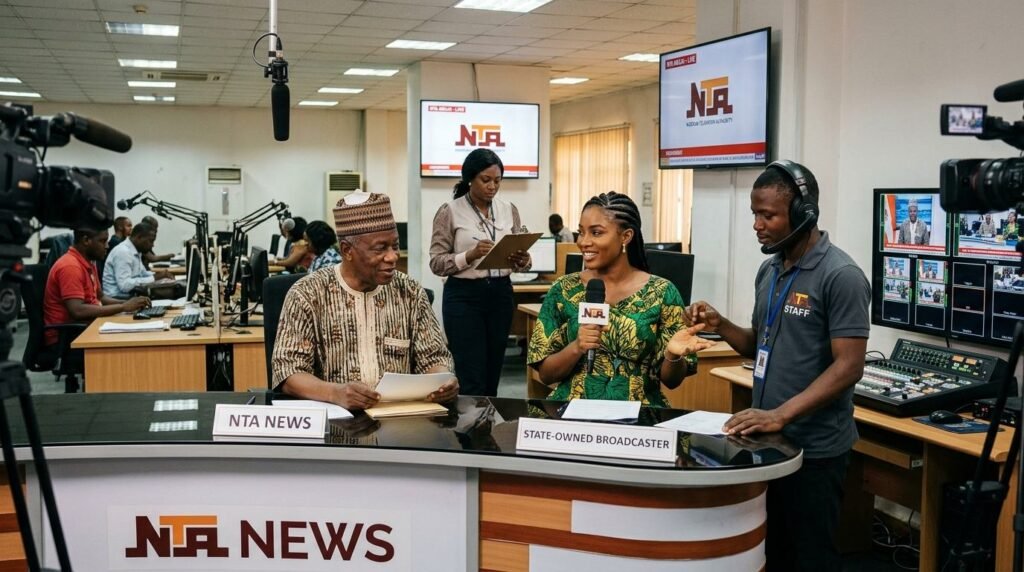
The Nigerian Television Authority is the largest television network in Africa by number of stations. It was established in 1977 and operates over 100 stations across Nigeria, covering every state and the Federal Capital Territory.
NTA broadcasts on multiple channels. NTA 2 Channel 5 in Lagos is one of its oldest and most recognised stations. NTA News Channel broadcasts 24-hour news coverage. NTA International reaches Nigerian diaspora audiences outside the country through satellite.
The network is funded by the Federal Government and generates additional revenue through advertising. It carries national programming including news, entertainment, sports, and public affairs content. Despite the growth of private cable channels, NTA remains the dominant free-to-air television network in terms of geographic reach.
| Station | Owner | Coverage |
|---|---|---|
| NTA Network | Federal Government of Nigeria | National, 100+ stations |
| NTA News Channel | Federal Government of Nigeria | National (24-hour news) |
| NTA International | Federal Government of Nigeria | Diaspora/international |
FRCN Television (Now Integrated into NTA Structure)
The Federal Radio Corporation of Nigeria has historically operated television services alongside its radio programming. Over time, several of its television operations have been absorbed into or aligned with the NTA structure. The FRCN continues to operate primarily as a radio broadcaster nationally.
State Government TV Stations in Nigeria
Every state in Nigeria operates at least one government owned television station. These stations are run by state broadcasting corporations and serve as the primary public broadcasting voice for each state government. Below are the major ones by geopolitical zone.
Lagos State
LBTV (Lagos Broadcasting Service Television)
Lagos State Broadcasting Service operates LBTV, which broadcasts across Lagos State and parts of Ogun State. It was relaunched and rebranded as part of efforts to modernise state broadcasting under the Lagos State Broadcasting Service. LBTV carries local news, Yoruba language programming, and state government announcements alongside entertainment content.
Rivers State
Rivers State Television (RSTV)
Rivers State Television is one of the older state government broadcasters in Nigeria, established in 1975. It serves Port Harcourt and the broader Rivers State audience. RSTV carries local news, cultural programming, and government content. It has maintained a consistent presence in the south-south region despite competition from private broadcasters like Arise TV and Channels Television.
Kano State
Radio Television Kano (RTK)
Radio Television Kano serves Northern Nigeria’s most populous state. It broadcasts in Hausa, English, and Fulfulde, making it one of the few stations with multilingual programming. RTK has a significant reach across Kano, Katsina, and neighbouring states where Hausa is the dominant language. Established in 1962, it is one of the oldest broadcasters in Northern Nigeria.
Kaduna State
Radio Television Kaduna (RTK Kaduna)
Kaduna State also operates its own television broadcaster, which is closely associated with the Kaduna State Broadcasting Service. It serves Kaduna and surrounding communities with news, public affairs, and cultural content.
Oyo State
Broadcasting Corporation of Oyo State (BCOS)
BCOS television is one of the most recognised state government broadcasters in the South West. It carries news, Yoruba language content, political programming, and public service announcements. BCOS has been in operation since 1959, originally established as the Western Nigeria Broadcasting Service, making it one of the oldest broadcast institutions in West Africa.
Enugu State
Enugu State Broadcasting Service (ESBS)
ESBS operates television services across Enugu State and reaches parts of the broader South East. It broadcasts primarily in English and Igbo. Like most state broadcasters, it carries government news, local events coverage, and public affairs programming.
Anambra State
Anambra Broadcasting Service (ABS)
ABS Television serves Anambra State and is one of the more active state broadcasters in the South East. It carries entertainment, news, and cultural programming with a strong Igbo language component.
Cross River State
Cross River Broadcasting Service (CRBC)
CRBC operates television broadcasting for Cross River State from Calabar. It serves a culturally diverse state with programming in English and local languages. CRBC also carries significant tourism and cultural content given Cross River State’s profile as a tourism destination.
Borno State
Borno Radio Television (BRTV)
BRTV serves Borno State from Maiduguri. It broadcasts in English, Hausa, Kanuri, and other local languages spoken across the Lake Chad Basin. The station has continued to operate through significant security disruptions in the North East region.
FCT Abuja
Abuja Television (ATV)
ATV is the television broadcasting service of the Federal Capital Territory Administration. It serves Abuja and the surrounding satellite towns of the FCT. ATV broadcasts local FCT news, government announcements, community programmes, and general entertainment content. For businesses and organisations based in Abuja, ATV is a relevant advertising platform for reaching FCT residents directly.
Other Notable State TV Stations
| State | Station | Notable Feature |
|---|---|---|
| Ondo State | OSRC TV | Strong Yoruba cultural programming |
| Delta State | Delta Broadcasting Service (DBS) | Serves Delta’s multilingual population |
| Akwa Ibom State | AIT Uyo (State-linked) / AKBC | Covers oil-producing South South state |
| Plateau State | Plateau Radio Television (PRTV) | Serves the Middle Belt region |
| Niger State | Niger State Television (NTA Niger) / NSTV | Covers large North Central state |
| Sokoto State | Sokoto State Television (SSTV) | Broadcasts in Hausa and Fulfulde |
| Kebbi State | Radio Television Kebbi (RKTV) | Covers North West Nigeria |
| Kwara State | Kwara State Television (KWTV) | Covers North Central Nigeria |
| Bauchi State | Bauchi State Television (BSTV) | North East regional broadcaster |
Get your business seen on top TV stations in Abuja and across Nigeria.
What Government TV Stations Mean for Advertisers
Government TV stations in Nigeria cover geographic areas that private broadcasters sometimes underserve. In rural parts of the North, South East, and Middle Belt, state television is often the most-watched free-to-air option. For businesses wanting to reach specific state populations, advertising on the relevant state station can be more targeted and significantly cheaper than advertising on national private channels like Channels TV or TVC.
Advertising rates on government TV stations vary widely. A 30-second spot on NTA Network can range from ₦150,000 to ₦500,000 depending on the time slot and whether it is a local or national run. State TV stations generally charge between ₦30,000 and ₦150,000 for a 30-second spot depending on the state and the slot. Prime time and news adjacency slots command higher rates at every station.
SoniBaze Digital handles media placements for clients across traditional and digital channels, including TV, billboard, and press advertising across Nigeria.
| Channel Type | Estimated 30-Second Spot Rate | Audience Reach |
|---|---|---|
| NTA Network (national run) | ₦300,000 to ₦500,000 | National |
| NTA (single station, local) | ₦150,000 to ₦250,000 | State/regional |
| State TV (major states) | ₦80,000 to ₦150,000 | State |
| State TV (smaller states) | ₦30,000 to ₦80,000 | State/local |
Frequently Asked Questions
How many government owned TV stations are in Nigeria?
Nigeria has over 50 government owned TV stations when you include the NTA network stations in each state plus state government broadcasting services. The NTA alone accounts for more than 100 individual transmission stations across the country, though many share programming feeds from the central NTA network.
What is the difference between NTA and state TV stations in Nigeria?
The NTA is a federal government broadcaster that operates nationally, with stations in every state and the FCT. State TV stations are owned and run by individual state governments and focus primarily on local news, cultural programming, and state government communications. NTA has a much larger reach and higher production budget, while state stations tend to have more localised content and audiences.
Can private businesses advertise on government TV stations in Nigeria?
Yes. Government TV stations in Nigeria accept commercial advertising from both public and private sector clients. They operate marketing and advertising departments that handle rate cards, scheduling, and creative placement. NTA stations in particular are widely used by FMCG brands, telecoms, financial institutions, and government agencies for national campaigns.
Is NTA still relevant in 2025?
Yes, particularly outside major cities. In states with limited access to cable TV services like DSTV or GOtv, NTA stations and state TV remain among the most-watched broadcasters. NTA’s reach across 36 states and the FCT also makes it one of the few channels capable of genuine national coverage for advertisers. Its viewership among older demographics and rural populations remains significant.
Which government TV station covers Abuja specifically?
Abuja Television (ATV) is the FCT’s dedicated government TV station and covers Abuja and its satellite towns. NTA Abuja also serves the capital as part of the NTA network. For businesses in the FCT targeting Abuja residents, both stations are relevant advertising options.
Are state TV stations in Nigeria profitable?
Most state TV stations in Nigeria operate at a loss and rely on state government funding to cover the gap. Revenue from commercial advertising rarely covers the full cost of operations. Several states have attempted to commercialise or privatise their broadcasting services over the years, but full government divestiture has remained rare. A small number of state stations have improved their financial position through aggressive commercial programming strategies.
Conclusion: Government TV Is Still Part of Nigeria’s Media Mix
Private television has grown fast in Nigeria. Channels TV, TVC, Arise TV, and Africa Magic draw large audiences. But government TV stations, from NTA nationally to BCOS in Oyo and RSTV in Rivers State, still form a significant part of how information reaches Nigerian audiences, especially outside the major urban centres.
For advertisers and media planners, ignoring government TV means ignoring a section of the population that private cable and satellite services have not fully captured. For anyone studying Nigerian media, understanding the structure of government broadcasting is essential context.
Get your business seen on top TV stations in Abuja and across Nigeria.