Radio advertising in Nigeria does not come with a standard price list. Ask five stations what they charge, and you will get five different answers. Rates change based on the station, the time slot, how many spots you book, and whether you are dealing with a national network or a local community station.
This article breaks down what a 30-second radio ad actually costs in Nigeria, the factors that move the price up or down, and what you need to know before committing your budget.
Ready to get your brand noticed? Let’s plan your PR strategy today.
Why Radio Ad Pricing in Nigeria Is Unclear
Most Nigerian radio stations do not publish their rates publicly. You have to call, enquire, and negotiate. This makes comparison difficult, especially for small businesses trying to plan a media budget without agency support.
Pricing also varies dramatically between cities. A 30-second spot on Wazobia FM Lagos during morning drive time costs significantly more than the same slot on a smaller station in Enugu or Kogi. Even within the same city, two stations targeting different demographics will quote completely different numbers for the same airtime.
The result is that many business owners either overpay because they do not know the going rate, or they underestimate their budget entirely and end up cutting the campaign short.
Factors That Affect the Cost of a Radio Ad in Nigeria
Station Reach and Audience Size
National stations with large, measurable audiences charge premium rates. Wazobia FM, Cool FM, Beat FM, and Smooth FM consistently rank among the most listened-to stations in Nigeria. Their combined listenership numbers run into the millions, and their ad rates reflect that.
Community and state-owned stations reach smaller, more localised audiences. Their rates are lower, sometimes significantly so, but the trade-off is narrower reach. For a business targeting a specific town or local government area, this can actually work in your favour.
Time Slot
This is probably the single biggest variable in radio ad pricing. Nigerian radio stations divide the broadcast day into dayparts, and rates differ substantially between them.
Morning drive time (roughly 6am to 10am) is the most expensive window. Commuters, market traders, and office workers are tuned in. Evening drive (4pm to 7pm) is the second-most expensive. Midday and late-night slots cost less. Some stations offer what they call “ROS,” meaning run of schedule, where your ad airs at any point the station chooses. ROS rates are cheaper but give you no control over when your message actually reaches people.
Duration and Frequency
A 30-second spot costs more than a 15-second one. A 60-second spot costs more still. Most commercial advertisers in Nigeria work with 30 or 45 seconds as a standard unit.
Frequency matters too. Booking a single spot is expensive on a per-unit basis. Buying a package of 20 spots over two weeks typically brings the per-spot cost down. Stations offer better rates for longer campaigns or higher volume bookings. If you are planning to run radio consistently, negotiate a package rather than paying spot by spot.
Station Location
Lagos stations command the highest rates in Nigeria, full stop. The city has the largest concentration of buying power, and competition for airtime is intense. Abuja stations are next, followed by Port Harcourt. Stations in smaller commercial cities like Kano, Ibadan, or Enugu charge noticeably less for comparable slots.
Production vs. Airtime
Many business owners budget for the ad spot but forget to factor in production. Creating the audio, which includes writing a script, hiring voice talent, adding music or jingles, and mixing the final 30-second file, costs money separately from buying the airtime. Some stations offer in-house production, which can reduce the total cost. Others do not, meaning you need to commission production independently before your ad can air.
30-Second Radio Ad Rates in Nigeria
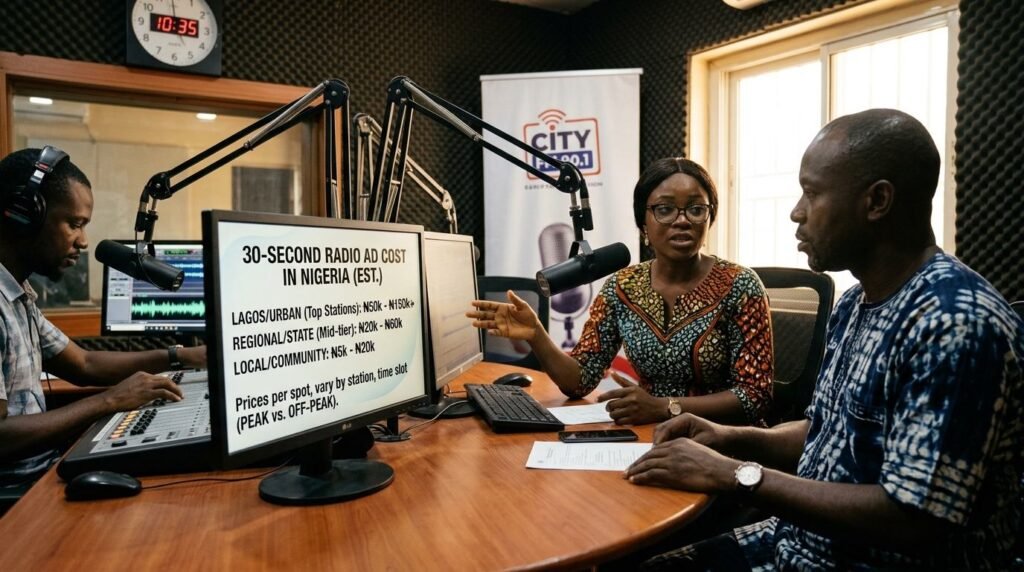
The figures below are market estimates based on prevailing rates across Nigerian commercial stations. Individual quotes will vary.
National and Tier-1 Stations (Lagos, Abuja)
| Station Tier | Time Slot | Estimated Cost Per 30-Second Spot |
|---|---|---|
| Premium national station (e.g. Cool FM, Wazobia FM Lagos) | Morning drive (6am – 10am) | ₦80,000 – ₦150,000 |
| Premium national station | Evening drive (4pm – 7pm) | ₦60,000 – ₦120,000 |
| Premium national station | Midday (10am – 4pm) | ₦30,000 – ₦70,000 |
| Premium national station | Late night / ROS | ₦15,000 – ₦35,000 |
Mid-Tier and State Capital Stations
| Station Tier | Time Slot | Estimated Cost Per 30-Second Spot |
|---|---|---|
| Mid-tier city station (Abuja, Port Harcourt) | Morning drive | ₦40,000 – ₦80,000 |
| Mid-tier city station | Evening drive | ₦30,000 – ₦60,000 |
| Mid-tier city station | Midday | ₦15,000 – ₦35,000 |
| Mid-tier city station | ROS | ₦8,000 – ₦20,000 |
Regional and Community Stations
| Station Tier | Time Slot | Estimated Cost Per 30-Second Spot |
|---|---|---|
| Community / state broadcaster | Prime time | ₦5,000 – ₦25,000 |
| Community / state broadcaster | Off-peak | ₦2,000 – ₦10,000 |
Typical Campaign Packages
A single spot rarely achieves much. Meaningful frequency typically requires at least 15 to 30 spots over a one to two week period. Here is what a basic campaign looks like in practical terms.
| Campaign Type | Spots | Duration | Estimated Total Spend |
|---|---|---|---|
| Entry-level local campaign | 15 spots, ROS | 1 week | ₦120,000 – ₦300,000 |
| Standard city campaign | 30 spots, mixed slots | 2 weeks | ₦400,000 – ₦900,000 |
| Prime-time push (national station) | 20 morning spots | 2 weeks | ₦1,600,000 – ₦3,000,000 |
| Full-month sustained campaign | 60+ spots, 1 station | 4 weeks | ₦800,000 – ₦2,500,000+ |
Production Costs
| Production Element | Estimated Cost |
|---|---|
| Script writing | ₦10,000 – ₦30,000 |
| Professional voice-over talent | ₦15,000 – ₦60,000 |
| Music / jingle / sound design | ₦20,000 – ₦80,000 |
| Full 30-second ad production (all-in) | ₦40,000 – ₦150,000 |
| Station in-house production | ₦10,000 – ₦50,000 (varies) |
Ready to get your brand noticed? Let’s plan your PR strategy today.
Radio vs. Other Nigerian Advertising Channels
Radio is one of the more affordable broadcast channels in Nigeria, but it is not always the right fit. Here is how it compares.
| Channel | Entry Cost | Audience Control | Measurability | Best For |
|---|---|---|---|---|
| Radio (local station) | Low to medium | Medium | Low | Local brand awareness, promotions |
| Radio (national station) | Medium to high | Low | Low | Mass awareness, FMCG, retail |
| TV (terrestrial) | High | Low | Low | National campaigns, large brands |
| Billboard (Lagos/Abuja) | Medium | Medium | Very low | Commuters, high-traffic visibility |
| Meta Ads (Facebook/Instagram) | Low | Very high | Very high | Targeted digital leads |
| Google Ads | Medium | Very high | Very high | Intent-based search traffic |
Radio reaches people who are not looking at a screen. It works well for brand recall, local promotions, and products with broad appeal. It performs less well for businesses that need trackable conversions or highly targeted audiences. For many Nigerian SMEs, combining radio with digital advertising produces stronger results than either channel alone.
Red Flags When Buying Radio Airtime in Nigeria
Some things to watch for before signing anything.
No written confirmation of spots booked. Always request a schedule showing the exact days and times your ad will air. Verbal agreements are common in the Nigerian radio market but difficult to enforce if your spots do not run as agreed.
Unusually low rates for prime time. If a station is quoting you ₦5,000 for a morning drive spot on a major Lagos station, something is wrong. Either the rates are outdated, the audience numbers are fabricated, or you are being misled about the time slot. Compare rates across at least two or three stations before committing.
No audience data. Reputable stations can provide some form of listenership data, even if it is imprecise. Be cautious about stations that cannot tell you anything about their audience size, age range, or geographic coverage.
Bundling you into services you did not ask for. Some stations push advertisers to pay for in-house production, sponsored segments, or presenter mentions as part of the deal. These can add value, but they can also inflate your bill significantly. Know exactly what you are paying for before you agree.
Frequently Asked Questions
How much does it cost to advertise on Cool FM Nigeria?
Cool FM is one of Nigeria’s most listened-to radio stations, with flagship operations in Lagos, Abuja, and Port Harcourt. A 30-second spot during morning drive time on Cool FM Lagos typically costs between ₦100,000 and ₦150,000. Off-peak slots can be significantly cheaper, starting around ₦25,000 to ₦50,000. Rates are negotiable, particularly for package bookings. Contact Cool FM directly for a current rate card.
Is radio advertising still effective in Nigeria in 2025?
Yes, but with important caveats. Radio reaches an estimated 70 to 80 percent of Nigerian adults on a weekly basis, particularly in markets where internet penetration is lower or where commuting is a daily reality. It remains effective for FMCG brands, local businesses, and product launches targeting a broad demographic. For businesses that need trackable leads or precise audience targeting, digital advertising typically delivers better returns.
What is the cheapest radio station to advertise on in Nigeria?
Community radio stations, state government broadcasting stations, and smaller regional FM stations offer the lowest rates, often as low as ₦2,000 to ₦5,000 per 30-second spot. The trade-off is limited reach and a narrower audience. For businesses operating in a specific town or district, this can be a cost-efficient option. For anything requiring city-wide or national coverage, the reach simply is not there.
Do I need an agency to buy radio airtime in Nigeria?
No, but it helps. Many businesses go directly to stations and negotiate their own deals. The challenge is that stations will not always offer their best rates to first-time direct buyers. A media buyer or advertising agency with existing relationships can often negotiate better packages, access preferential rates, and handle the administrative side of scheduling and confirmation. For campaigns above ₦500,000, using professional media buying support is usually worth the fee.
Can I run a radio ad campaign on a small budget in Nigeria?
Yes. A realistic entry-level campaign on a regional or mid-tier station can run for as little as ₦100,000 to ₦200,000 for one to two weeks including production. That is not a massive campaign, but it is enough to build some local awareness for a new business, announce a promotion, or support an event. The key is concentrating your spots in a single time slot rather than spreading a small budget thinly across different dayparts.
What is the difference between a 30-second and a 15-second radio ad in Nigeria?
A 15-second spot typically costs 60 to 70 percent of what a 30-second spot costs on the same station and time slot. It is cheaper, but it gives you roughly half the time to communicate your message. Fifteen seconds is enough for a very simple prompt, like a jingle or a one-line offer with a phone number. Thirty seconds allows you to name the brand, explain the offer, and include a call to action. Most advertising professionals recommend 30 seconds as the minimum for a new or unfamiliar brand.
Conclusion: Budget for Radio Advertising in Nigeria Realistically
Radio is not free. It is not even particularly cheap if you want meaningful frequency on a serious station. A well-planned campaign on a mid-tier city station will typically cost between ₦300,000 and ₦800,000 for two weeks of consistent airtime, before you add production costs.
That said, radio reaches Nigerians that digital channels do not always get to. People driving to work, traders setting up for the day, and households that rely on FM for information are all part of the Nigerian radio audience. For the right business and the right message, it converts.
The decision is not really radio versus digital. For most Nigerian businesses with a serious marketing budget, the question is how to divide spend between the two in a way that maximises total reach and return.
Ready to get your brand noticed? Let’s plan your PR strategy today.