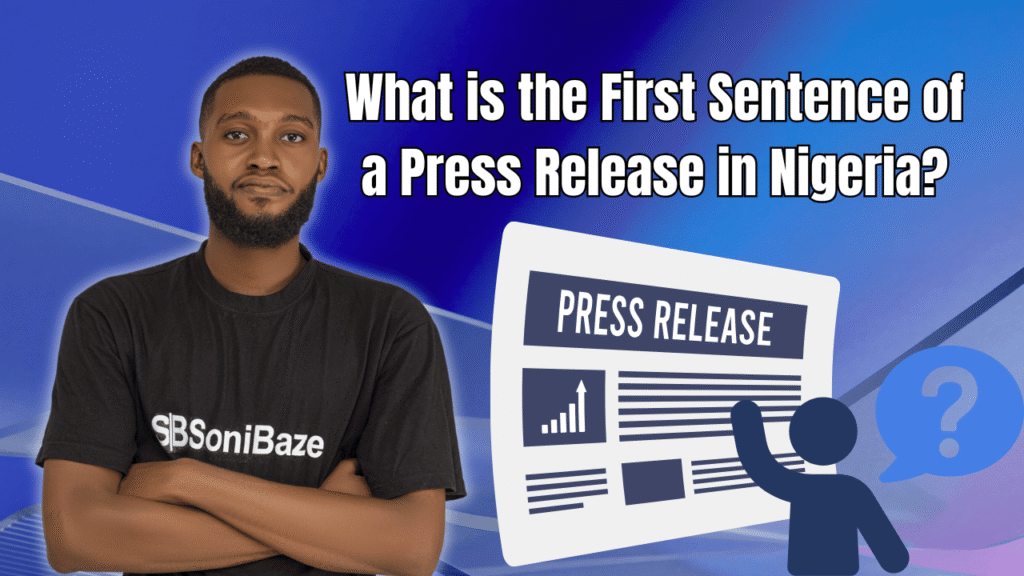
Most press releases fail before the journalist reads the second paragraph. The first sentence is where the decision gets made. Read on or move to the next email.
That one sentence carries a lot of weight. Get it wrong and it does not matter how good the rest of the release is.
Want your brand featured in top media outlets? Let’s make it happen with our press release.
Why the First Sentence Is the Most Important Part
Journalists in Nigeria receive dozens of press releases every week. News editors at outlets like Punch, Vanguard, Channels TV, and BusinessDay are not reading for entertainment. They are scanning for a story. If the first sentence does not give them one immediately, the release goes nowhere.
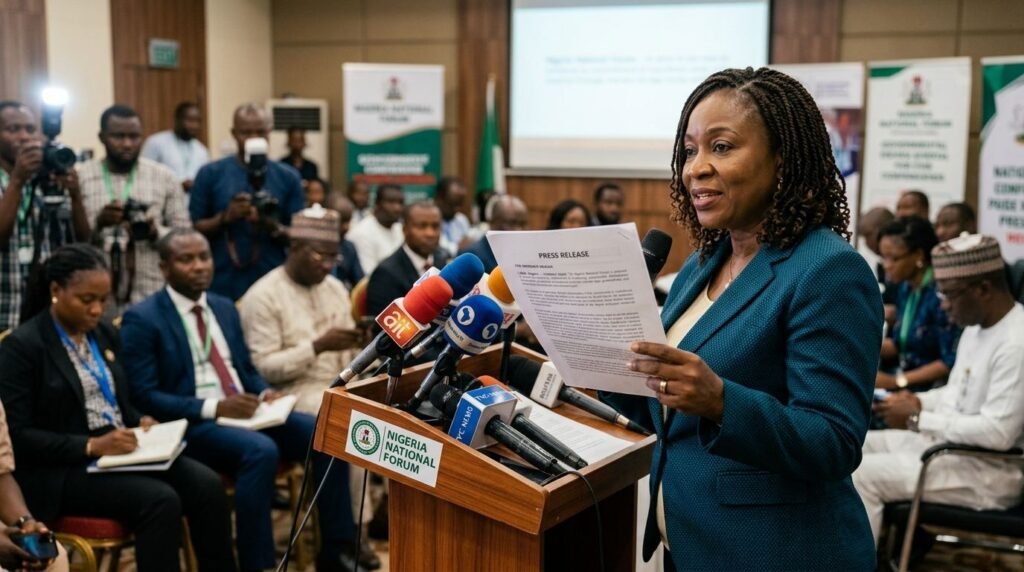
The first sentence of a press release is called the lead. It is not an introduction. It is not a warm-up. It is the news itself, compressed into one clear, factual statement.
A well-written lead answers the most urgent question the journalist has: what actually happened? Everything else, context, background, quotes, and supporting detail, comes after.
What the First Sentence Must Contain
The standard rule for a press release lead is that it should answer as many of the five Ws as possible in a single sentence: who, what, when, where, and why. You do not always need all five, but you need at least three.
Here is what that looks like in practice:
| Element | Question It Answers | Example |
|---|---|---|
| Who | Which organisation or person is this about? | Abuja-based fintech startup PayStack Nigeria |
| What | What happened or what are they announcing? | has launched a new instant payment gateway |
| When | When did this happen or take effect? | effective from 1 June 2025 |
| Where | Where is this taking place? | across all 36 states |
| Why | Why does this matter? | to cut transaction processing time by 60 percent |
Not every press release will include all five in the lead. A product launch might not need a “where.” A funding announcement might not need a “why” in the first sentence. The goal is to give the journalist enough information to immediately understand what the news is.
The Structure of a Strong Lead Sentence
A strong press release lead follows a simple pattern: subject + action + result or significance.
The subject is the organisation or person making the announcement. The action is what they have done or are doing. The result or significance is what that means, whether in numbers, impact, or change.
Here is a weak lead and a strong one for the same announcement:
Weak: “MedCare Nigeria is pleased to announce an exciting new development in the area of healthcare access for Nigerians across the country.”
Strong: “MedCare Nigeria has opened three new diagnostic centres in Kano, Enugu, and Abuja, bringing affordable healthcare testing to an estimated 800,000 additional Nigerians.”
The weak version is vague, self-congratulatory, and says nothing. The strong version names the news, gives specifics, and shows impact. A journalist can work with the second one. The first one gets deleted.
Common Lead Sentence Formulas for Nigerian Press Releases
Different types of announcements call for slightly different lead structures. Below are the most common formats used in Nigerian press releases, with examples.
Product or Service Launch
Formula: [Company name] has launched [product/service name], [brief description of what it does], available from [date/location].
Example: “Lagos-based logistics company SwiftMove has launched a same-day delivery service covering all local government areas in the FCT, starting from 15 May 2025.”
Funding or Investment Announcement
Formula: [Company name] has raised [amount] in [funding round] led by [investor], to [purpose of funds].
Example: “Abuja agritech startup FarmDirect has raised ₦500 million in Series A funding led by Sahel Capital, to expand its produce distribution network across northern Nigeria.”
Partnership or Collaboration
Formula: [Company A] and [Company B] have entered a [type of agreement] to [objective], effective [date].
Example: “United Bank for Africa and the Federal Ministry of Education have signed a memorandum of understanding to fund digital skills training for 50,000 Nigerian secondary school students by December 2025.”
Award or Recognition
Formula: [Organisation/individual] has been named [award/recognition] by [awarding body] for [reason].
Example: “Kano-based solar energy company SunGrid Nigeria has been named the 2025 Most Innovative Clean Energy Company in West Africa by the African Business Awards.”
Event Announcement
Formula: [Organisation] will host [event name] on [date] at [venue], bringing together [who] to [purpose].
Example: “The Lagos Chamber of Commerce will host the 2025 Nigeria Business Summit on 20 July at the Eko Hotel and Suites, bringing together over 500 business leaders to address trade and investment challenges.”
Crisis or Response Statement
Formula: [Organisation] has [action taken] following [incident], and is [current status or next steps].
Example: “Zenith Bank has suspended online transactions on its mobile platform following a reported security breach on Sunday and is working with the Central Bank of Nigeria to restore full service within 48 hours.”
What to Avoid in the First Sentence
Do Not Start with the Company Name Alone
“XYZ Nigeria Limited is a leading provider of…” is a description, not news. No journalist cares who you are until they know what you have done.
Do Not Use Adjectives Like “Exciting,” “Proud,” or “Pleased”
These words signal that the release was written by a marketing team, not a news team. Journalists strip this language out immediately. It adds nothing and weakens credibility.
Do Not Bury the News
Some press releases spend the first sentence setting up context. “Against the backdrop of Nigeria’s growing digital economy…” The news comes two sentences later. By then, many editors have already moved on. State the news first. Context comes second.
Do Not Use Jargon Without Explanation
A lead sentence packed with industry acronyms or technical terms will confuse the journalist, particularly at general news outlets. If a term needs explaining, it does not belong in the first sentence.
Want your brand featured in top media outlets? Let’s make it happen with our press release.
How Long Should the First Sentence Be?
Short. One sentence. Between 25 and 40 words is the ideal range for a press release lead in Nigeria.
Longer than 40 words and it becomes hard to process quickly. Under 20 words and it often lacks enough information to be useful. The goal is to pack in the core facts without making the sentence a chore to read.
Here is the same announcement at three different lengths:
| Version | Word Count | Assessment |
|---|---|---|
| “Kaduna startup EduBridge has partnered with the Kaduna State Government to provide free coding training to 10,000 students in 2025.” | 23 words | Strong. Clear, specific, complete. |
| “EduBridge, a technology education startup founded in 2022 and based in Kaduna, has entered into a partnership agreement with the Kaduna State Government, which will provide free coding and software development training to approximately 10,000 secondary school and university students across the state during the 2025 academic year.” | 49 words | Too long. Can be cut significantly. |
| “EduBridge has partnered with the Kaduna government.” | 8 words | Too short. Missing key specifics. |
The first version is the one to aim for.
How Nigerian Press Releases Differ from International Ones
The core structure of a press release lead is the same globally. What changes in Nigeria is the context you are writing into.
Nigerian media audiences respond well to specific geographic references. Mentioning that something affects Abuja, Lagos, Kano, or Port Harcourt specifically makes a story feel local and relevant rather than abstract. Including a Naira figure rather than a dollar equivalent makes financial announcements land better with local editors.
Nigerian business journalists also pay close attention to government involvement, regulatory angles, and job creation. If your announcement creates employment, has government backing, or addresses a gap in the Nigerian market, say so in the first sentence. These angles increase pick-up rates significantly at outlets like BusinessDay, The Punch, and The Cable.
Frequently Asked Questions
Does the first sentence of a Nigerian press release need to mention the company name?
Yes, as a general rule. The company name is part of the “who” in the five Ws. Leaving it out of the lead forces the journalist to scan further down to understand what organisation is behind the news. Include the company name and, where helpful, a one or two word descriptor of what the company does, such as “Lagos-based fintech company” or “Abuja digital agency.”
Can the first sentence be a question?
No. Press releases are statements of fact, not rhetorical devices. Starting with a question like “Have you ever wondered what it takes to transform Nigeria’s healthcare system?” signals that the release was written with a marketing mindset rather than a journalistic one. Journalists do not find this approach compelling. State the news as a fact.
How is a press release lead different from a headline?
The headline is a single short line that captures the story in six to ten words. The lead is the first full sentence of the body text and expands on the headline with names, numbers, and context. Both need to be factual and specific, but the lead carries more detail. Write the headline and lead as a pair, each reinforcing the other.
What tense should the first sentence use?
Present perfect is the most common choice: “Company X has launched,” “Organisation Y has appointed,” “Startup Z has raised.” It signals that something has just happened without requiring a specific time marker. Past simple (“Company X launched”) is also acceptable when the date is included. Avoid future tense in the lead for events that have already occurred.
Should I include a quote in the first sentence?
No. Quotes belong in the second or third paragraph of a press release. The first sentence is for facts, not attributed opinions. Even a quote from the CEO cannot carry the same news value as a factual statement. Put the facts first, then support them with a quote from a named spokesperson lower in the release.
Does the first sentence format change for press releases sent to Nigerian broadcast media?
Slightly. Radio and television journalists read for how a story will sound when spoken aloud. For broadcast media, the lead should be even shorter and cleaner, ideally under 25 words, with no figures that are hard to read out loud. Round numbers work better on broadcast than precise ones. “Over one million Nigerians” works better in a broadcast lead than “1,043,200 Nigerians.”
Conclusion: One Sentence, One Shot
The first sentence of your press release is not where you introduce your company. It is not where you build up to the announcement. It is the announcement, stated plainly, with enough facts to make a journalist stop and keep reading.
Get the lead right and the rest of the release has a chance. Get it wrong and nothing else in the document matters.
If your press releases are being sent out but not getting picked up by Nigerian media, the lead is usually the first place to look. SoniBaze Digital writes and distributes press releases for Nigerian businesses across 20,000 media platforms, including national newspapers, news websites, and broadcast outlets. The work starts with getting the first sentence right.
Want your brand featured in top media outlets? Let’s make it happen with our press release.