A press release that does not get picked up is a waste of money and effort. Most Nigerian businesses make this mistake regularly, not because the news is bad, but because the press release is written poorly.
Journalists receive dozens of releases every day. They scan, not read. If your release does not communicate the point within the first two sentences, it gets deleted. This article covers exactly how to write a press release that Nigerian editors and journalists will actually use.
Want your brand featured in top media outlets? Let’s make it happen with our press release.
What a Press Release Is (and What It Is Not)
A press release is a formal written statement sent to media houses to announce something newsworthy. It is written in the third person, structured like a news article, and designed to be published with minimal editing.
It is not an advertisement. It is not a company profile. And it is not a long letter to the editor. The moment a press release starts sounding like a sales pitch, editors ignore it.
Understanding this distinction matters. Businesses that treat press releases as free advertising end up confused about why nothing gets published. Journalists are looking for news. Your job is to give it to them.
When to Write a Press Release in Nigeria
Not every update your business makes is worth a press release. Nigerian media outlets, particularly the major ones like Punch, Vanguard, BusinessDay, and The Guardian, have editorial standards. They need a reason to publish.
Situations that justify a press release include a product or service launch, a new business opening, a partnership or merger announcement, an award or certification received, a new senior hire, a major contract win, a response to a public issue affecting your industry, or a community initiative your organisation is leading. Research, survey results, and data your company has gathered can also make strong releases.
If what you want to announce does not fit any of those categories, it probably is not ready to be a press release yet.
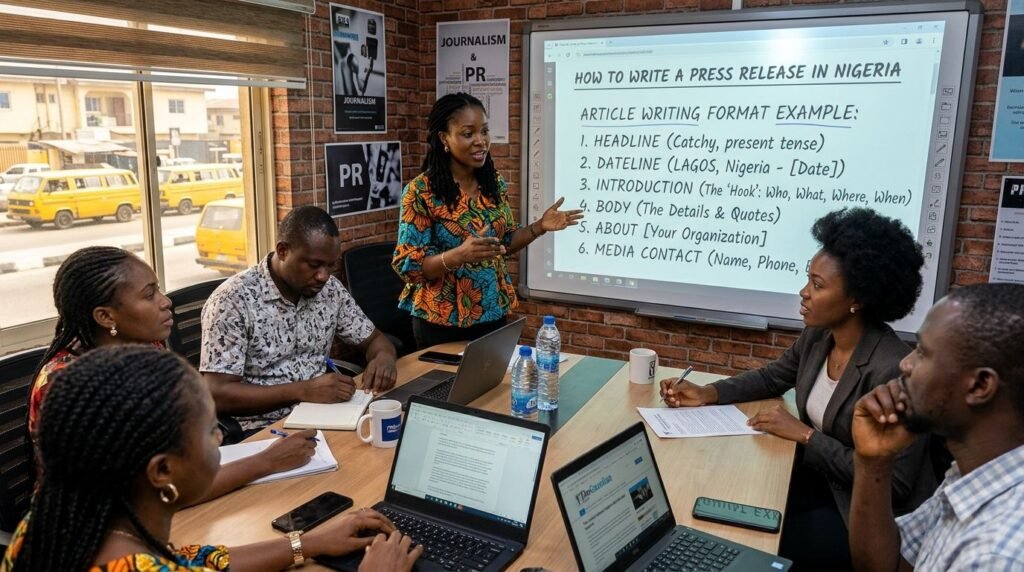
Press Release Format at a Glance
| Element | Details |
|---|---|
| Headline | One sentence. Newsworthy, factual. No hype. |
| Dateline | City name and date before the first paragraph |
| Lead paragraph | Who, what, when, where, why. All in two to three sentences. |
| Body | Supporting details, quotes, context. Two to three paragraphs. |
| Boilerplate | One paragraph about your company at the end |
| Contact information | Name, phone number, email address |
| End marker | Close with ### or -END- |
| Word count | 400 to 600 words is standard |
Steps to Write a Press Release in Nigeria
Step 1: Identify the News Angle
Before you write a single word, ask yourself: why would a journalist care about this? The answer to that question is your news angle.
A news angle is the specific reason this information matters right now. “We launched a new product” is not a news angle. “Abuja-based fintech startup launches zero-fee transfer service for market traders” is. The second version tells a journalist who it affects, what it does, and why it matters.
The stronger and more specific your angle, the better your chances of getting coverage. Think about what makes your announcement different from what competitors have done, or how it connects to something happening in Nigeria right now.
Step 2: Write a Headline That Earns the Click
Your headline is the first thing an editor reads. It is also often the last.
Write one sentence. Make it active, specific, and factual. Avoid exclamation marks. Avoid words like “revolutionary,” “exciting,” or “innovative.” Those words tell editors nothing and signal immediately that the release is promotional.
Compare these two examples. “XYZ Company Launches Exciting New Platform” tells a journalist nothing. “XYZ Company Launches Free Loan Tracking App for Nigerian SMEs” tells them exactly what happened and who it affects.
One clear, descriptive sentence is all you need.
Step 3: Write the Dateline
The dateline goes directly before your opening paragraph. It states the city of origin and the date of the release.
For a Nigerian press release, it looks like this: ABUJA, May 11, 2025. For Lagos-based companies, it would read: LAGOS, May 11, 2025. This is a small detail. Most editors expect it, and leaving it out looks unprofessional.
Step 4: Write the Lead Paragraph
This is the most important paragraph in your press release. It answers the five Ws: who, what, when, where, and why. All in two to three sentences.
Everything the journalist needs to understand the story should be here. If your lead paragraph is vague or takes three sentences just to introduce the company, you have already lost the editor’s attention. Think of it like the summary on the back of a book. If it does not hook someone quickly, they move on.
Here is an example of a strong lead: “Karu-based digital marketing agency SoniBaze Digital has announced the expansion of its press release distribution service to cover 20,000 media platforms across Nigeria and internationally, making it one of the broadest distribution networks operated by an Abuja-based agency.”
One paragraph. All the relevant facts. No fluff.
Step 5: Write the Body
The body of your press release runs two to three paragraphs after the lead. Each paragraph adds one layer of supporting information.
The first body paragraph gives more detail on what was announced. The second provides context, background, or relevant market data. The third, if needed, addresses the broader significance or next steps.
Keep paragraphs short. Two to three sentences each. If a paragraph runs more than four sentences, break it.
Step 6: Add a Quote
Every credible press release includes at least one quote from a senior figure in the organisation, typically the CEO, Managing Director, or a relevant director.
The quote should add something that the factual paragraphs do not. It is the one place in a press release where opinion and voice are appropriate. A weak quote restates what was already said: “We are excited about this launch.” A strong quote adds perspective: “Access to affordable digital marketing has historically been a challenge for businesses outside Lagos. This expansion changes that for thousands of Abuja-based SMEs.”
Keep the quote to two to three sentences. Attribute it clearly with the person’s full name and title.
Step 7: Write the Boilerplate
The boilerplate is the short “About” paragraph at the end of every press release. It describes your company in three to four sentences.
It covers what your company does, where it operates, and any relevant credentials. It does not change from release to release. Write it once and attach it to every press release you send. Journalists use it when they need background for their story, so accuracy matters more than creativity here.
A sample boilerplate: “SoniBaze Digital is a full-service digital marketing and media agency based in Karu Site, Abuja. The agency provides SEO, paid advertising, content marketing, social media management, web development, and press release distribution across Nigeria and internationally. SoniBaze Digital is rated 4.9/5 on Sortlist.”
Step 8: Add Contact Information
After the boilerplate, list the contact details for your media liaison. This should include a full name, phone number, and professional email address.
Journalists who want to follow up, request an interview, or verify a fact need to reach someone quickly. If your contact details are wrong, missing, or go to a generic inbox nobody checks, coverage opportunities disappear. Assign one specific person to handle press enquiries and use their direct details.
Step 9: Close the Release Properly
At the end of the document, add ### on its own line. This is the standard journalistic convention for signalling the end of a press release. Some organisations use -END- instead. Either is acceptable.
Do not add additional information after this marker. If you have supporting materials, photography, or data tables, mention them as attachments or note that they are available on request.
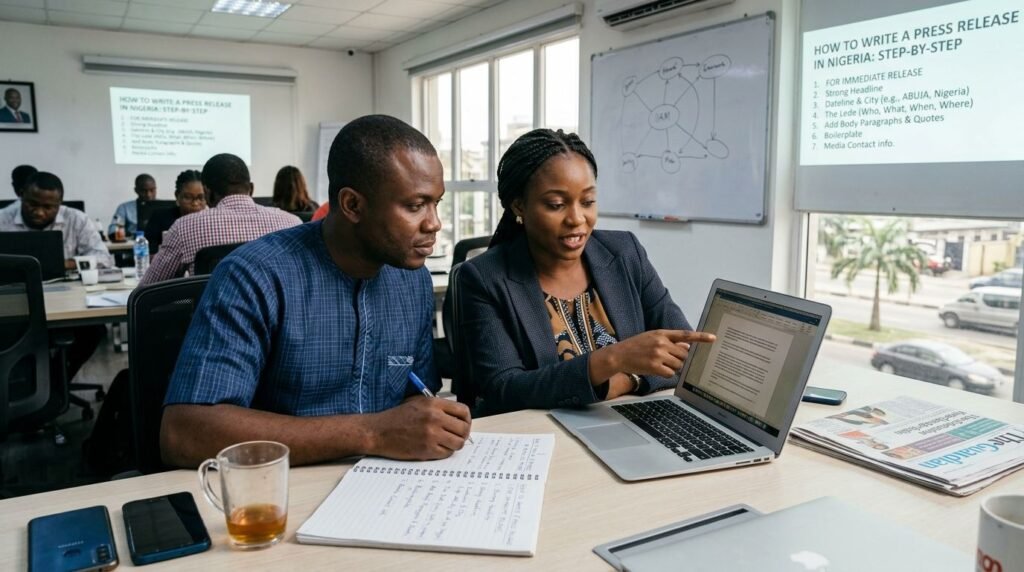
Common Press Release Mistakes in Nigeria
Writing a press release that reads like an advertisement is the most common error. If the first paragraph contains the words “exciting,” “proud to announce,” or “delighted to share,” rewrite it. Those phrases flag it as promotional content immediately.
Another frequent mistake is sending the same release to every journalist on a generic list. A technology journalist at BusinessDay is not interested in a press release about a Borno State farming cooperative. Segment your media list and send relevant releases to relevant journalists. The effort takes ten extra minutes and significantly improves pickup rates.
Long press releases are also a problem. A Nigerian press release should not exceed 600 words. Anything longer is asking an editor to do the editing work you should have done yourself. Cut everything that does not directly serve the story.
Finally, do not follow up with a phone call asking “did you receive my press release?” five minutes after sending it. Give it 48 hours, then send one brief follow-up email if the story is genuinely time-sensitive.
Want your brand featured in top media outlets? Let’s make it happen with our press release.
Press Release Checklist
| Item | Done? |
|---|---|
| Headline is one factual sentence with no hype | |
| Dateline is present with correct city and date | |
| Lead paragraph answers who, what, when, where, why | |
| Body is two to three short paragraphs | |
| Quote from a named senior figure is included | |
| Boilerplate is present and accurate | |
| Contact name, phone, and email are listed | |
| Release ends with ### or -END- | |
| Word count is between 400 and 600 words | |
| No promotional language in the opening paragraphs |
Frequently Asked Questions
How long should a press release be in Nigeria?
400 to 600 words is the accepted range. A press release shorter than 300 words lacks the detail journalists need to write a story. Anything over 700 words is unlikely to be read in full. Keep it tight and focused.
Should I write my press release in English or include Pidgin?
Write in formal English. Nigerian media outlets publish in standard English, and your press release should match that register. Pidgin and colloquial language have no place in a press release intended for editorial consideration.
Can I send the same press release to multiple media outlets?
Yes. Sending to multiple outlets simultaneously is standard practice. Most journalists understand this. The exception is when you are offering an exclusive story to one specific outlet. In that case, state clearly that you are offering an exclusive, and do not send it elsewhere until they have responded or declined.
What is the best day and time to send a press release in Nigeria?
Tuesday, Wednesday, and Thursday mornings are the most effective. Monday mornings are busy with weekend catch-up. Fridays are slow because journalists are wrapping up the week. Sending between 8am and 10am gives your release the best chance of being seen before the day’s editorial planning is complete.
Do I need to distribute my press release through an agency?
Not necessarily. If you have good relationships with journalists at the relevant outlets, you can send directly. Distribution agencies like SoniBaze Digital, Pressedia, PRNigeria, and Evaluate PR Network are worth using when you need broader coverage across national and international platforms, or when you do not have existing media contacts. Agencies can also write the release for you if writing is not a strength in your team.
What is the cost of distributing a press release in Nigeria?
A single press release distributed to Nigerian outlets typically starts from ₦30,000 for basic local distribution. National coverage with multiple major outlets costs between ₦80,000 and ₦300,000. If you want international placement on platforms like Yahoo Finance or Business Insider Africa, expect to pay ₦300,000 to ₦600,000 or more depending on the agency and number of platforms.
Conclusion: A Well-Written Release Gets Used
Nigerian journalists are busy. They are not going to rewrite a poorly structured press release into a usable story. If yours arrives in the right format, with a clear news angle, a strong headline, and a tight lead paragraph, it stands a real chance of being published.
Follow the structure in this article. Apply the checklist before you send. And be honest with yourself about whether your announcement is genuinely newsworthy, because good writing cannot save a weak story.
Want your brand featured in top media outlets? Let’s make it happen with our press release.