Many people assume social media management is easy because they already use social media personally. Running accounts for a brand or a client is a completely different job. It requires a specific combination of creative, analytical, and communication skills that take time and deliberate practice to develop.
This article covers the core skills you need to work as a social media manager in Nigeria, what each skill actually involves, and how they come together in the day-to-day work of a professional in this role.
Want real results from social media marketing? More followers, engagements, and consistent leads.
What Does a Social Media Manager Actually Do?
A social media manager is responsible for building and maintaining a brand’s presence across social platforms. This includes planning content, writing captions, designing visuals, scheduling posts, responding to comments and messages, running paid campaigns, and reporting on performance.
The role is both creative and strategic. You are expected to understand what kind of content your audience responds to, stay current with platform trends and algorithm changes, and communicate the brand’s voice consistently across every post. For businesses in Nigeria, where social media is a primary channel for customer acquisition and brand trust, the quality of social media management has a direct effect on revenue.
A social media manager working in an agency handles multiple clients across different industries. One working in-house manages a single brand across all its platforms. Both require the same core skills, though the in-house role typically goes deeper into one brand’s audience while the agency role requires quick adaptation across many.
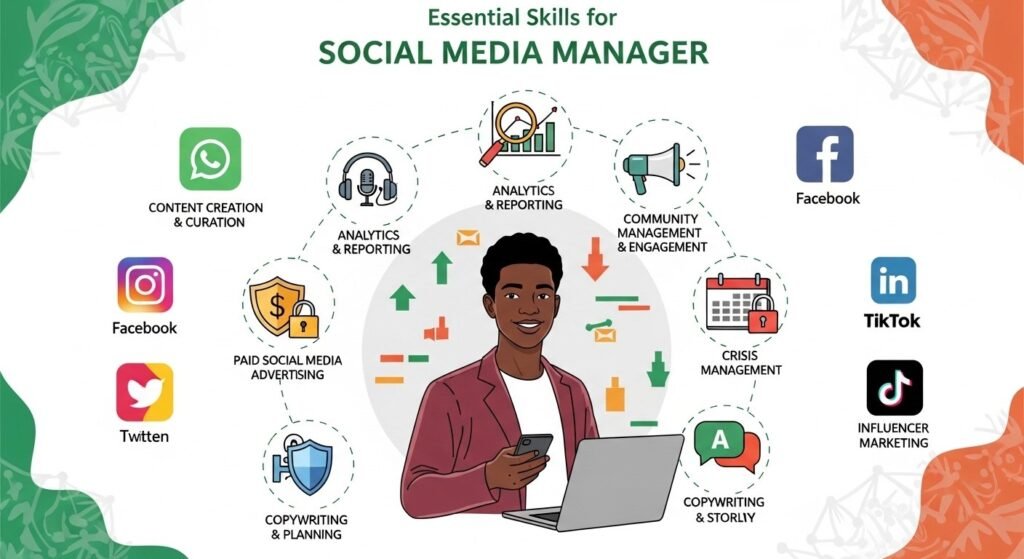
Core Skills You Need to Be a Social Media Manager
1. Content Planning and Strategy
Social media management starts with a plan. Before creating a single post, you need to understand who the audience is, what they care about, what the brand is trying to communicate, and how often content should go out.
Content planning involves building a monthly or weekly content calendar that covers the right mix of educational posts, promotional content, engagement-driven content, and trending topics. You need to know how to plan ahead without making content feel rigid or disconnected from what is happening in real time.
Without a content strategy, accounts tend to become inconsistent. Irregular posting, unclear messaging, and content that does not connect to business goals are the results of operating without a plan. This is one of the most fundamental skills a social media manager can have.
2. Copywriting and Caption Writing
Every post you publish contains text. Writing captions that stop people from scrolling, communicate a clear message, and prompt an action is a skill that separates effective social media managers from those who simply post content.
Good caption writing for social media is different from long-form writing. You are working with limited attention spans, and your first sentence has to earn the reader’s time for the rest. You also need to understand how to write differently for different platforms: Instagram captions can be longer and more conversational, while X (Twitter) demands brevity, and LinkedIn requires a more professional tone.
In the Nigerian market, understanding how your specific audience communicates matters significantly. A fintech brand in Lagos speaks differently to its audience than a lifestyle brand targeting Abuja’s middle class. Knowing how to adapt your writing to fit the brand voice and the platform is a foundational copywriting skill.
3. Graphic Design and Visual Content Creation
Most social media content requires some form of visual. As a social media manager, you do not need to be a professional graphic designer, but you do need to be able to create clean, on-brand visuals without depending on a designer for every post.
Canva is the most widely used tool for this in Nigeria, and proficiency in it is a practical requirement for most social media roles. You should be able to design post graphics, Instagram stories, cover images, carousels, and promotional banners that align with the brand’s visual identity.
Beyond the technical side, you also need a basic understanding of visual communication: what makes a design readable, how to use colour and contrast effectively, and when a simple image works better than a designed graphic. These are not design degree-level skills, but they do require deliberate learning and practice.
4. Short-Form Video Creation and Editing
Short-form video has become one of the most important content formats across Instagram Reels, TikTok, and YouTube Shorts. Social media managers who cannot produce video content are at a significant disadvantage.
You need to know how to plan a video concept, shoot it on a smartphone, add captions, choose audio, and edit it into a format that holds attention. Tools like CapCut are widely used in Nigeria and offer a practical entry point for non-professional video editing. The goal is not cinematic quality; it is clear communication and engaging presentation.
Understanding what types of video perform well on each platform is also part of the skill. TikTok audiences respond to personality-driven, informal content. Instagram Reels perform better with polished visuals and trending audio. YouTube Shorts work well for educational tips and quick how-to content. Knowing the difference and producing accordingly takes platform experience.
5. Community Management and Engagement
Social media is not a broadcast channel. It is a two-way communication tool, and managing that communication is a core part of the job. Community management involves responding to comments, handling DMs, flagging customer complaints, and maintaining a consistent and appropriate brand voice in every interaction.
In Nigeria, where consumers are vocal on social media and public responses to comments are visible to thousands of followers, the way a brand responds matters. A poorly worded reply to a complaint can spread quickly. A well-handled interaction can build trust and demonstrate accountability.
Community management also involves proactive engagement: commenting on relevant posts, participating in trending conversations where appropriate, and building relationships with followers over time. This takes patience, social awareness, and a clear understanding of where the brand’s voice should and should not go.
6. Platform Knowledge and Algorithm Awareness
Each social media platform operates differently. Instagram rewards consistent posting and strong engagement in the first hour. Facebook’s algorithm favours posts that generate meaningful interactions. LinkedIn gives priority to native content and professional discussion. TikTok’s algorithm is less dependent on followers and more driven by watch time and completion rates.
A social media manager needs to understand how each platform works, what content formats it supports, how its algorithm distributes content, and how its audience behaves. This knowledge is not static. Platforms update their algorithms regularly, introduce new features, and shift in terms of which content performs best.
Staying current means reading industry updates, paying attention to platform announcements, and testing new content formats. Social media managers who keep working with the same approach they learned two years ago will see declining results because the platforms have moved on.
7. Analytics and Performance Reporting
Every piece of social media activity generates data. Knowing how to read that data and use it to improve future content is what separates a manager who is learning and growing from one who is just posting and hoping.
You should be comfortable reading native analytics from Meta Business Suite, Instagram Insights, LinkedIn Analytics, and TikTok Analytics. Key metrics to track include reach, impressions, engagement rate, follower growth, profile visits, link clicks, and, where relevant, conversion data. Monthly reporting should pull this data together and translate it into clear takeaways for the client or business.
Beyond reading numbers, the skill is in interpretation. A drop in reach might signal a posting frequency issue, an algorithm change, or a content quality problem. Understanding which and responding accordingly is what makes analytics genuinely useful rather than just a reporting formality.
8. Paid Social Media Advertising
Organic reach on social media has declined significantly across most platforms. Running paid ads is increasingly a requirement for social media managers, not an optional add-on.
You need to understand how to set up campaigns on Meta Ads Manager, choose the right campaign objective, build audience targeting, design effective ad creatives, set budgets, and read ad performance data. For managers working in Nigeria, understanding how Meta’s ad delivery works in the Nigerian market, including which placements perform well and how to budget in naira for specific results, is practical knowledge that comes with experience.
Google Ads is a related but separate skill. Some social media manager roles include it, particularly in smaller businesses where one person handles all digital advertising. Even if your role is social-only, a working understanding of paid ads makes you significantly more valuable to employers and clients.
Want real results from social media marketing? More followers, engagements, and consistent leads.
9. Scheduling and Workflow Management
Consistent posting is one of the most basic requirements of social media management, and maintaining consistency across multiple platforms and clients requires organised workflows. Scheduling tools like Buffer, Hootsuite, or Meta’s native scheduling allow you to plan content in advance and post at optimal times without being online around the clock.
Workflow management also means knowing how to manage content approval processes, track deadlines, communicate with clients or team members, and keep multiple content calendars running simultaneously. Tools like Notion, Trello, or Google Sheets are commonly used to manage this.
For agency social media managers handling four or five clients at once, the ability to stay organised without dropping quality on any account is as important as the creative skills that fill the content calendar.
10. Brand Voice and Audience Understanding
Every brand has a personality, and it is the social media manager’s job to communicate that personality consistently in every caption, reply, and story. Developing a clear sense of brand voice and applying it across content types and platforms requires both creative skill and careful observation of what the brand has said before.
Audience understanding goes alongside this. Knowing who follows the brand, what motivates them, what concerns they have, and what kind of content they engage with shapes every decision a social media manager makes. This knowledge comes from analytics data, comment reading, and genuine curiosity about the people you are trying to reach.
Brands whose social media managers have built a deep understanding of both the brand and its audience tend to produce content that feels natural and resonant rather than generic. This is one of the harder skills to teach because it comes largely from attention and experience.
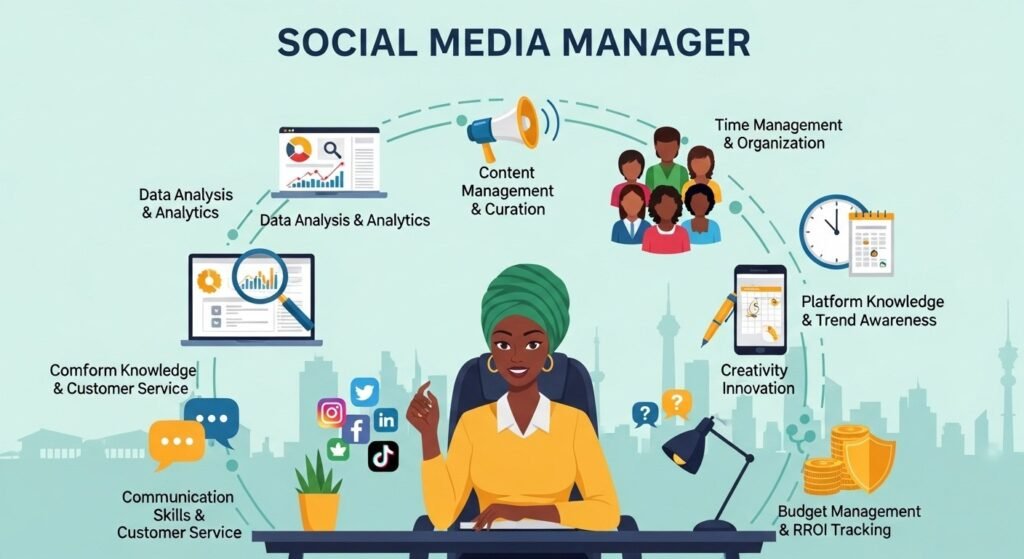
Skills Summary Table
| Skill | What It Involves | Tools Commonly Used |
|---|---|---|
| Content Planning | Building content calendars and monthly strategy | Notion, Google Sheets, Trello |
| Copywriting | Writing captions, CTAs, and platform-specific text | Google Docs, Notion |
| Graphic Design | Creating on-brand visual content for posts | Canva |
| Video Creation | Shooting and editing short-form video content | CapCut, Adobe Premiere Rush |
| Community Management | Responding to comments, DMs, and engaging audiences | Native platform tools |
| Platform Knowledge | Understanding algorithms, formats, and best practices | Meta, TikTok, LinkedIn, X |
| Analytics | Reading and interpreting performance data | Meta Business Suite, Instagram Insights |
| Paid Advertising | Running and managing paid social campaigns | Meta Ads Manager, Google Ads |
| Scheduling | Planning and automating content publishing | Buffer, Hootsuite, Meta Scheduler |
| Brand Voice | Communicating brand personality consistently | Content guidelines, brand kits |
Frequently Asked Questions
Do you need a degree to become a social media manager in Nigeria?
No. Social media management is a skills-based career. Clients and employers in Nigeria look at your portfolio, your results, and your ability to demonstrate what you know. A degree in marketing, communications, or a related field can provide useful background, but it is not a requirement. Certified training in digital marketing and consistent self-learning will take you further than a certificate that does not include practical skills.
How long does it take to become a social media manager?
With focused study and hands-on practice, you can develop the core skills needed in three to six months. Managing real accounts, even if unpaid initially for your own brand or a small business, accelerates your learning significantly. Building a portfolio of results, such as documented follower growth, engagement improvements, or successful campaigns, is what positions you for paid work.
How much do social media managers earn in Nigeria?
Entry-level social media managers at agencies or small businesses typically earn between ₦60,000 and ₦150,000 per month. Mid-level managers with a proven track record and the ability to run paid campaigns can earn between ₦200,000 and ₦400,000 per month. Experienced managers in senior roles or those managing high-value client accounts can earn ₦500,000 or more. Freelancers with multiple clients can earn considerably higher depending on their client base and scope of work.
What platforms should a social media manager in Nigeria focus on?
Instagram and Facebook are the most commercially important platforms for most Nigerian consumer brands. LinkedIn is essential for B2B, professional services, and corporate brands. TikTok is growing rapidly and is particularly important for reaching audiences under 35. X (Twitter) is valuable for brands in media, fintech, entertainment, and government. The platforms you prioritise depend on where your client’s target audience actually spends time.
Is it better to specialise in one platform or manage multiple?
For beginners, it is practical to learn across the major platforms so you can serve a wider range of clients. As you gain experience, many social media managers develop deeper expertise in one or two platforms, particularly if they work in a specific industry. Agencies typically expect managers to be functional across Instagram, Facebook, and LinkedIn at minimum, with TikTok becoming increasingly standard.
Can a social media manager work remotely in Nigeria?
Yes. Social media management is one of the most remote-friendly careers in the Nigerian digital economy. Most of the work, including content creation, scheduling, community management, and reporting, is done online. Many Nigerian social media managers work with local clients remotely and take on international clients paying in foreign currency, which significantly increases their earning potential.
Conclusion: Build the Skills, Then Build the Portfolio
Becoming a social media manager in Nigeria is achievable, but it requires more than knowing how to use the apps. You need to understand content strategy, write well, design visuals, produce video, read data, and manage the business side of client relationships. These are all learnable skills.
The most important step after learning is doing. Managing a real account, even at a small scale, teaches you things that no course can fully cover. Start with one brand, apply what you have learned, track the results, and build from there.
SoniBaze Digital runs a tech academy in Karu, Abuja offering certified training in digital marketing and social media management, among other disciplines. Training is available physically, online, and as corporate programs.
Want real results from social media marketing? More followers, engagements, and consistent leads.